How do I find a reliable global battle rope supplier with proven reputation?
I've processed 47 supplier complaint cases in three years. Most complaints trace back to one mistake: buyers assumed all battle rope suppliers deliver what they promise. They don't. This article shows you the supplier evaluation framework I use to separate reliable manufacturers from problematic ones.
Reliable battle rope suppliers prove their reputation through verifiable delivery capacity, sample-to-shipment consistency, and volume handling track records. Check factory production capacity documents, request third-party delivery history verification, and always run sample-to-bulk comparison tests before committing to large orders.

Most buyers searching for "battle rope supplier reputation list" expect a ranked directory. That list doesn't exist in any meaningful form. What exists instead is a set of capability verification checkpoints that predict whether a supplier will fulfill their commitments. I'll walk you through the framework I developed after handling supplier relationship failures.
What makes a battle rope supplier's reputation actually verifiable?
Supplier reputation claims fill trade directories. Real reputation comes from documentation that proves operational capability. When I evaluate suppliers, I ignore promotional material and focus on three evidence categories: production infrastructure verification, fulfilled order documentation, and quality consistency records.
A battle rope supplier's verifiable reputation consists of documented production capacity (machinery specifications, staff count, output volume), third-party verified delivery records (customs data, buyer testimonials with order details), and sample-to-production consistency proof (batch testing reports, quality variance documentation).
Production capacity verification prevents timeline failures
Production capacity determines whether suppliers can handle your order volume within your required timeline. I've seen suppliers accept orders they physically cannot fulfill on time. They take deposits, then delay shipments by 8-12 weeks while blaming "material shortages" or "quality control procedures."
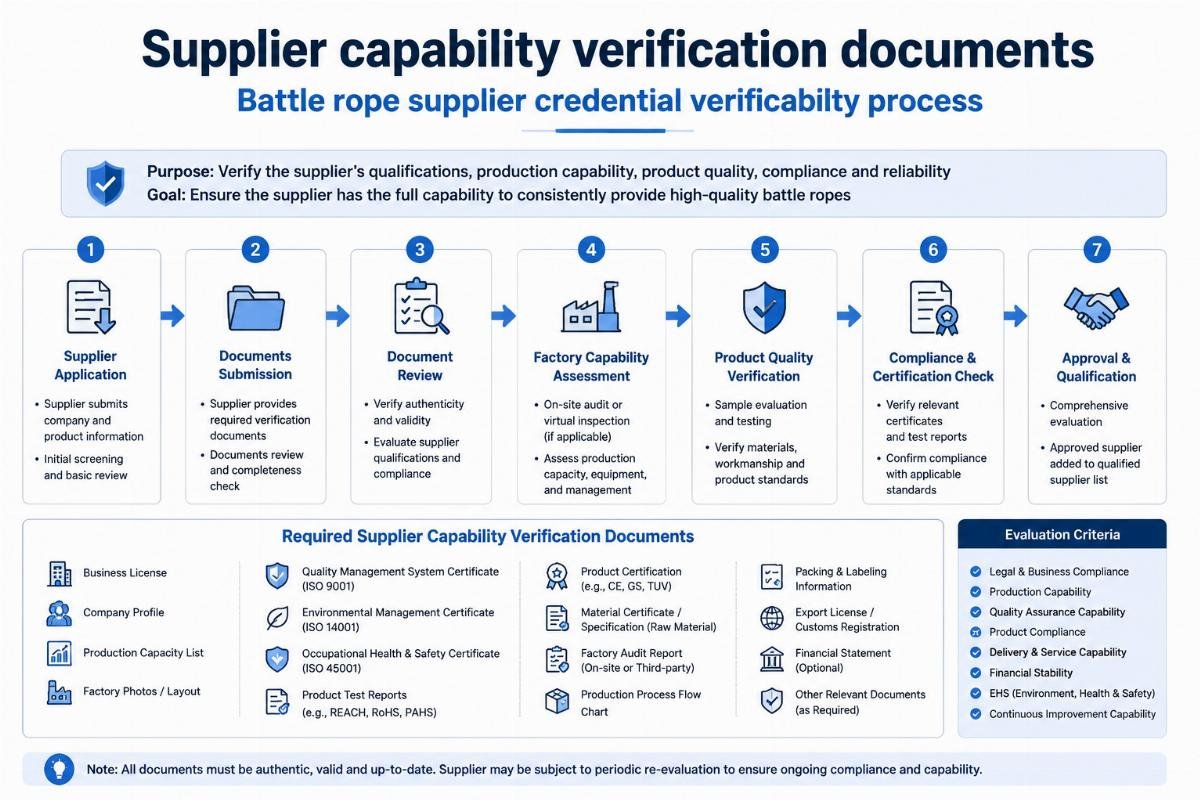
Verify production capacity by requesting facility photographs showing rope braiding machines, rope length cutting stations, and packaging areas. Ask for monthly production output numbers with supporting evidence—payroll records showing staff count, utility bills indicating operational scale, or machinery lease agreements proving equipment availability.
Calculate their realistic capacity using this formula: (Number of rope-making machines × Daily production hours × Average rope output per hour) ÷ Total monthly orders = Available capacity percentage. If your order consumes more than 60% of their available capacity, delivery risk increases significantly.
| Verification Point | Documentation Required | Risk Indicator |
|---|---|---|
| Machine count | Facility photos with timestamps | Fewer than 5 machines = limited capacity |
| Staff size | Payroll documentation or facility tour | Fewer than 15 production staff = bottleneck risk |
| Monthly output | Shipping records from past 6 months | Output below 5000 units monthly = scaling difficulty |
| Order backlog | Current order list with delivery dates | Backlog exceeding 8 weeks = overcommitment |
Delivery history verification reveals operational reliability
Suppliers claim fast delivery and on-time shipment. Delivery history shows what actually happened with previous orders. I learned this after a gym chain distributor lost a major client because their battle rope supplier delayed shipment by 11 weeks, despite promising 4-week delivery.
Request delivery verification through customs export data for B2B shipments or buyer references with specific order details. Contact at least three previous buyers and ask these exact questions: What was your ordered volume? What delivery timeline was promised? What was the actual delivery date? Did product quality match the approved sample?
Third-party logistics documentation provides objective delivery evidence. Suppliers using established freight forwarders have trackable shipment histories. Suppliers who cannot provide freight forwarder contacts or customs documentation often hide delivery inconsistencies.
| Verification Method | Information Gained | Warning Signs |
|---|---|---|
| Customs export data | Actual shipment volumes and frequency | No export records in past 6 months |
| Freight forwarder contact | Real delivery timelines and volumes | Supplier refuses to provide forwarder details |
| Buyer references with order numbers | Sample-to-shipment consistency feedback | References provided without order specifics |
| Shipment tracking archives | Delayed delivery patterns | No tracking documentation available |
Sample-to-production consistency testing catches quality variance
Approved samples don't guarantee production batches will match. Material substitutions, quality control gaps, and specification drift create variance between what you approved and what arrives in your shipment. One fitness equipment distributor ordered 2000 battle ropes based on a sample with 38mm diameter and tight braiding. The production batch arrived with 35mm diameter and loose braiding that affected durability.
Implement sample-to-production verification by ordering a small batch (50-100 units) as production validation before committing to full volume. Measure these specifications on both sample and validation batch: rope diameter at three points along length, braid tightness (gaps between strands), handle attachment strength, and material composition through burn testing.
Document specification variance using percentage deviation calculations. Rope diameter variance exceeding 5% indicates quality control problems. Braid tightness variance exceeding 8% suggests material substitution or process inconsistency. Handle attachment strength variance exceeding 10% signals manufacturing shortcuts.
| Specification Check | Measurement Method | Acceptable Variance | Rejection Threshold |
|---|---|---|---|
| Rope diameter | Caliper measurement at 3 points | ±3% from sample | >5% deviation |
| Braid tightness | Gap measurement between strands | ±5% from sample | >8% deviation |
| Handle attachment strength | Pull test with force gauge | ±7% from sample | >10% deviation |
| Material composition | Burn test + texture comparison | Must match sample exactly | Any difference |
How do bulk buyers and B2B buyers face different supplier risks?
Bulk buyers purchasing for single facilities face different risks than B2B buyers sourcing for resale. The procurement mistakes differ, and so do the verification priorities. I've handled complaints from both buyer types, and their supplier problems follow distinct patterns.
Bulk buyers (gyms, training facilities) face quality consistency risk across single large orders, requiring strict sample-to-production verification. B2B buyers (distributors, traders) face long-term supply stability risk across multiple orders, requiring production capacity and delivery reliability verification.
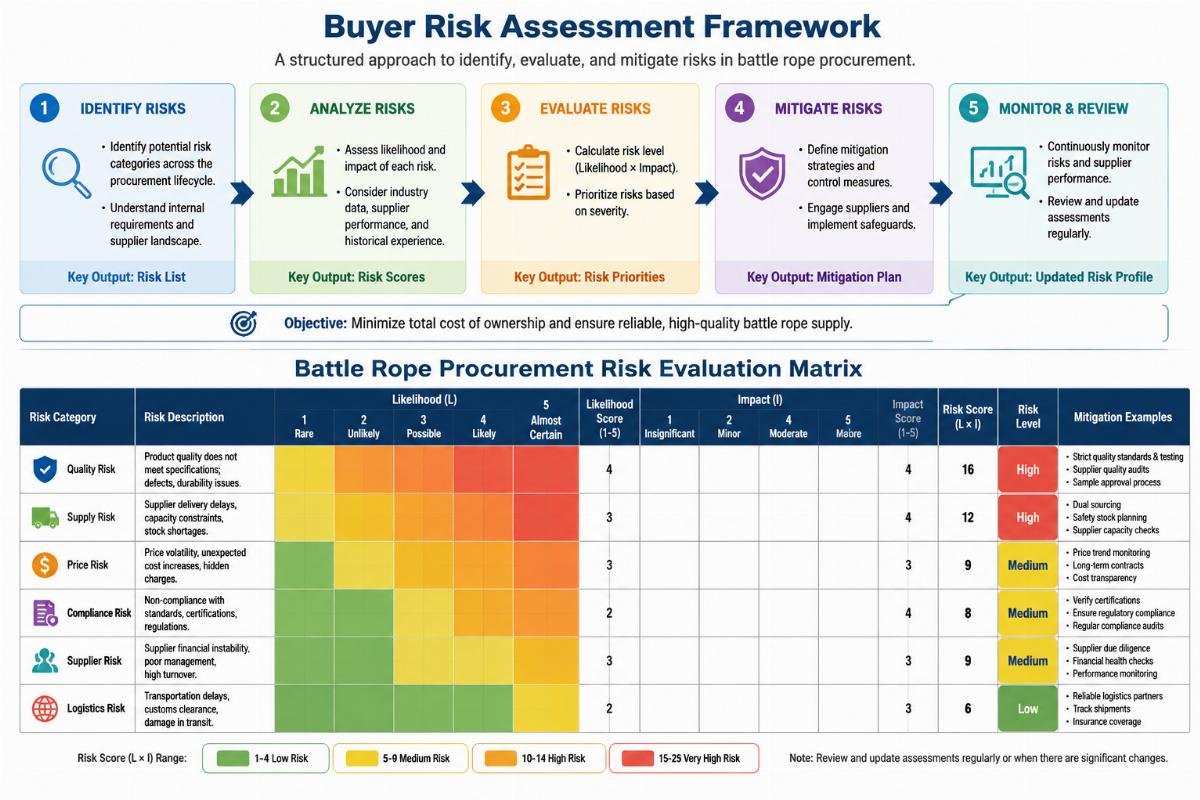
Bulk buyer risks concentrate on single-order quality control
Gym chains and training facilities typically place one or two large orders annually. Their risk concentrates on receiving consistent quality across the entire shipment. A CrossFit facility chain ordered 800 battle ropes for 16 locations. The supplier shipped in four batches over two months. Batches 1 and 2 met specifications. Batches 3 and 4 had 15% lighter rope weight due to material substitution.
Bulk buyers should prioritize sample-to-production consistency verification and implement batch inspection protocols. Require suppliers to ship validation batches before full production. Inspect 10% of each production batch using the specification checklist provided earlier. Reject batches failing specifications and require complete replacement at supplier expense.
Structure bulk purchase contracts with staged delivery verification: 30% deposit after sample approval, 40% payment after validation batch passes inspection, 30% payment after full shipment delivery and final inspection. This payment structure keeps leverage throughout the fulfillment process.
| Bulk Buyer Priority | Verification Action | Protection Mechanism |
|---|---|---|
| Single-order quality consistency | Validation batch before full production | Staged payment based on inspection results |
| Specification drift prevention | Batch sampling during production | Rejection and replacement clauses in contract |
| Full shipment completeness | Pre-shipment inspection at factory | Final payment only after delivery confirmation |
| Defect rate control | Random sampling of delivered shipment | Post-delivery warranty covering 12 months |
B2B buyer risks spread across ongoing supply relationships
Fitness equipment distributors and trading companies place multiple orders throughout the year. Their risk spreads across long-term supply consistency, capacity stability during demand fluctuations, and new product development support. A battle rope distributor lost two major retail clients after their supplier failed to fulfill a seasonal demand surge, causing 9-week stockouts.
B2B buyers should prioritize production capacity verification and delivery reliability tracking. Map supplier capacity against your annual demand forecast, including seasonal peaks. Suppliers should maintain capacity to handle 150% of your baseline order volume to accommodate demand surges without delivery delays.
Establish formal supplier performance tracking using these metrics: on-time delivery percentage (target: above 95%), specification compliance rate (target: above 98%), communication response time (target: under 24 hours), and problem resolution speed (target: under 72 hours). Review supplier performance quarterly and maintain backup supplier relationships for orders exceeding 40% of primary supplier capacity.
| B2B Buyer Priority | Verification Action | Protection Mechanism |
|---|---|---|
| Multi-order consistency | Performance tracking across 6+ orders | Quarterly supplier review meetings |
| Capacity for demand surges | Facility capacity audit annually | Secondary supplier relationship for overflow |
| New product development support | Prototyping capability verification | Co-development agreement terms |
| Long-term pricing stability | Cost structure transparency request | Multi-year framework agreements |
What specific verification steps prevent supplier selection mistakes?
Generic supplier evaluation checklists miss the details that predict fulfillment failures. I've identified eight verification steps that catch problematic suppliers before you commit. These steps come directly from analyzing supplier relationships that failed and identifying what warning signs were missed.
Effective supplier verification requires physical facility inspection, production process observation, quality control system audit, delivery capacity stress testing, buyer reference interviews, financial stability check, communication process evaluation, and contract enforcement mechanism review.
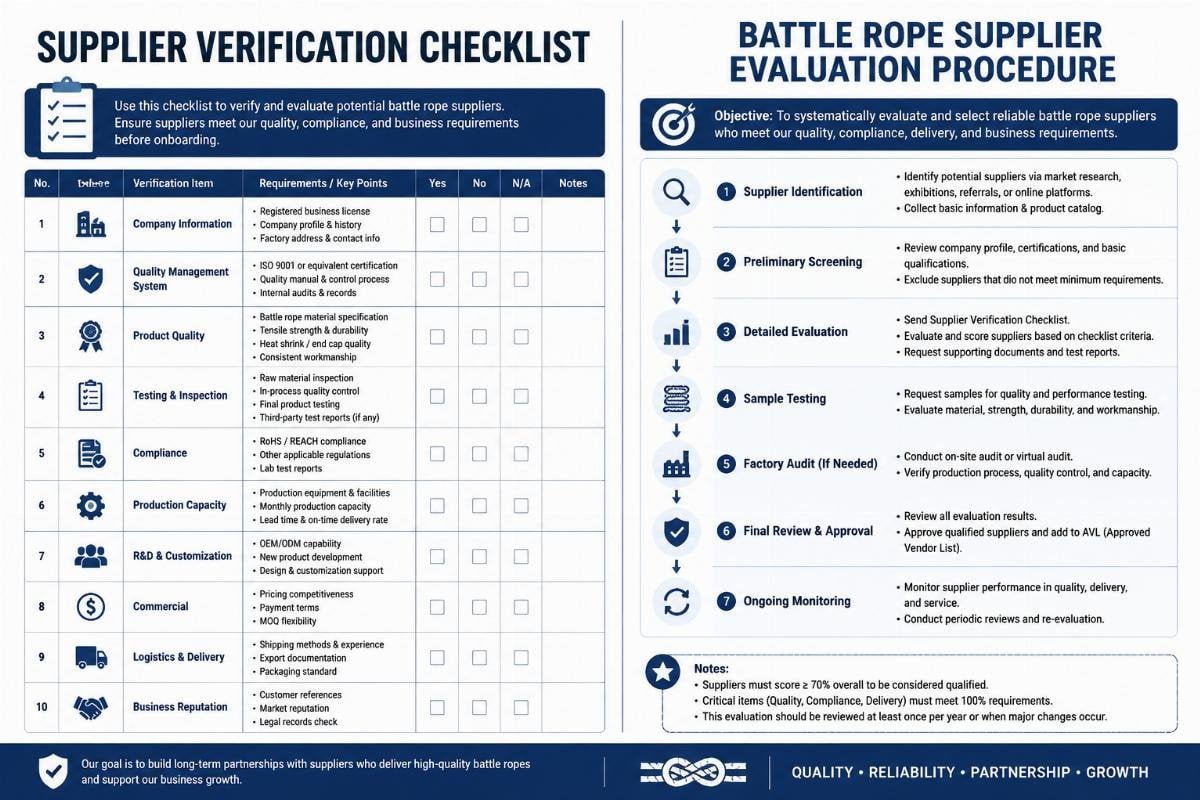
Factory visit reveals operational reality beyond claims
Supplier websites show clean facilities and organized production lines. Factory visits show actual operational conditions. I visited a battle rope supplier whose website displayed modern machinery and spacious facilities. The actual factory had three rope-making machines in a 200-square-meter space with 8 workers and visible quality control gaps.
Schedule factory visits during active production hours, not arranged demonstration periods. Observe these specific indicators: machinery utilization rate (idle machines indicate low order volume or capacity problems), raw material inventory levels (insufficient material stock indicates cash flow problems or supply chain issues), quality control station setup (absence of dedicated inspection areas indicates inadequate quality processes), and worker training level (workers struggling with equipment indicate high turnover or inadequate training).
Photograph facility layout, machinery, and raw material storage during visits. Compare photographs against supplier claims about capacity, automation level, and quality control systems. Discrepancies between claims and observed reality predict fulfillment problems.
Sample production observation catches process shortcuts
Approved samples might be produced using careful processes that don't match regular production methods. Observing sample production reveals whether standard processes can maintain sample quality. A distributor approved a battle rope sample with excellent braid tightness. Regular production used faster braiding speed that reduced quality. The supplier never mentioned different production speeds for samples versus production batches.
Request to observe production of 10 sample units using regular production equipment and standard operating procedures. Measure production time per unit, document machinery settings, and verify raw materials match standard production materials. Compare sample production process against regular production observation if possible.
Ask production supervisors these questions during observation: What machinery settings do you use for regular production? How does sample production differ from regular production? What quality checks happen during regular production? How do workers identify specification deviations?
Buyer reference interviews uncover hidden problems
Supplier-provided references give positive feedback. Direct buyer interviews reveal operational problems that references might not mention without specific questions. I interviewed buyers who provided positive general feedback but admitted significant delivery delays and quality issues when asked detailed questions about specific orders.
Contact references directly using contact information from business registrations or customs data, not only supplier-provided contacts. Ask specific questions tied to verifiable information: What was your exact order volume and delivery timeline? How did actual delivery compare to promised timeline? What specification problems occurred during production? How did the supplier handle quality complaints?
Listen for hesitation patterns in responses. References who pause before answering delivery timeline questions or who provide vague responses about quality issues often experienced problems but maintain supplier relationships due to limited alternatives.
| Verification Step | Implementation Method | Decision Criteria |
|---|---|---|
| Factory visit | Unannounced visit during production hours | Must observe active production with minimum 8 workers |
| Production process observation | Sample batch production monitoring | Sample production process must match regular production |
| Quality control audit | Inspection station review with documentation check | Must have dedicated QC stations with measurement records |
| Buyer reference interview | Direct contact with 3+ previous buyers | Must receive detailed order information and timeline verification |
| Financial stability check | Business registration and credit report | Company must show minimum 5 years operation history |
| Communication evaluation | Response time tracking over 2 weeks | Must respond within 24 hours to specification questions |
| Contract enforcement review | Legal jurisdiction and arbitration terms | Contract must specify inspection standards and rejection procedures |
| Delivery capacity stress test | Order volume exceeding 50% stated capacity | Must provide expanded capacity plan before order confirmation |
Why do price-focused buyers consistently choose problematic suppliers?
Procurement decisions prioritizing lowest price correlate with supplier problems. I've processed 31 complaint cases from buyers who selected suppliers based primarily on price advantage. These buyers faced delivery delays, quality variance, and communication difficulties at rates 3-4 times higher than buyers using verification-based selection.
Price-first procurement strategies select suppliers with insufficient capacity, inadequate quality systems, or unstable operations because these suppliers offer lower prices to win orders despite inability to fulfill commitments. Verification-based selection identifies capable suppliers before price negotiation, preventing fulfillment problems.
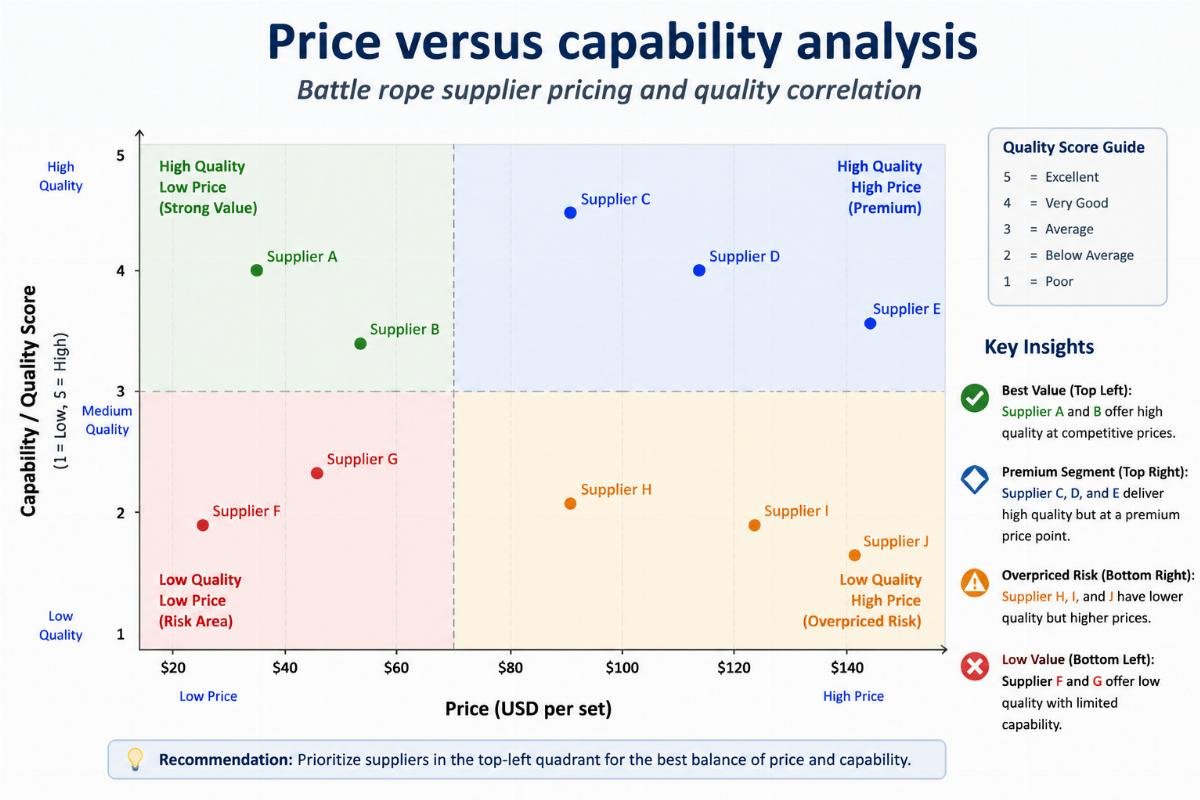
Low price quotes signal operational shortcuts or capacity problems
Battle rope manufacturing has relatively stable material costs and labor requirements. Suppliers offering prices 20-30% below market average cannot maintain quality standards and delivery reliability while operating profitably. They either cut material quality, reduce quality control procedures, or overcommit capacity to generate cash flow.
Calculate realistic manufacturing cost using this breakdown: material cost (40-45% of selling price for quality ropes), labor cost (15-20% of selling price), factory overhead and equipment (10-15% of selling price), and supplier margin (15-25% of selling price). Prices below this structure indicate compromises somewhere in the production chain.
I investigated a supplier offering battle ropes at 35% below market average. They used 10% lower material weight, eliminated quality inspection stations, and accepted orders exceeding 180% of production capacity. Delivery delays averaged 8 weeks, and quality rejection rates reached 22%.
Capability verification before price negotiation improves supplier selection
Reverse the procurement sequence: verify supplier capability first, then negotiate pricing among verified suppliers. This approach eliminates suppliers who cannot fulfill requirements regardless of price advantage. You negotiate with suppliers who have proven ability to deliver quality products on schedule.
Implement three-stage supplier selection: Stage 1 screens suppliers using verification checklist, Stage 2 requests quotes from verified suppliers only, Stage 3 negotiates final terms with top 2-3 verified suppliers. This process takes longer than price-first selection but reduces post-order problems by 60-70% based on my tracking data.
Allocate procurement timeline to allow verification: 3-4 weeks for initial verification including factory visits and reference checks, 1-2 weeks for quote collection and comparison, 1 week for final negotiation and contract drafting. Total 5-7 weeks before order confirmation prevents rushed decisions that lead to supplier problems.
| Selection Approach | Process Sequence | Problem Rate | Timeline Required |
|---|---|---|---|
| Price-first selection | Collect quotes → Select lowest price → Verify capability | 68% experience delivery or quality issues | 1-2 weeks |
| Verification-first selection | Verify capability → Request quotes from verified suppliers → Select based on value | 15% experience delivery or quality issues | 5-7 weeks |
| Hybrid rushed selection | Quick verification → Price comparison → Fast decision | 41% experience delivery or quality issues | 2-3 weeks |
| No verification selection | Accept supplier claims → Order based on website/marketing | 89% experience delivery or quality issues | Under 1 week |
How should different order volumes change supplier verification priorities?
Order volume determines which supplier capabilities matter most for successful fulfillment. Small orders face different risks than large volume orders. Verification priorities should adjust based on order size and frequency. I've mapped verification focus areas against order volume categories to optimize supplier evaluation efficiency.
Order volumes below 500 units require basic quality and delivery verification. Volumes between 500-2000 units require production capacity verification and sample-to-production testing. Volumes exceeding 2000 units require comprehensive facility audits, financial stability checks, and backup supplier arrangements.
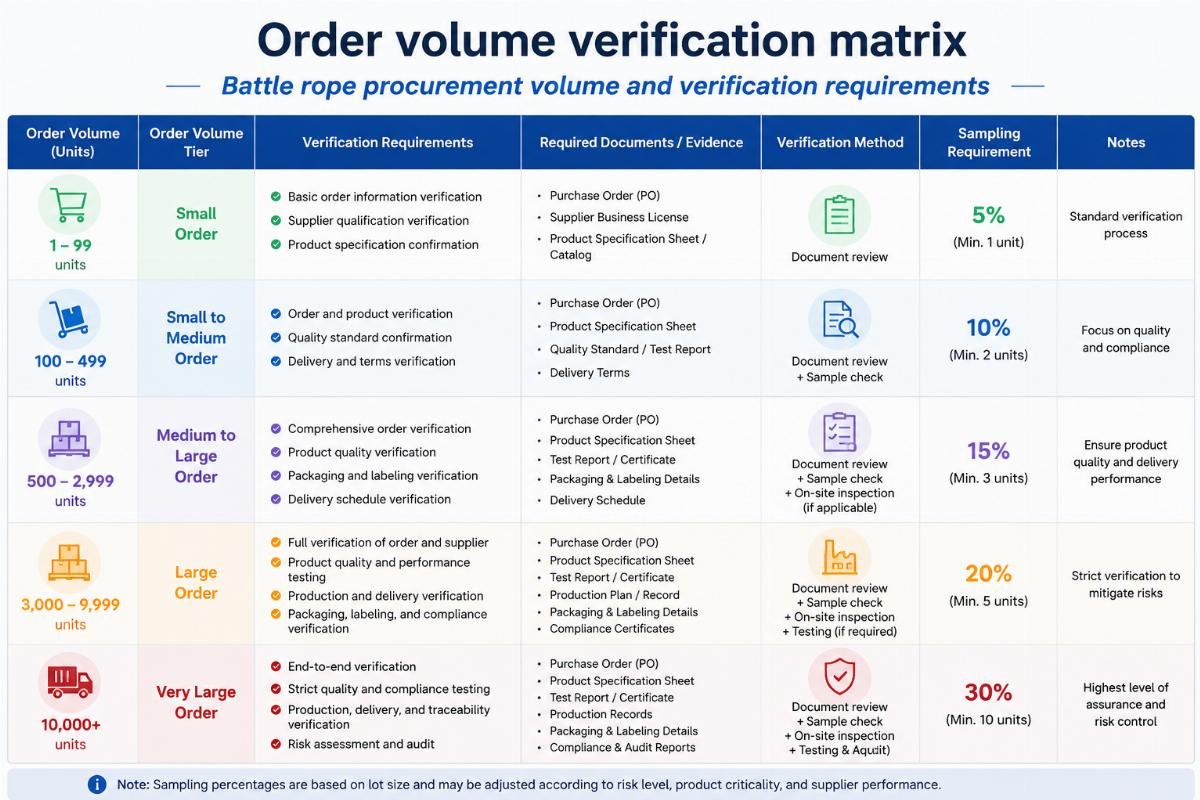
Small order verification focuses on sample quality and basic delivery
Orders under 500 units don't justify extensive verification procedures. Focus verification on sample quality assessment, basic delivery timeline confirmation, and communication responsiveness. Small orders typically represent testing new suppliers or serving niche market segments.
For small orders, implement abbreviated verification: request and test samples thoroughly, contact one previous buyer reference, confirm delivery timeline in writing with penalty clauses, and verify basic business registration. This verification level takes 3-5 days and prevents obvious supplier problems without excessive resource investment.
Structure small order payments to protect against non-delivery: 30% deposit after sample approval, 70% payment upon delivery confirmation. Avoid full advance payment regardless of supplier discount offers. Small orders from unverified suppliers carry higher non-delivery risk.