Cost to Ship Gym Equipment from China to Latin America | Bick Wholesale Supplier
Most buyers obsess over ocean freight rates, only to discover that port surcharges, demurrage, and salt-spray damage account for a larger share of the true landed cost.
The real cost to ship gym equipment from China to Latin America is never just the ocean freight invoice. It is the sum of base freight, terminal handling charges, customs clearance fees, inland trucking, and—most critically—hidden penalties like demurrage, container detention, and corrosion-related warranty claims that surface months after the container doors open.
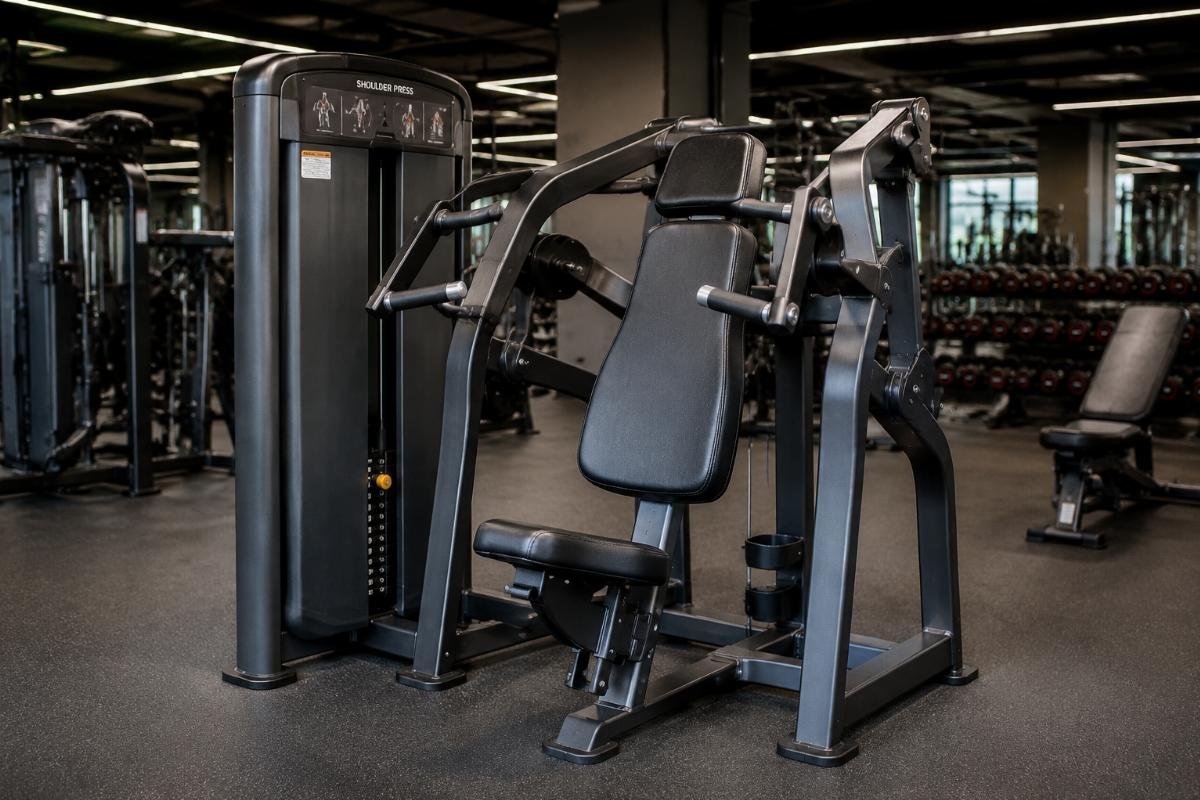
I still remember my first trip to a gym in Mexico City. We had shipped a full container of commercial Smith machines through Manzanillo, and when the client uncrated the first unit, the chrome plating on three Olympic bars had already blistered. Forty-plus days at sea, stacked near the bow where salt spray concentrates, and nobody had specified a corrosion-resistant packaging grade. The client was furious—not because the freight bill was high, but because the warranty replacement cost several times what proper packaging would have added at origin. That trip reshaped how I think about the cost to ship gym equipment from China to Latin America: the visible line items on a freight quote are only the starting point. [NEED_CITE: Latin American port congestion surcharge breakdown per regional freight index]
Let me walk you through the cost structure, the trade terms that actually matter, and the packing decisions that separate a smooth delivery from a mid-six-figure loss.
What Are the Main Cost Components When Shipping Gym Equipment to Latin America?
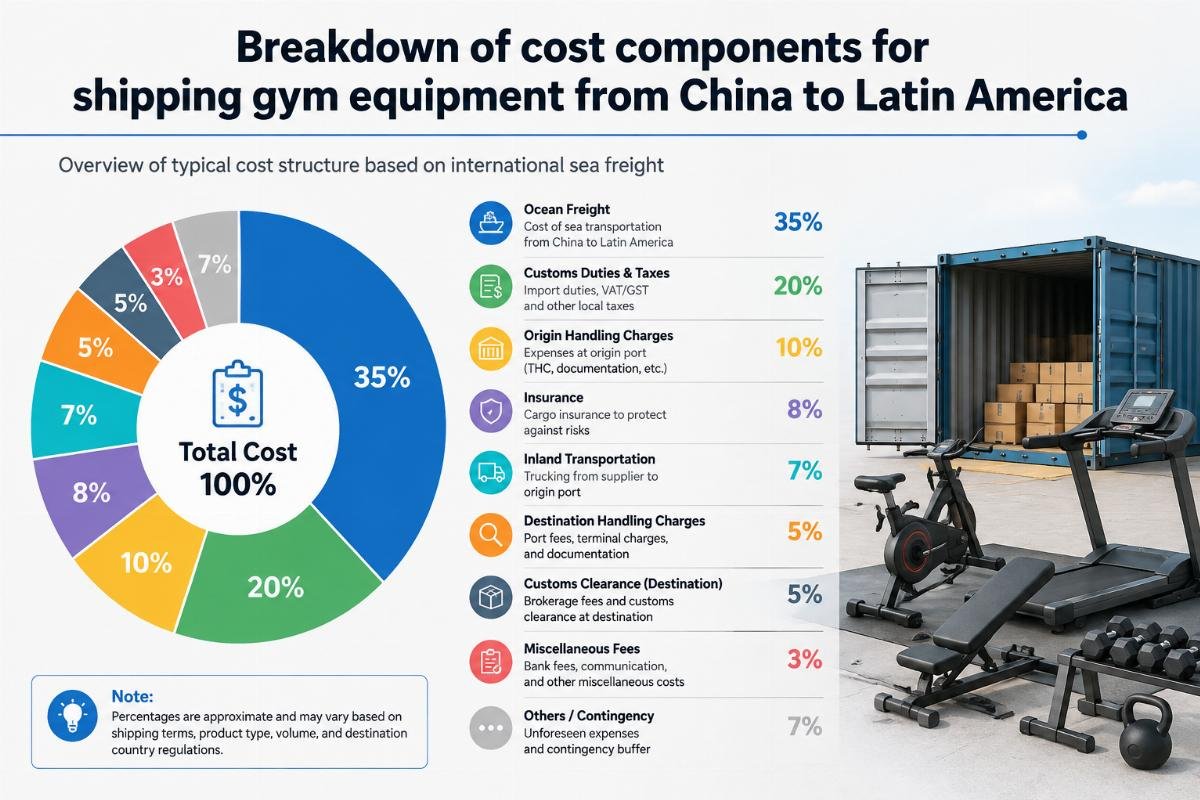
The landed cost of gym equipment from China to Latin America breaks into four layers: base ocean freight, origin and destination port charges, customs clearance and duties, and inland delivery—with port-side penalties and damage claims often eclipsing the freight itself.
Here is how each layer behaves on the China-to-LatAm corridor:
-
Base ocean freight. This is the rate you see on a forwarder’s quote sheet. It fluctuates with bunker fuel, vessel capacity, and seasonal peaks. On the Pacific route to Mexico’s west coast, transit typically runs in the range of four to five weeks. To Brazil’s Santos or Chile’s San Antonio, expect a longer transit window, especially if transshipment via Panama or Busan is involved. [NEED_CITE: average transit time China to major Latin American ports per carrier schedule data]
-
Origin charges (China side). These include terminal handling charges, customs declaration fees, export inspection if applicable, and container stuffing supervision. For a full container of plate-loaded machines or a consolidated shipment of free weights and cable crossovers, origin charges are relatively predictable.
-
Destination port charges (Latin America side). This is where costs spiral. Terminal handling charges at Santos, Manzanillo, or Callao are often higher than Chinese counterparts. More importantly, port congestion surcharges, peak season surcharges, and low-sulfur fuel adjustments can be added with limited advance notice. [NEED_CITE: destination port surcharge structure at Santos and Manzanillo per local terminal operator bulletins]
-
Customs clearance and duties. Latin American customs regimes are documentation-intensive. Brazil’s import licensing system, Mexico’s NOM compliance checks, and Chile’s VAT collection at the border all add time and cost. A single missing certificate can hold a container for weeks, triggering storage fees that compound daily.
-
Inland trucking. From port to warehouse, trucking costs depend on distance, road conditions, and whether the delivery site has dock-level access. Many gym facilities in secondary cities face additional charges for narrow-street delivery or crane-assisted unloading of heavy items like functional trainers and full Smith machine cages.
The mistake most first-time importers make is treating the ocean freight quote as the total cost. In reality, port-side fees and delay penalties frequently represent a substantial portion of the final landed expense. [NEED_CITE: proportion of landed cost made up by port and delay charges on China-LatAm trade lane]
FOB vs CIF — Which Terms Actually Save You Money on the China-LatAm Route?
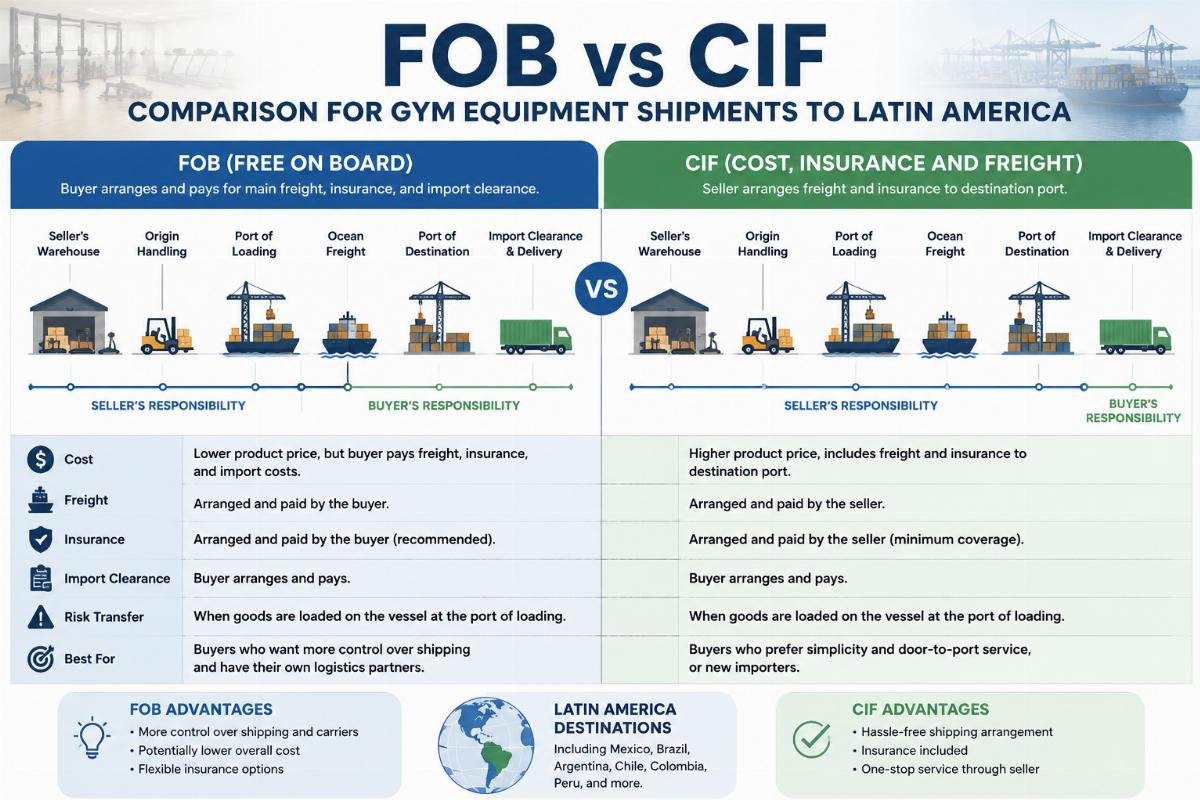
FOB looks cheaper on paper, but CIF often delivers a lower true landed cost for Latin American buyers who lack direct negotiating leverage with carriers and destination terminals.
Under FOB, the buyer controls the ocean freight booking and assumes responsibility from the port of loading onward. In theory, this gives the buyer freedom to shop for the best freight rate. In practice, several dynamics work against FOB on the China-LatAm lane:
-
Carrier space allocation. During peak season, carriers prioritize shippers with consistent volume commitments. A Latin American buyer booking a handful of containers per quarter will face higher spot rates and weaker space guarantees than a Shandong factory shipping dozens of containers monthly.
-
Origin terminal coordination. Under FOB, the buyer’s forwarder must coordinate with the factory’s loading schedule. Misalignment leads to container detention at the terminal, rollover to the next vessel, and missed sailing windows. Under CIF, the factory controls the entire origin chain, reducing coordination friction.
-
Destination port leverage. This is the critical point. Latin American buyers often have limited ability to negotiate destination terminal handling charges or secure extended free time at the port. When a factory ships under CIF, it can bundle destination charges into the overall offer and use its volume across multiple clients to negotiate better terms with destination agents.
I worked with a distributor in São Paulo who insisted on FOB for his first few orders. Each time, demurrage at Santos ate into his margins because his forwarder could only secure a standard free-time window. When we switched the same routes to CIF, our consolidation volume allowed us to negotiate extended free time at the terminal, and his effective landed cost dropped noticeably—even though the CIF price appeared higher at first glance. [NEED_CITE: Incoterms 2020 obligations and risk transfer points for FOB and CIF]
That said, CIF is not universally better. If a buyer has established relationships with carriers, a strong customs broker at destination, and the ability to consolidate shipments from multiple Chinese suppliers into a single buyer’s consol, FOB can be competitive. The key is to compare total landed cost, not just the freight line item.
How to Reduce Shipping Costs Through Container Consolidation and Packing Optimization?
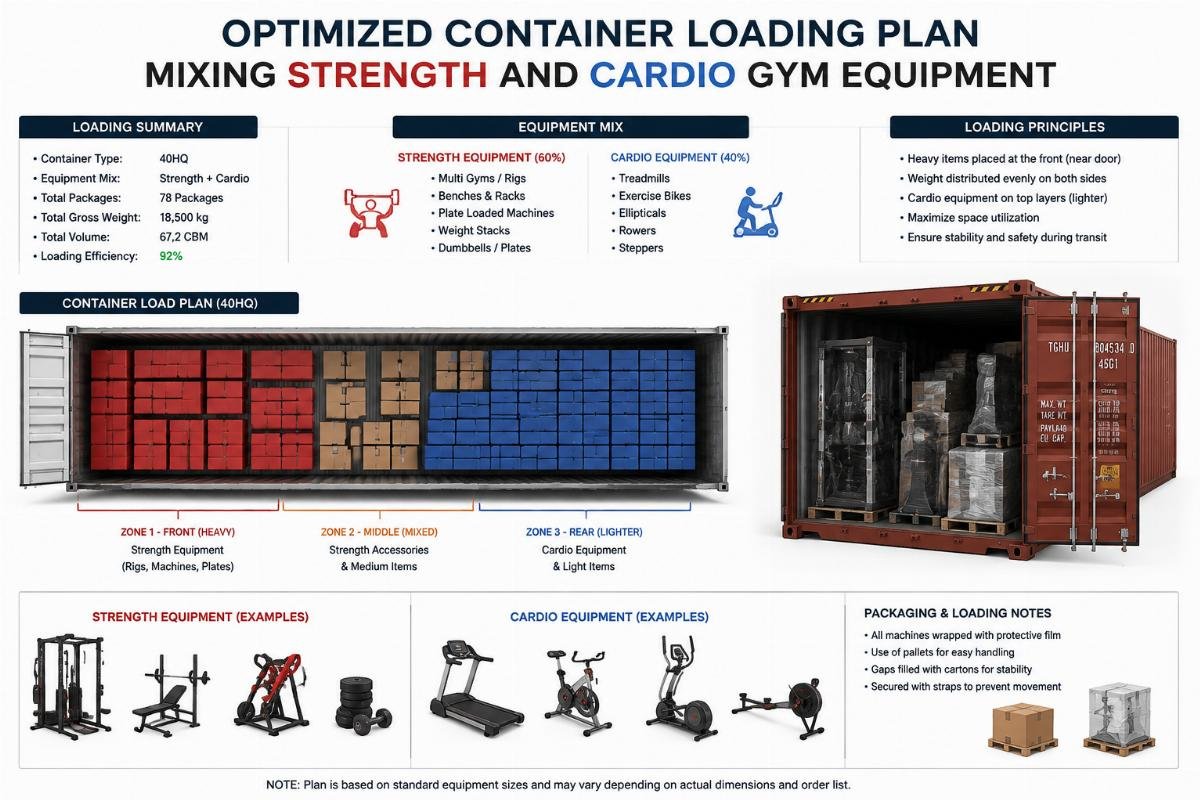
Mixing strength machines with cardio equipment in a single consolidated container can raise the loading rate substantially, turning what would require two partial containers into one efficiently packed shipment.
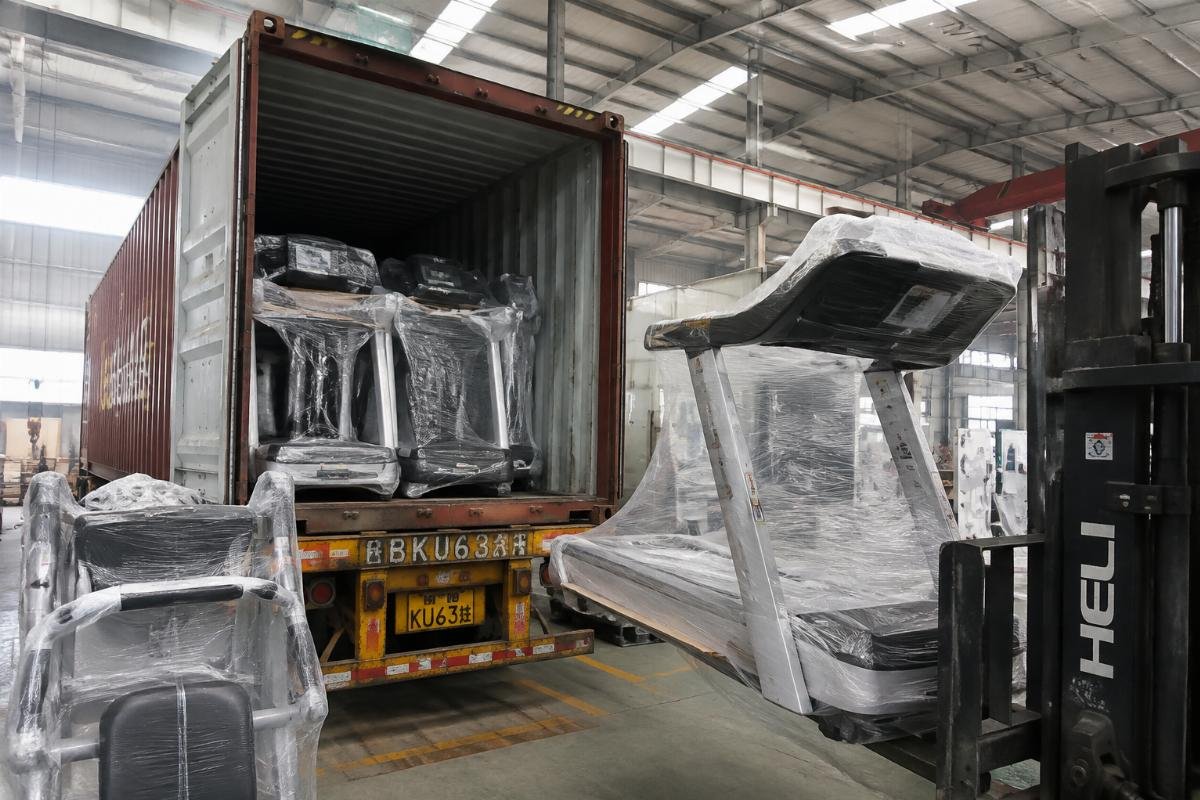
Gym equipment is notoriously difficult to containerize. A commercial Smith machine ships in a tall, narrow crate that wastes vertical space. A plate-loaded leg press is heavy but compact. A commercial treadmill is long and wide but relatively hollow inside. If you load a container with only one product type, you will hit either the weight limit or the volume limit long before the container is full.
The consolidation approach works like this:
-
Heavy compact items first. Plate-loaded machines, dumbbell sets, and weight plates go on the container floor as a dense base layer. These items hit the weight limit quickly, so they must be positioned to distribute load evenly and leave no dead space underneath.
-
Tall hollow items next. Functional trainers, cable crossovers, and Smith machine cages are placed upright or on their side frames, nested into the gaps left by the base layer. Their internal cavities can often accommodate smaller boxed items like benches, medicine balls, or accessory kits.
-
Long flat items last. Treadmills, ellipticals, and rowing machines are loaded in the remaining longitudinal space. Their packaging is designed to stack, and the hollow space above the console can hold retail boxes of resistance bands, yoga mats, or small free-weight sets.
A Chilean client ordering a boutique studio package initially planned two separate shipments: one for strength equipment and one for cardio. By consolidating into a single container with optimized nesting, we raised the volumetric utilization from roughly half-full to nearly maxed out, and his per-unit freight cost dropped accordingly. [NEED_CITE: standard internal dimensions and payload limits of 20GP and 40HQ containers]
The packing optimization also extends to how individual machines are prepared. Removable parts—seat pads, weight stacks, selector pins—should be detached and boxed separately inside the main crate. This reduces the overall crate dimensions and prevents internal damage during transit. For mixed-material shipments, steel frames and rubber-coated items should be separated by cardboard dividers to avoid surface marking.
What Hidden Fees at Latin American Ports Can Double Your Landed Cost?
Demurrage, detention, and salt-spray corrosion are the three silent budget-killers that turn a well-priced shipment into a financial loss—yet they rarely appear on the initial freight quote.
Let me break down each one:
Demurrage charges. When a container arrives at a Latin American port and sits inside the terminal beyond the free-time window, the terminal operator charges a daily demurrage fee. At Santos, these fees escalate steeply after the initial free period—often doubling or tripling on successive days. Customs clearance delays, missing documentation, or port congestion can push a container well past free time before the cargo is even released. [NEED_CITE: demurrage fee escalation schedule at Santos port terminal]
The fix is proactive: ensure all import licenses, certificates of origin, and compliance documents are pre-cleared with the customs broker before the vessel arrives. Under CIF terms, the factory can also negotiate extended free time with the destination agent based on consolidated volume.
Container detention. This is separate from demurrage. Once the container leaves the terminal gate, the shipping line allows a limited number of days for the consignee to unload and return the empty container. If the gym facility is under construction or the receiving team is not ready, detention charges accumulate daily. I have seen detention fees on a single container reach a level that nearly matched the original ocean freight cost.
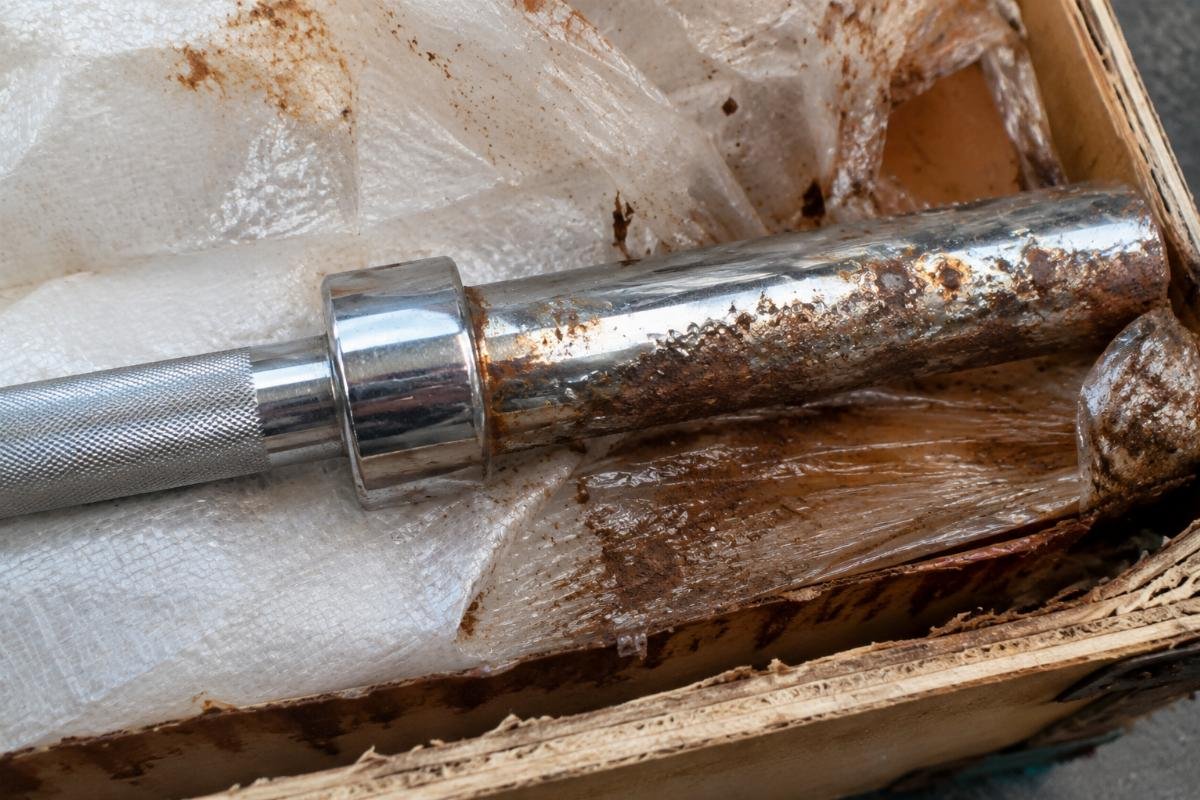
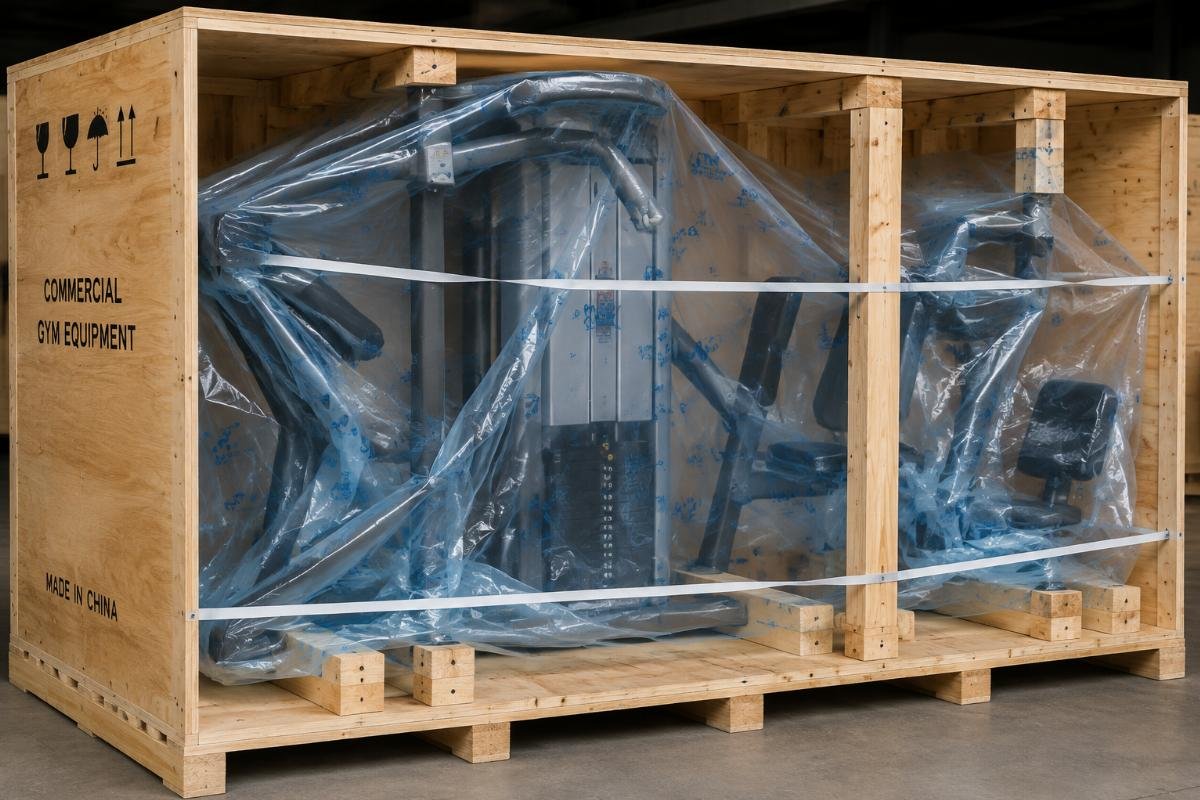
Salt-spray corrosion. This is the damage that does not show up until weeks after delivery. Chrome-plated Olympic bars, zinc-plated selectorized machine frames, and polished stainless steel components are all vulnerable during extended sea transit. Without proper packaging—specifically, VCI (volatile corrosion inhibitor) wrapping and desiccant packs inside sealed polyethylene liners—salt moisture penetrates the packaging and attacks exposed metal surfaces. The Mexico City job I mentioned at the start was a textbook case: the chrome blistering was not visible at the port, only after the client opened the crates in a humid warehouse environment. [NEED_CITE: corrosion prevention standards for metal goods during ocean freight]
The cost of replacing corroded components—manufacturing, re-shipping, customs re-entry—far exceeds the modest per-unit cost of upgraded packaging at origin.
How Should Buyers Prepare Packaging and Documentation to Avoid Damage and Delays?
Export-grade packaging and pre-validated documentation are the two lowest-cost, highest-impact investments a Latin American buyer can make before a container leaves China.
On the packaging side, the standard for gym equipment bound for Latin America should include:
-
Inner protection. All chrome, zinc, and polished surfaces wrapped in VCI paper or film, with desiccant sachets sealed inside the inner polyethylene layer. This creates a micro-environment that suppresses salt-spray attack during the multi-week transit.
-
Structural bracing. Heavy items like plate-loaded stacks and Smith machine weight horns must be blocked and braced inside the crate to prevent shift during vessel roll. Plywood dividers, foam corner protectors, and steel-band strapping are standard requirements.
-
Outer crate specification. Solid plywood or multi-layer corrugated cartons with palletized bases. The crate must withstand forklift handling at both origin and destination, plus stacking inside a container that may be loaded to ceiling height.
On the documentation side, Latin American customs authorities require precise alignment between the commercial invoice, packing list, bill of lading, and certificate of origin. Common errors include:
- Mismatched HS codes between the invoice and the destination country’s tariff schedule.
- Missing CE certification marks on product labels when required by local technical regulations.
- Incomplete wood packaging fumigation certificates when plywood crates are used. [NEED_CITE: ISPM 15 wood packaging material requirements for international shipments]
A Brazilian client once faced a full container hold at Santos because the packing list listed individual machine weights in kilograms while the bill of lading declared total weight in pounds. The discrepancy triggered a customs audit, and the container sat for weeks. The lesson: document consistency is not a clerical detail—it is a cost-control measure.
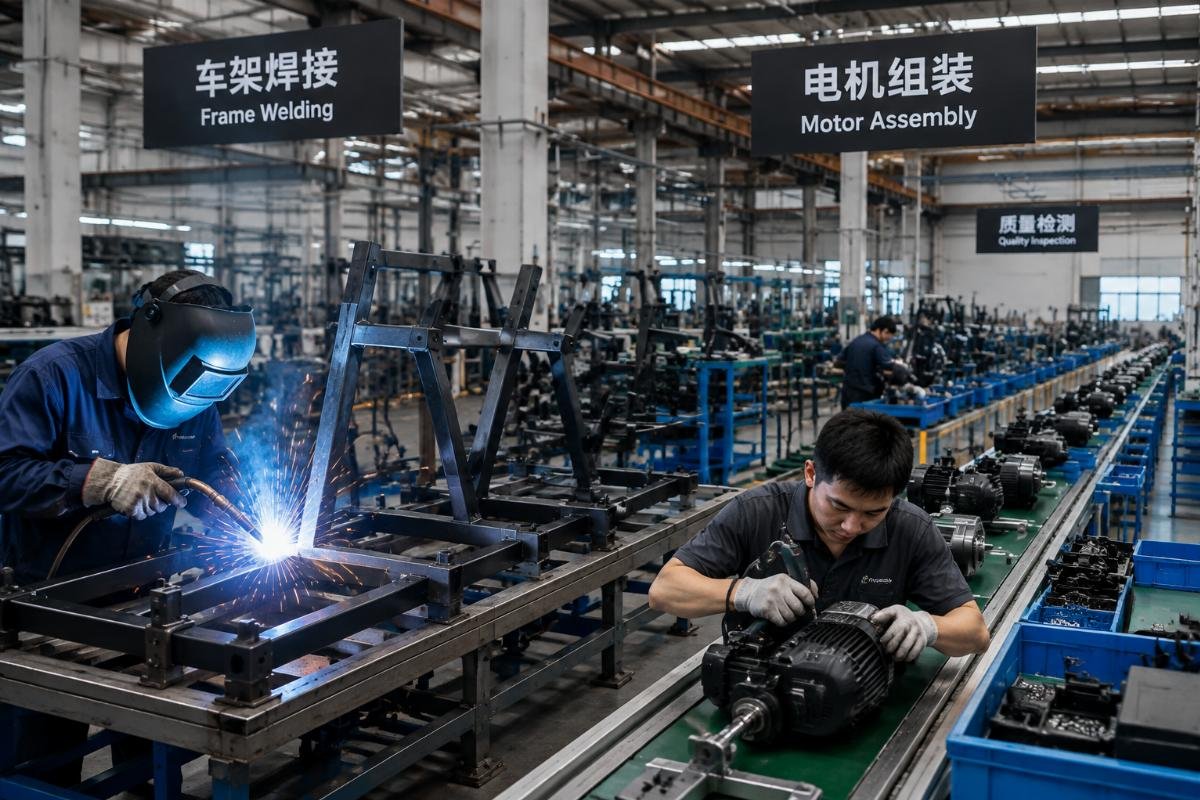
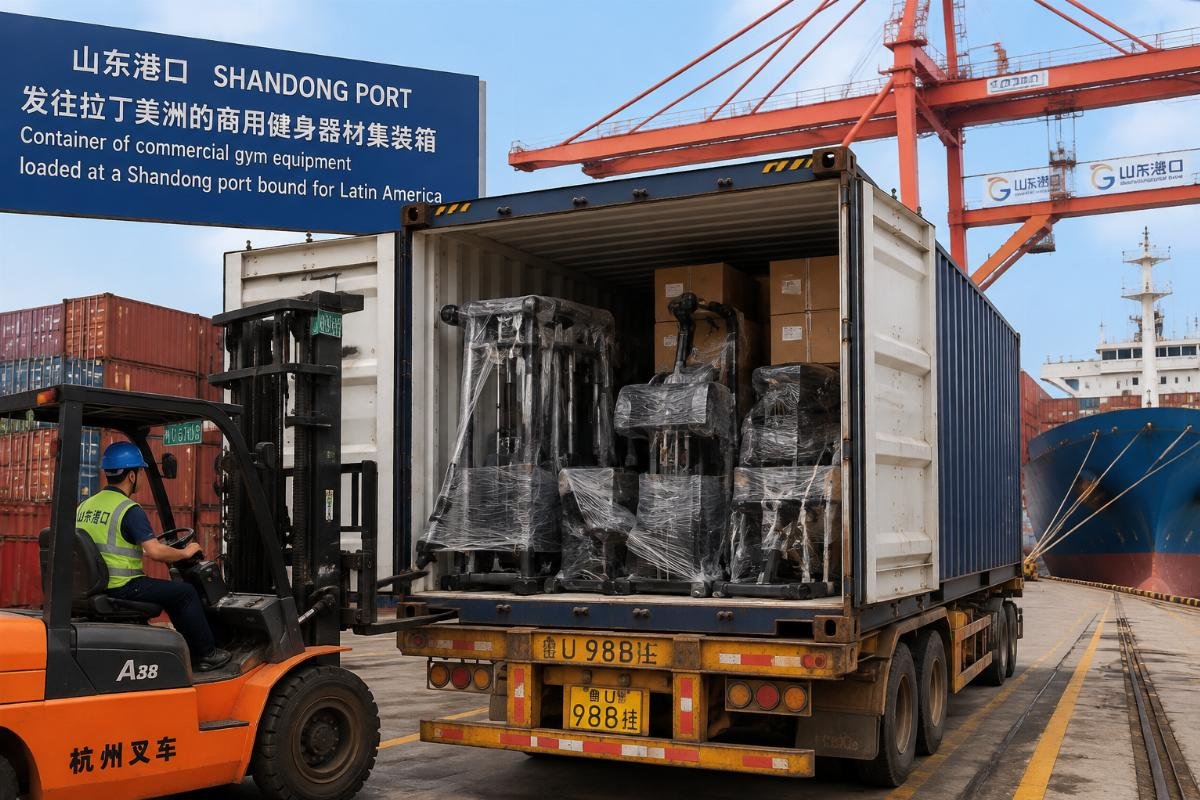
At our facility in Shandong, every export shipment undergoes a pre-loading inspection that verifies packaging integrity, surface protection, and document alignment before the container is sealed. This is not an upsell; it is standard procedure for any order bound for Latin America, because the cost of a return shipment or a corrosion claim dwarfs the inspection effort.
Conclusion
The cost to ship gym equipment from China to Latin America is a multi-layer equation where freight is only the opening bid. Port penalties, corrosion damage, and documentation errors routinely inflate the true landed cost far beyond the initial quote. Buyers who treat packaging, trade terms, and container consolidation as strategic variables—not afterthoughts—consistently achieve lower total costs and smoother deliveries than those who focus solely on the ocean freight rate.