Commercial Gym Equipment Manufacturer from China | Bick Factory Direct
CE certification does not automatically clear Canadian customs. Importing fitness equipment into Canada requires cCSA, ETL, or equivalent North American safety marks—CE alone will get your shipment held at the border. The most reliable path is sourcing from a fitness equipment supplier for Canada that pre-validates electrical compliance, voltage configuration, and container logistics before production begins.
I still remember standing in a hotel mechanical room in the Gulf, staring at two scorched elliptical drive boards. The machines had arrived in a full container, unboxed, installed, and powered up—only to fry within the first week because the motor controllers were wired for a voltage frequency that didn’t match the building’s supply. The client’s project manager was furious. The root cause was not the equipment quality; it was a specification sheet that listed the wrong electrical standard. Since then, every time I open a quotation file for a cross-border gym project, the first line I check is the destination country’s electrical code, not the price per unit. [NEED_CITE: Canadian electrical safety certification requirements for imported fitness equipment per CSA standards]
Getting the compliance layer right is only the starting point. A fitness equipment supplier for Canada must also demonstrate verifiable factory capability, flexible container loading options, and a spare parts pipeline that survives the ocean crossing. What follows is a field-level breakdown of how to evaluate, order, and receive commercial gym equipment from a Chinese manufacturer without ending up with containers full of expensive paperweights.
What Certifications Does Canada Require for Imported Fitness Equipment?
CE marking is not recognized as a substitute for Canadian safety certification. Canada operates under the Canadian Electrical Code and requires third-party certification from agencies accredited by the Standards Council of Canada. For motorized fitness equipment—treadmills, ellipticals, spin bikes, rowing machines—the acceptable marks include cCSA, cETL, and cUL. Non-motorized strength equipment and free weights face fewer electrical barriers but still must meet material safety and labeling requirements under Canadian consumer product regulations. [NEED_CITE: Certification marks accepted by Canadian provincial electrical safety authorities for imported commercial fitness equipment]
The confusion typically starts when a buyer sees "CE" on a spec sheet and assumes global coverage. CE is a European conformity declaration. It has zero legal standing at a Canadian port of entry. Provincial safety officers in Ontario, British Columbia, Alberta, and Quebec will inspect motorized equipment on arrival, and any unit lacking a recognized Canadian certification mark will be rejected or held pending costly retroactive testing.
| Certification Mark | Recognized in Canada | Covers Motorized Cardio | Covers Strength/Free Weights |
|---|---|---|---|
| cCSA | Certified | Full | Labeling required |
| cETL | Certified | Full | Labeling required |
| cUL | Certified | Full | Labeling required |
| CE Only | Not recognized | Not accepted | Not accepted |
Beyond the certification mark itself, the voltage and frequency configuration must match Canadian grid standards: 120V/60Hz for standard outlets and 208-240V/60Hz for dedicated commercial circuits. A fitness equipment supplier for Canada that ships 230V/50Hz equipment—standard for European or Middle Eastern markets—will create an immediate failure point on installation. I have seen entire cardio fleets require on-site transformer installations because the factory defaulted to the wrong voltage profile on the production order. The cost of those transformers, plus the downtime, wiped out the savings the buyer thought they were getting from factory-direct pricing.
The practical step is straightforward: before signing a purchase order, request the factory’s certification test reports specifically issued for the Canadian market, and cross-reference the voltage plate specifications against the electrical plan of the installation site. A competent fitness equipment supplier for Canada will have these documents ready and will flag any mismatch before production starts. [NEED_CITE: Voltage and frequency specifications for commercial fitness equipment in Canadian electrical code]
How Do You Verify a Chinese Fitness Equipment Factory’s Real Capability?
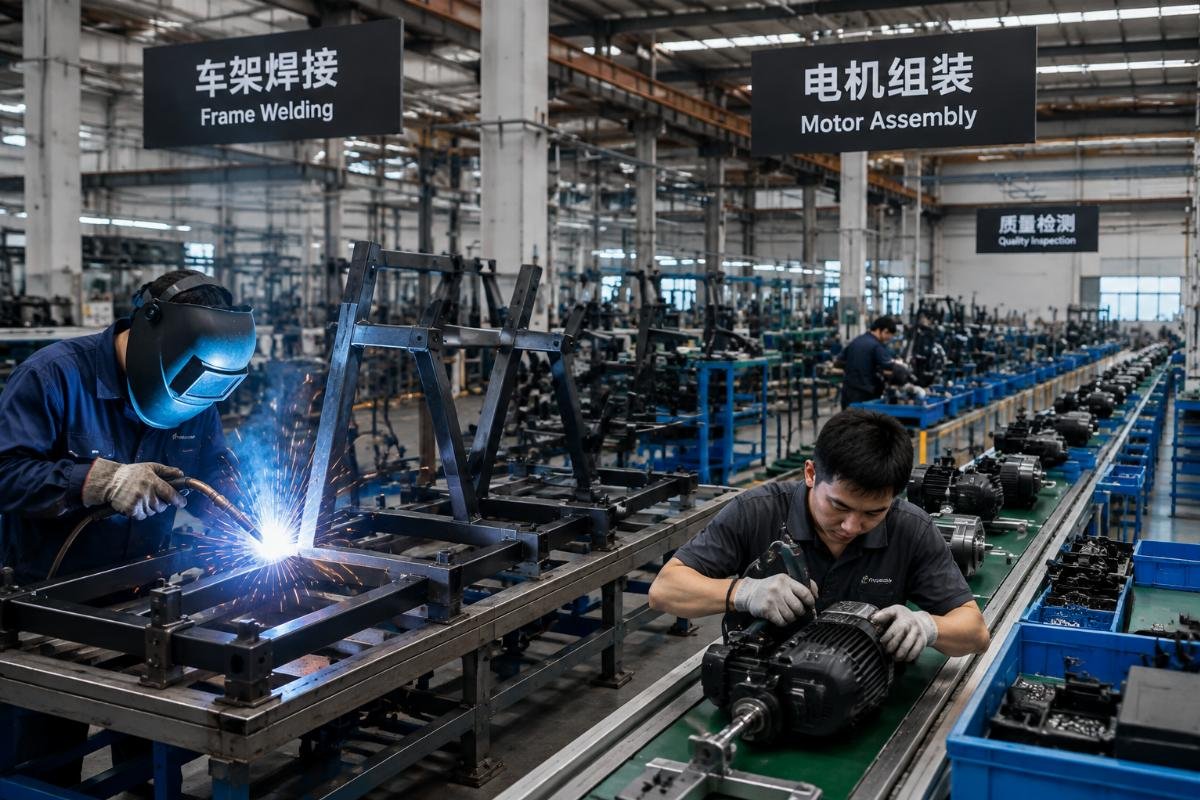
Factory audits on paper look very different from factory floors in person. Any manufacturer can produce a glossy brochure and a polished website. The real test is whether the production line, quality control checkpoints, and certification documentation hold up under scrutiny. When evaluating a fitness equipment supplier for Canada, I look at three things: the welding and finishing process, the certification file depth, and the delivery track record for similar projects.
Welding quality on commercial-grade frames is the single most visible indicator of manufacturing seriousness. Look for continuous welds on load-bearing joints, not spot tacks. Check the powder coating thickness and adhesion—commercial equipment in Canadian gyms faces heavy daily use, and thin coatings chip within months, exposing bare steel to rust. A factory that invests in automated welding robots and multi-stage coating lines is signaling long-term commitment, not just export volume. [NEED_CITE: Manufacturing quality benchmarks for commercial fitness equipment frames and finishes]
Certification file depth separates real manufacturers from trading companies. Ask for the actual test reports—not just a certificate image—issued by an accredited lab like TÜV, SGS, or Intertek, specifically covering the models you intend to order. A genuine fitness equipment supplier for Canada will provide model-specific test reports with Canadian certification marks. If the factory can only show a generic CE certificate and promises to "get cCSA later," that is a red flag. Retrofitting certification after production is exponentially more expensive and time-consuming than building it into the design from the start.
Delivery track record matters because gym projects run on timelines. A hotel opening date does not shift because your container is stuck in customs. Ask the factory for references from previous Canadian or North American projects. A fitness equipment supplier for Canada with genuine cross-border experience will have case studies showing complete gym fit-outs—cardio zones, strength circuits, free weight areas—delivered on schedule with all documentation cleared. I have worked with buyers who switched suppliers mid-project because the original factory could not produce a single cCSA-certified treadmill in time, delaying a hotel opening by months. The lesson is simple: verify before you commit, not after.
Full Container vs. LCL Consolidation: Which Shipping Method Fits Your Order?
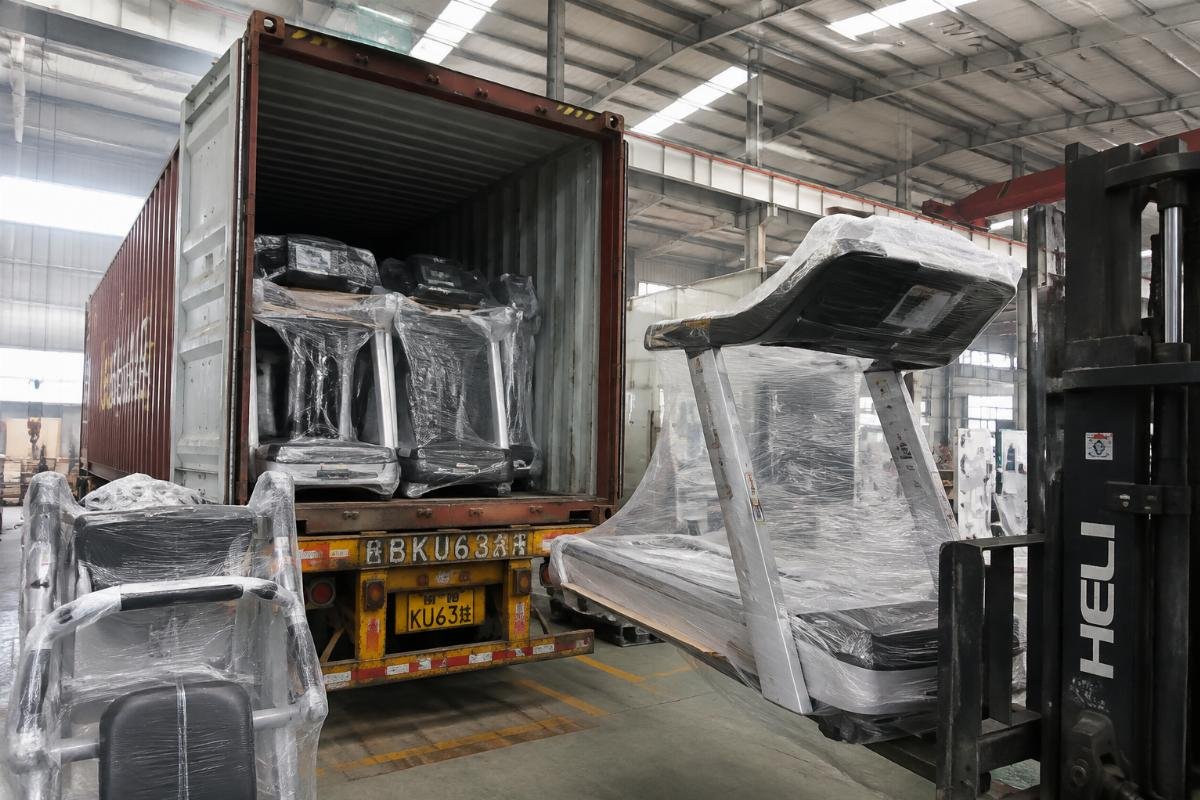
A full container is not always the cheapest or smartest choice. The instinct for first-time importers is to fill a 40-foot high cube container and maximize per-unit freight savings. But for buyers testing a new supplier or outfitting a mid-size facility, a full container forces over-ordering on slow-moving SKUs just to hit the volume threshold. A fitness equipment supplier for Canada that offers flexible container consolidation—mixing cardio, strength, and free weights into a single shared container—often delivers better economics for initial orders and renovation projects.
The decision comes down to order composition. A commercial gym package typically includes motorized cardio units, plate-loaded and selectorized strength machines, functional training rigs, dumbbell sets, and flooring. These items have vastly different dimensions and weights. A single commercial treadmill occupies significant floor space in a container, while a set of adjustable dumbbells fills a fraction of that volume. Loading only treadmills into a full container wastes cubic capacity. Mixing equipment types into a consolidated shipment uses the container more efficiently and lets you order the exact SKU mix your project requires.
| Order Scenario | Recommended Method | Key Consideration |
|---|---|---|
| First trial order, multiple SKUs | LCL or shared container | Minimize dead stock risk |
| Full gym fit-out, high volume | Full container | Lower per-unit freight cost |
| Replacement or expansion order | LCL or shared container | Match exact replenishment needs |
| Distributor restocking popular lines | Full container | Maximize margin per unit |
For a hotel developer outfitting a boutique fitness center, the order might include a handful of treadmills, a few ellipticals, a functional trainer, a set of benches, and a dumbbell rack. That mix does not fill a full container. A fitness equipment supplier for Canada that can consolidate those items with other buyers’ orders into a shared container saves the buyer from paying for empty air. The consolidation process requires precise loading plans—knowing which machines stack, which disassemble for flat packing, and how to distribute weight across the container floor. [NEED_CITE: Container loading optimization methods for mixed fitness equipment shipments]
The risk with LCL is longer transit times and more handling, which increases the chance of cosmetic damage. A reliable fitness equipment supplier for Canada will use reinforced corner protectors, internal bracing, and moisture barriers to protect equipment during shared container transit. Ask about the factory’s packing standards before committing. If they cannot show you a loading plan or explain how they protect high-value items in a shared container, look elsewhere.
What Does the End-to-End Ordering Process Look Like?
The gap between inquiry and installation is where most import problems originate. A structured ordering process protects both buyer and factory from specification errors, certification gaps, and delivery surprises. When working with a fitness equipment supplier for Canada, the process should follow a clear sequence: specification confirmation, certification verification, production, pre-shipment inspection, and logistics coordination.
The first step is specification alignment. This is not just about choosing models from a catalog. It involves confirming frame color, upholstery material, console features, voltage configuration, and certification requirements for every single SKU. I have seen orders go wrong because the buyer assumed "standard configuration" meant Canadian voltage, when the factory’s standard was European. A detailed specification sheet, signed off by both parties before production, eliminates this ambiguity.
Certification verification comes next. Before the factory cuts metal, they should provide updated certification documents for every motorized model in the order, confirming cCSA or cETL coverage for the Canadian market. A fitness equipment supplier for Canada that treats this as an afterthought is a liability. [NEED_CITE: Pre-production certification verification workflow for imported fitness equipment]
Production and pre-shipment inspection form the critical quality gate. For large orders, hiring a third-party inspection service to verify build quality, electrical safety, and packaging integrity before the container is sealed is a small cost compared to the expense of returning defective units from Canada. The inspection should cover weld quality, coating adhesion, motor function under load, console operation, and packing density.
Logistics coordination is the final step. The fitness equipment supplier for Canada should handle export customs clearance, provide complete shipping documentation—including commercial invoice, packing list, bill of lading, and certificates of origin—and coordinate with the buyer’s freight forwarder for Canadian customs clearance. Missing or incorrect documentation delays clearance and incurs storage fees at the port. A factory experienced in Canadian imports will have this process standardized.
How Do Spare Parts and After-Sales Support Work Across Borders?
Spare parts availability determines the real lifespan cost of gym equipment. Every motorized machine will eventually need a replacement drive board, a new belt, a console module, or a sensor. The question is not whether you will need parts—it is how quickly you can get them when the machine goes down. A fitness equipment supplier for Canada that ships equipment without a spare parts strategy is setting the buyer up for extended downtime and frustrated members or guests.
The most effective approach is shipping a spare parts package with the initial order. This includes high-wear consumables—running belts, deck lubrication kits, console fuses, sensor cables—and critical electronic modules like drive boards and lower control boards. The cost of adding these parts to the container at the time of initial shipment is minimal compared to the cost and delay of air-shipping a single replacement board months later. A fitness equipment supplier for Canada that includes a recommended spare parts list with every quotation is demonstrating after-sales maturity. [NEED_CITE: Recommended spare parts inventory for commercial fitness equipment lifecycle maintenance]
Technical support responsiveness is the other half of the equation. When a machine faults, the gym owner or maintenance technician needs access to error code documentation, wiring diagrams, and remote troubleshooting guidance. A fitness equipment supplier for Canada that provides digital technical manuals, video troubleshooting guides, and direct communication channels with factory engineers reduces mean time to repair significantly. I have seen gym operators in North America wait weeks for a simple diagnostic answer because the supplier had no English-language technical documentation and no responsive engineering contact. That kind of gap turns a minor issue into a major member complaint.
Warranty terms should be explicit and documented. Understand what is covered, what is excluded, and how warranty claims are processed across borders. Some factories offer replacement parts free of charge under warranty; others require the buyer to cover shipping. Clarify this before ordering, not after a failure.
Conclusion
Importing gym equipment into Canada is a compliance and logistics challenge, not just a pricing exercise. The right fitness equipment supplier for Canada combines verified cCSA or cETL certification, voltage configuration matched to Canadian grid standards, flexible container consolidation options, and a spare parts pipeline that keeps equipment running long after installation. Validate the factory’s certification depth, lock down specifications before production, and build spare parts into your initial order. The equipment that survives the crossing and keeps working is the equipment that was spec’d correctly from day one.