Commercial Fitness Equipment Supplier – Factory Direct OEM/ODM Wholesale
Matching equipment specs, certifications, and MOQ flexibility to your target market matters far more than chasing the lowest FOB quote.
Starting a fitness equipment import business hinges on choosing the right supplier tier — one that aligns frame construction, load ratings, cable systems, and after-sales support with your end-user segment — rather than simply comparing unit prices on a spreadsheet.
I spent years welding frames on a factory floor in Dalang, Dongguan, before moving into export sales. One shipment to a Riyadh gym chain still haunts me: the buyer had handed us a spec sheet对标 a top European brand, and every number on paper looked right. But the pin diameter on the Smith machine weight stack was off by a few millimeters — a detail neither spec sheet nor invoice flagged — and the whole container sat stuck at customs for weeks. That order taught me that the numbers buyers obsess over are rarely the ones that cause field failures. Steel wall thickness tolerance, welding seam treatment, and pulley cable rating are the real failure points, and almost no spec sheet lists them. [NEED_CITE: common field failure modes in commercial strength equipment per ISO 20957 field reports]
Let me walk you through how a fitness equipment import business is actually built — from picking the first product mix, to vetting a supplier, to reading between the lines of a spec sheet, to modeling the real landed cost, and finally to setting up after-sales before the container even sails.
What Type of Fitness Equipment Should You Import First?
Your first product mix must match your target customer segment — commercial gym, hotel fitness center, or home retail — because each segment demands a completely different equipment tier, certification set, and spare-parts strategy.
A distributor loading a mixed 40HQ container for a Middle East gym chain needs a very different SKU ratio than a hotel developer outfitting a boutique fitness floor, or a first-time importer testing a single-unit sample. [NEED_CITE: commercial vs. light-commercial fitness equipment specification differences per IHRSA facility classification]
Take a distributor I worked with in West Africa. He wanted to fill a container with everything — treadmills, plate-loaded machines, free weights, functional rigs — in one shot. The instinct is understandable: maximize freight efficiency. But the reality is that cardio, strength, and free weights have very different CBM utilization rates, weight distributions, and warranty risk profiles. Mixing them without a clear SKU priority often means the high-margin strength pieces get squeezed out by bulky cardio shells, or the free weights eat into the payload limit before the container is visually full.
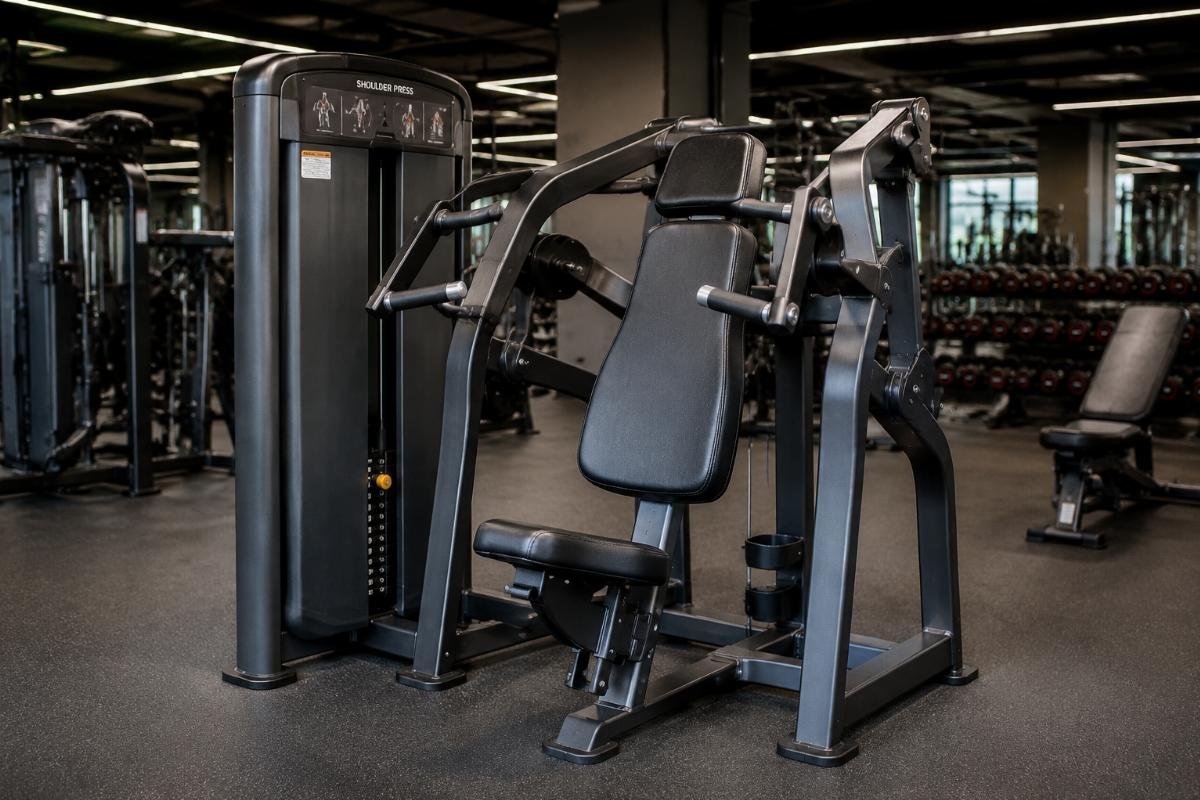
For a hotel developer, the priority flips. Floor area per station matters more than absolute durability, because hotel gyms see moderate daily traffic but demand compact footprints and clean aesthetics. A selectorized stack machine that serves multiple muscle groups in a single footprint often outperforms a full plate-loaded line in that context. [NEED_CITE: space planning benchmarks for hotel and boutique fitness facilities]
A first-time importer, on the other hand, should resist the urge to commit to a full container immediately. A single-unit or small-batch trial order reveals far more about a supplier’s real consistency than any factory tour photo. The sample-to-bulk conversion timeline, the defect rate tolerance threshold, and the lead time from order to port are the metrics that matter — not the glossy brochure.
| Segment | Priority Spec | Certification Need | Spare-Parts Strategy |
|---|---|---|---|
| Commercial Gym Chain | Heavy-duty frame, high load rating | CE / EN ISO 20957 full series | Local wear-parts stock mandatory |
| Hotel / Apartment | Compact footprint, quiet operation | CE basic + noise rating | Supplier-backed warranty sufficient |
| Home Retail / E-Commerce | Retail packaging, popular SKUs | Market-specific consumer safety | Minimal — replace-unit model |
| Boutique Studio / CrossFit | Functional rigs, free weights | Load rating verification | Consumables buffer only |
The fitness equipment import business is not a single-product game. It is a portfolio game, and the portfolio must be built around who actually uses the equipment.
How Do You Verify a Chinese Fitness Equipment Supplier?
Go far beyond Alibaba ratings and factory photos — audit welding quality in person or via third party, request traceable test reports, and confirm OEM/ODM capability with real branded samples before committing to a production run.
Most first-time buyers start their search on B2B platforms, filter by "verified supplier," and then compare unit prices. This approach systematically selects for marketing sophistication, not manufacturing quality. A supplier with a polished storefront and a long list of certificates on display may still weld with inconsistent penetration, use mild steel where the spec calls for cold-rolled, or outsource frame fabrication to a second-tier shop without telling you. [NEED_CITE: supplier audit checklist for fitness equipment manufacturing per industry best practices]
Here is what a real verification process looks like.
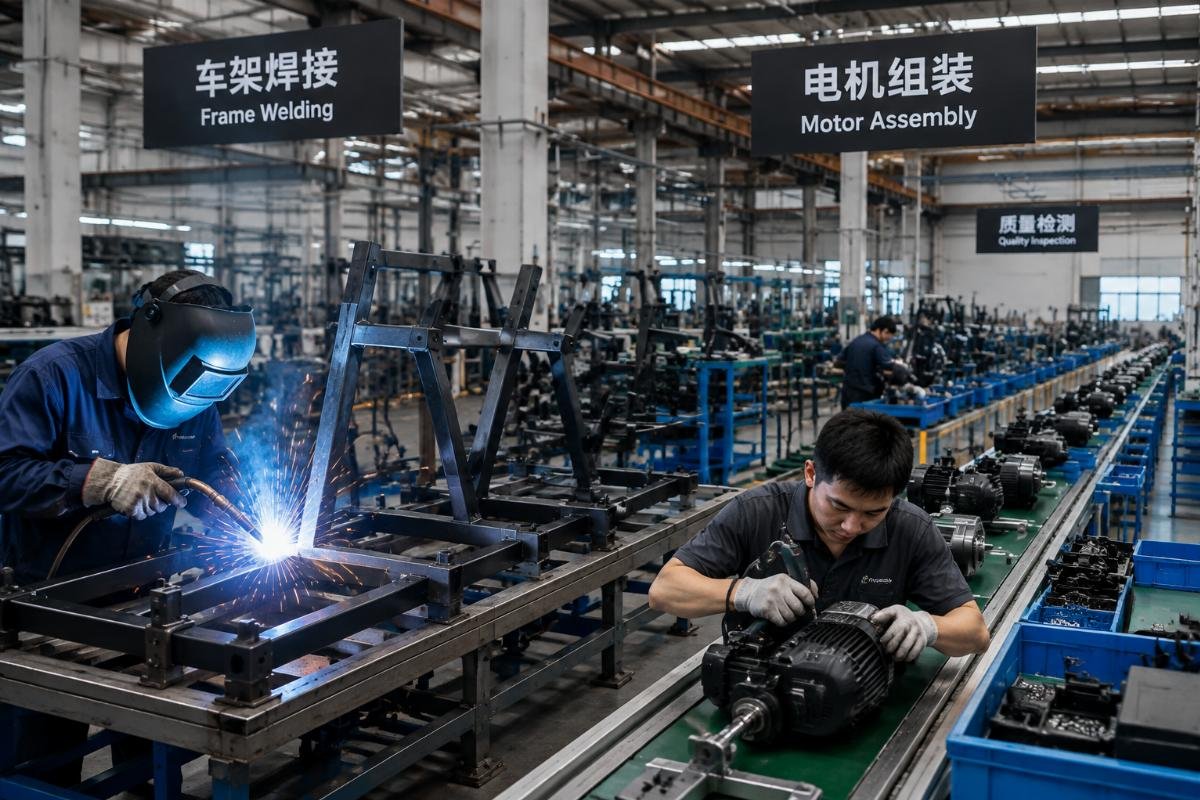
First, confirm the factory’s actual production scope. Many listed "manufacturers" are trading companies that front for multiple workshops. Ask for a live video walk-through of the welding bay, the powder-coating line, and the assembly floor — not a pre-recorded tour. Watch the welders. Look for consistent bead width, proper joint preparation, and clean grinding at stress points. A supplier who hesitates to show the welding bay in real time is telling you something.
Second, validate certifications independently. CE marking is mandatory for most export markets, but not all CE certificates are created equal. Some are self-declared with no third-party test backing; others come from notified bodies with real audit trails. Ask for the certificate number and cross-check it against the issuing body’s database. For the EN ISO 20957 safety series, request the actual test report — not just the certificate cover page. [NEED_CITE: CE marking validation process and notified body database lookup for fitness equipment]
Third, test OEM/ODM capability with a real branding sample. Any factory can slap your logo on a catalog product. True OEM capability means the supplier can modify frame geometry, adjust stack weight increments, customize upholstery color and stitching, and integrate your electronics or console design — all while maintaining structural integrity. Ask for a sample that incorporates at least two custom modifications, and then put that sample through a load cycle test before approving bulk production.
A buyer from Southeast Asia once shared his experience with me. He had placed a full container order based on a perfect-looking sample — only to find that the bulk production run used noticeably thinner upholstery foam and a different pulley cable brand than the sample. The supplier had not disclosed the substitution. Without a pre-shipment inspection clause and a sealed approval sample on file, the buyer had almost no leverage.
| Verification Step | What to Request | Red Flag |
|---|---|---|
| Factory Scope | Live video of welding, coating, assembly | Pre-recorded tour only |
| CE Certification | Certificate number + issuing body | Self-declared with no test report |
| EN ISO 20957 | Full test report, not just cover page | Report older than two years |
| OEM/ODM Sample | Two+ custom modifications | Supplier refuses or delays |
| Pre-Shipment Inspection | Sealed approval sample + inspection clause | No written inspection standard |
The fitness equipment import business lives or dies on supplier credibility, and credibility is built through verifiable process — not through platform badges.
How Do You Compare Specs Without Getting Misled by Spec Sheets?
Build a side-by-side comparison matrix covering frame steel gauge, load rating, cable tensile strength, upholstery grade, and electronics compatibility — because the details that brands hide are exactly where field failures happen.
Most buyers assume that matching a brand-name spec sheet guarantees equivalent quality. This is one of the most costly misconceptions in the fitness equipment import business. Two machines can list identical "max user weight" and "frame material" on paper, yet perform completely differently in the field — because steel wall thickness tolerance, welding seam treatment, and pulley cable rating are almost never disclosed on standard spec sheets. [NEED_CITE: hidden specification variables that cause commercial fitness equipment field failures]
Here is a real example. A buyer in Latin America was comparing two suppliers for a cable crossover machine. Both listed a max user weight of 150 kg and a frame material of "steel." But when we pulled the actual production drawings, one supplier used a rectangular tube with a substantially thicker wall at the critical stress joint, while the other used a thinner-wall tube with an external reinforcement plate that looked fine in photos but added a fatigue-prone weld point. The second option was cheaper on paper. In the field, it failed within months at that exact joint.
The comparison matrix should cover at least these dimensions:
| Spec Dimension | What to Look For | Why It Matters |
|---|---|---|
| Frame Steel Gauge | Wall thickness at stress joints, not just tube size | Thin walls at joints cause fatigue cracking |
| Welding Quality | Full penetration, ground smooth, no porosity | Poor welds are the top structural failure mode |
| Load Rating | Dynamic load, not just static | Static ratings misrepresent real gym use |
| Cable System | Tensile strength rating, cable brand | Underrated cables snap under repeated load |
| Pulley Assembly | Bearing type, alignment precision | Misaligned pulleys wear cables prematurely |
| Upholstery | Foam density, vinyl grade, stitching | Low-density foam compresses within months |
| Electronics Compatibility | Console interface, voltage range, protocol | Mismatched electronics cause warranty claims |
Notice that almost none of these appear on a typical one-page spec sheet. You have to ask for them. And you have to verify them — either through a pre-shipment sample teardown or a trusted third-party inspection.
A buyer in the Middle East once brought me a spec comparison between our equipment and a well-known European brand. Every number on the European brand’s sheet looked superior. But when we measured the actual frame wall thickness on a sample of that European brand that had been in a local gym for a couple of years, it was within the same tolerance range as ours. The "superior" spec was partly a marketing artifact — a best-case laboratory number, not a production-floor guarantee.
This is the core lesson: spec sheets are marketing documents until you verify them against physical production. The fitness equipment import business rewards buyers who dig past the first page.
What Does It Really Cost to Import a Container of Gym Equipment?
Model your full landed cost — including ocean freight, customs duty, last-mile delivery, spare-parts buffer, and after-sales reserves — because the FOB quote is only the starting line, not the finish.
Most new importers fixate on the per-unit FOB price and treat everything else as an afterthought. This is a fast track to margin erosion. The real cost of a container of gym equipment includes layers that never appear on a supplier’s quotation. [NEED_CITE: full landed cost model for fitness equipment import including freight, duty, and after-sales reserve]
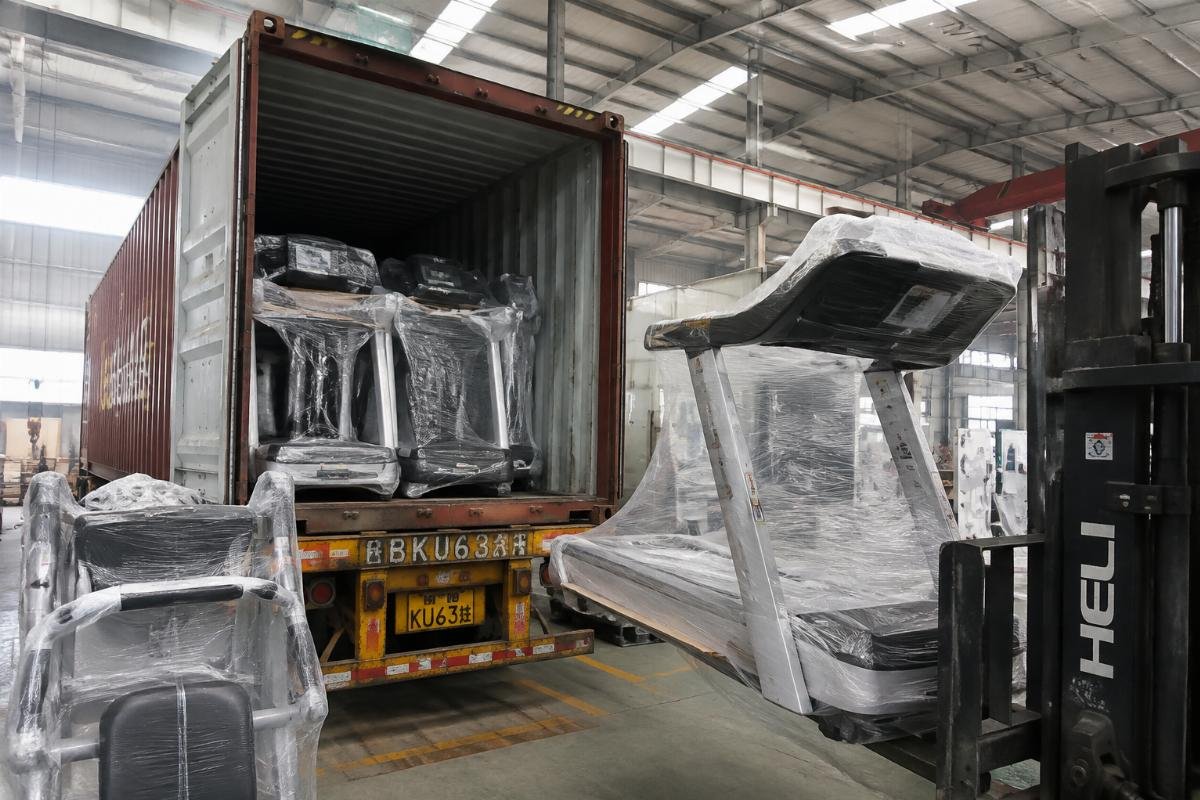
Start with ocean freight. A 40HQ container rate fluctuates significantly by season and route. More importantly, the freight cost per unit changes dramatically depending on how efficiently you load the container. A container filled with only treadmills — bulky, heavy, and hard to stack — will carry far fewer sellable units than a mixed load that nests flat-pack strength frames, stacks free weights densely, and fills void spaces with accessories. The per-unit freight savings from intelligent mixed loading can be substantial.
Then comes customs duty. Duty rates vary by destination country and by equipment classification. Some markets apply higher tariffs on complete assembled machines than on knock-down kits. A fitness equipment import business that structures its shipment as partially disassembled can legally reduce duty exposure — but only if the supplier can pack and label accordingly.
Last-mile delivery is another hidden layer. A container arriving at a port does not automatically reach a gym floor. Internal transport, unloading equipment, and floor installation all add cost. Heavy plate-loaded machines and full weight stacks may require specialized handling that the buyer has not budgeted for.
And then there is the spare-parts buffer — the line item that almost every new importer skips, and almost every experienced importer swears by. Cables, pulleys, adjustment pins, upholstery patches, and console components wear out in the field. If you do not ship a spare-parts package with the initial container, a single cable failure can turn into weeks of machine downtime while a replacement crosses international borders. The cost of stocking wear parts locally is a fraction of the cost of a single extended downtime incident.
| Cost Layer | Typical Range | Optimization Lever |
|---|---|---|
| FOB Unit Price | Base | Negotiate on volume, not single-unit |
| Ocean Freight | Varies by route and season | Mixed-container loading efficiency |
| Customs Duty | Varies by HS code and country | Knock-down vs. assembled classification |
| Last-Mile Delivery | Often underestimated | Pre-arrange local handling |
| Spare-Parts Buffer | Small percentage of total | Ship with initial container |
| After-Sales Reserve | Critical for warranty claims | Negotiate supplier co-funding |
A distributor in East Asia learned this the hard way. He negotiated an aggressive FOB price, saved noticeably on per-unit cost, and then discovered that the duty classification for his market added a significant percentage on top — and that the supplier’s standard packing was fully assembled, triggering the higher duty rate. The "savings" on FOB were more than wiped out. The fitness equipment import business is a margin business, and margins are protected in the details.
How Do You Set Up After-Sales Support Before Your First Shipment Arrives?
Negotiate spare-parts packages, warranty claim procedures, and technical documentation at the order stage — not after the container lands — because after-sales in the fitness equipment import business is the buyer’s responsibility, not the supplier’s.
Most new distributors assume that after-sales is the supplier’s problem. This assumption collapses the moment the first machine fails in the field and the supplier is eight time zones away, responding to emails once a day. A cable replacement that should take two days can stretch into weeks if the replacement part has to be shipped internationally, cleared through customs, and delivered to a gym that has already lost member trust. [NEED_CITE: after-sales support framework for imported commercial fitness equipment]
The solution is to front-load after-sales planning into the order itself.
First, negotiate a spare-parts package as a line item in the purchase order. This package should include the wear components most likely to fail in the first year: cables, pulleys, adjustment pins, seat sliders, upholstery patches, and any electronic components specific to the console. The cost of this package is a small fraction of the total order, but it transforms your ability to respond to field issues from weeks to hours.
Second, agree on a written warranty claim procedure before production starts. Define what qualifies as a warranty claim versus normal wear, what documentation the buyer must provide (photos, video, serial numbers), what the supplier’s response timeline is, and how replacement parts or credit will be issued. Without this agreement in writing, every claim becomes a negotiation — and negotiations across time zones and languages are slow, frustrating, and relationship-damaging.
Third, secure technical documentation in advance. This includes assembly manuals, wiring diagrams, exploded parts drawings, and troubleshooting guides — ideally in the language of your end market. When a gym technician in a new market needs to diagnose a console fault or replace a cable routing, having clear documentation on hand is the difference between a quick fix and a stranded machine.
A buyer in North Africa shared a situation that illustrates this perfectly. His first container arrived without a spare-parts package, because he had assumed the supplier would ship replacements on demand. When a selectorized machine’s cable frayed within the first month, he contacted the supplier, who confirmed the replacement would ship within days. "Days" turned into weeks, because the replacement had to be produced, inspected, consolidated with other outgoing shipments, and then cleared through customs at the destination. The machine sat idle for an extended period, and the gym owner demanded a credit. The buyer ended up paying for a local cable fabrication that cost several times what a pre-shipped spare would have cost.
| After-Sales Element | When to Arrange | Risk of Delay |
|---|---|---|
| Spare-Parts Package | At order stage | Weeks of machine downtime |
| Warranty Claim Procedure | Before production | Disputed claims, relationship damage |
| Technical Documentation | With first shipment | Delayed field repairs |
| Local Technician Training | Before or with delivery | Misdiagnosis, repeated failures |
The fitness equipment import business is not just about moving boxes across borders. It is about building a local service capability that keeps equipment running — and that capability starts with the order, not with the first breakdown.
Conclusion
A successful fitness equipment import business is built on spec-level diligence, not price-level optimism. Match your product mix to your end-user segment, verify suppliers through physical evidence rather than platform badges, compare specs on the dimensions that actually cause failures, model the full landed cost instead of fixating on FOB, and embed after-sales planning into the very first order. The suppliers who can support you across all five dimensions — like Bick, with its OEM/ODM flexibility, commercial-grade construction, CE certification, and container-load consolidation capability — become long-term partners, not just vendors. The ones who cannot will cost you far more than their initial price advantage ever saved.