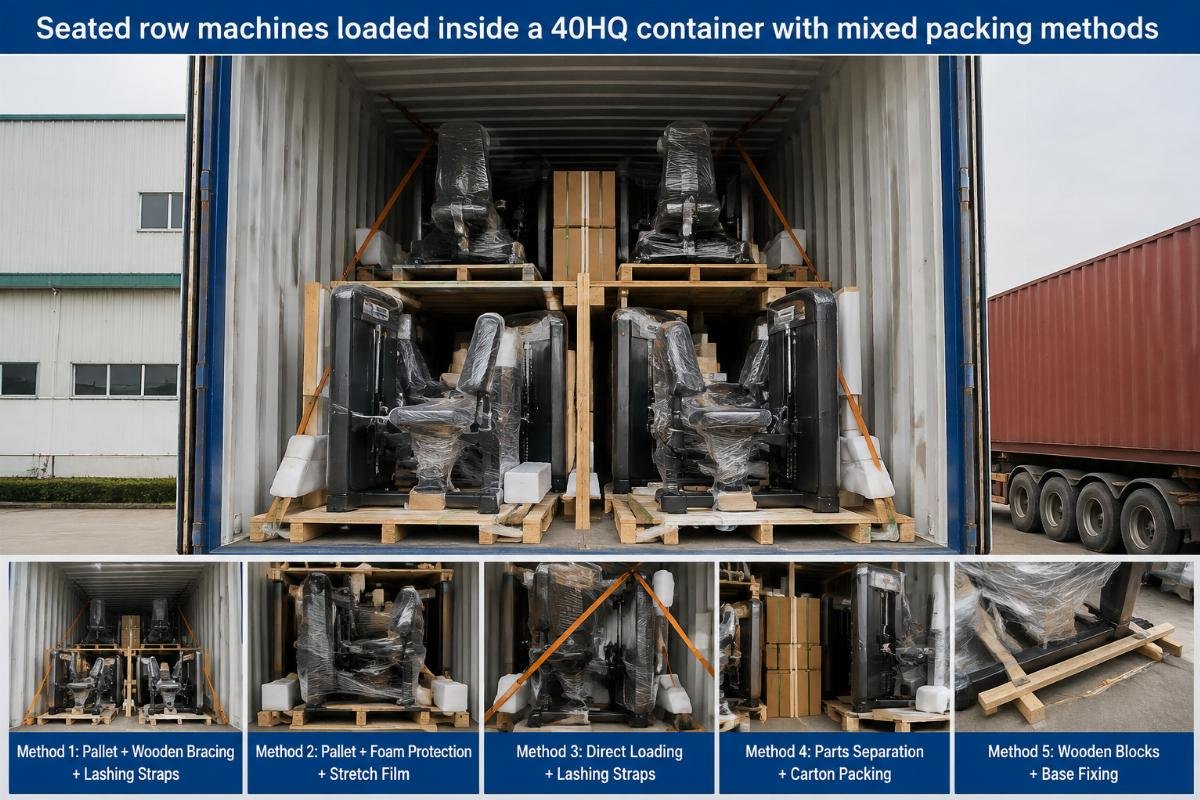
Leg Press Machine Bulk Order Container Loading Config from Bick Manufacturer
Fully assembled leg press machines are a freight cost trap.
Maximizing container loading configuration for leg press machine bulk orders requires shifting from assembled shipping to optimized knock-down (KD) protocols, strict volumetric weight balancing, and destination-specific customs labeling to prevent demurrage charges that can exceed the product value.
The smell of salt and diesel at Qingdao Port is distinct, but the silence of a stalled container yard is deafening. I learned this not from a textbook, but from watching a forty-foot high cube container sit idle in Lagos for over a month. The cargo inside was pristine commercial strength equipment, including several heavy-duty leg press units. The paperwork was flawless: bill of lading, certificate of origin, and packing lists all matched. The failure was invisible to the naked eye until the local customs officer pointed to a missing warning label on the packaging, mandated by regional safety regulations. The resulting demurrage fees accumulated daily, eventually surpassing the profit margin of the entire shipment. This incident reshaped my approach to export logistics. It is not enough to manufacture robust equipment; one must engineer the logistics chain with the same precision as the steel frames themselves. [NEED_CITE: common causes of customs delays in West African ports]
Understanding the mechanics of freight costs reveals why packing density dictates true profitability. Many buyers focus intensely on the FOB unit price, negotiating every dollar off the ex-works cost, while overlooking the landed cost per unit. If a container holds fewer units due to inefficient packing, the freight cost allocated to each machine skyrockets. This is where the concept of container loading configuration for leg press machine becomes critical. It is not merely about stacking boxes; it is about solving a three-dimensional puzzle where every cubic meter counts.
Why Does Packing Density Matter More Than Unit Price?
Freight cost per unit is the hidden variable that determines final profitability in bulk imports.
When importing heavy strength equipment, the actual weight often hits the container limit before the volume does. However, with complex shapes like leg press frames, wasted air space is the primary enemy. A standard 40ft high cube container has a fixed internal volume. If you ship fully assembled units, you are essentially paying to ship air. The structural geometry of a leg press, with its angled sled rails and bulky seat assemblies, creates unavoidable voids when stacked traditionally.
Consider the difference between shipping assembled versus KD. In an assembled state, the footprint of a single leg press machine is large and irregular. By disassembling the main frame, separating the weight horns, and flattening the seat backrests, the volumetric footprint shrinks dramatically. This allows for a nesting effect, where smaller components fill the gaps created by the main frames. [NEED_CITE: impact of KD packing on container utilization rates for fitness equipment]
| Packing Method | Space Efficiency | Damage Risk | Customs Complexity |
|---|---|---|---|
| Fully Assembled | Low | High | Low |
| Partially Disassembled | Medium | Medium | Medium |
| Optimized KD | High | Low (if packed correctly) | High (requires detailed PL) |
The table above illustrates the trade-offs. While fully assembled units simplify installation at the destination, they drastically reduce the number of units per container. For a regional distributor ordering a full container load, this inefficiency translates to a significantly higher cost per unit once freight is amortized. The goal is to achieve a balance where the savings in freight outweigh the labor cost of assembly at the destination. This is the core principle behind effective container loading configuration for leg press machine planning.
How to Maximize Units Per Container?
Strategic disassembly and nesting techniques can increase container capacity by a significant factor compared to standard shipping methods.
To maximize the number of units, one must treat the leg press not as a single object, but as a set of modular components. The main frame, typically the heaviest and bulkiest part, should be packed flat. The sled assembly, which carries the user’s weight, can often be detached and placed alongside or within the hollow sections of the main frame if designed appropriately. Weight horns and selector pins are small, dense items that should be boxed separately and used to fill voids in the corner posts of the container or between the main frames.
At our manufacturing facilities, we have refined the KD design specifically for export. The frame tubes are engineered to nest within each other, reducing the overall width of the packed bundle. This design choice allows for a tighter fit within the container walls, minimizing the lateral shift during transit. [NEED_CITE: engineering principles for nesting strength equipment frames]
The process involves several key steps:
- Frame Flattening: Remove all protruding elements like weight horns and seat adjustments.
- Component Grouping: Box all small hardware, bolts, and pins into a single, dense crate per machine or per batch.
- Layering: Place the heaviest frames on the bottom layer, ensuring even weight distribution across the container floor.
- Void Filling: Use the boxed accessories and lighter components to fill the triangular gaps created by the angled frames.
This method requires precise coordination between the production line and the loading team. Each box must be labeled clearly to facilitate easy identification during unloading and assembly. When executed correctly, this approach optimizes the container loading configuration for leg press machine shipments, allowing distributors to move more inventory in a single trip. This efficiency is a key advantage for buyers looking to minimize their carbon footprint and freight expenditure simultaneously.
What Are the Hidden Customs Risks in Strength Equipment?
Incomplete documentation and non-compliant labeling are the primary causes of costly clearance delays.
Customs clearance is not a uniform process globally. Each destination country has specific requirements for imported machinery, particularly those intended for public use like gym equipment. A common oversight is the assumption that a CE certificate or ISO standard is sufficient for all markets. In reality, local regulations may require specific warning labels in the local language, material declarations, or even pre-import permits.
The case in Lagos mentioned earlier is a prime example. The absence of a specific safety warning label, required by local consumer protection laws, led to a prolonged hold. The cost of storing the container, plus the daily demurrage fees charged by the port authority, eroded the entire profit margin. [NEED_CITE: examples of labeling requirements for fitness equipment in emerging markets]
To mitigate these risks, buyers must verify the following before shipment:
- Labeling Compliance: Ensure all safety warnings and instructional decals meet the linguistic and regulatory standards of the destination country.
- HS Code Accuracy: Verify that the Harmonized System code used on the commercial invoice matches the local classification for strength training equipment. Misclassification can lead to unexpected duties or penalties.
- Material Declaration: Some countries require detailed declarations of the materials used, especially for steel and plastic components, to assess environmental or safety compliance.
These details must be integrated into the packing list and commercial invoice. A discrepancy between the physical goods and the documentation is a red flag for customs officers. By addressing these requirements proactively, buyers can ensure a smoother clearance process. This attention to detail is part of a comprehensive container loading configuration for leg press machine strategy, extending beyond physical packing to include regulatory compliance.
How to Consolidate Mixed Orders Safely?
Combining heavy machines with lighter accessories requires careful weight distribution to prevent damage during transit.
Many buyers opt to consolidate their orders, mixing heavy strength machines like leg presses with lighter items such as yoga mats, resistance bands, or dumbbells. This strategy can improve container utilization by filling the remaining voids after the heavy equipment is loaded. However, it introduces new risks if not managed properly.
Heavy items must always be secured at the bottom of the container to maintain a low center of gravity. Lighter, softer items like mats and foam rollers can be used to cushion heavier metal parts, but they should not be relied upon for structural support. If heavy boxes are placed on top of lightweight accessories, the latter will compress, leading to potential damage to both the accessories and the stability of the stack. [NEED_CITE: best practices for mixed cargo stowage in shipping containers]
A successful consolidation plan involves:
- Base Layer: Load all heavy leg press frames and main structures first, securing them to the container floor if necessary.
- Intermediate Layer: Place medium-weight items like weight plates and dumbbell sets on top of or between the frames, ensuring they are tightly packed to prevent shifting.
- Top Layer: Use lightweight, compressible items like mats and accessories to fill the remaining space at the top. These items can act as a buffer against the container roof.
This layered approach ensures that the weight is distributed evenly and that fragile items are protected. It also maximizes the use of every cubic meter of space. For distributors, this means they can offer a wider range of products to their clients without incurring the cost of additional shipments. Effective consolidation is a hallmark of advanced container loading configuration for leg press machine logistics, demonstrating a holistic approach to supply chain management.
Conclusion
Efficient logistics is as critical as product quality in international fitness equipment trade.
Mastering the container loading configuration for leg press machine shipments transforms freight from a cost center into a competitive advantage. By adopting KD packing, adhering to strict customs compliance, and strategically consolidating mixed orders, buyers can significantly reduce their landed costs. The goal is not just to move goods, but to move them intelligently, ensuring that every cubic meter of space contributes to the bottom line. This disciplined approach minimizes risk, avoids hidden fees, and ensures that equipment arrives ready for immediate installation and use.