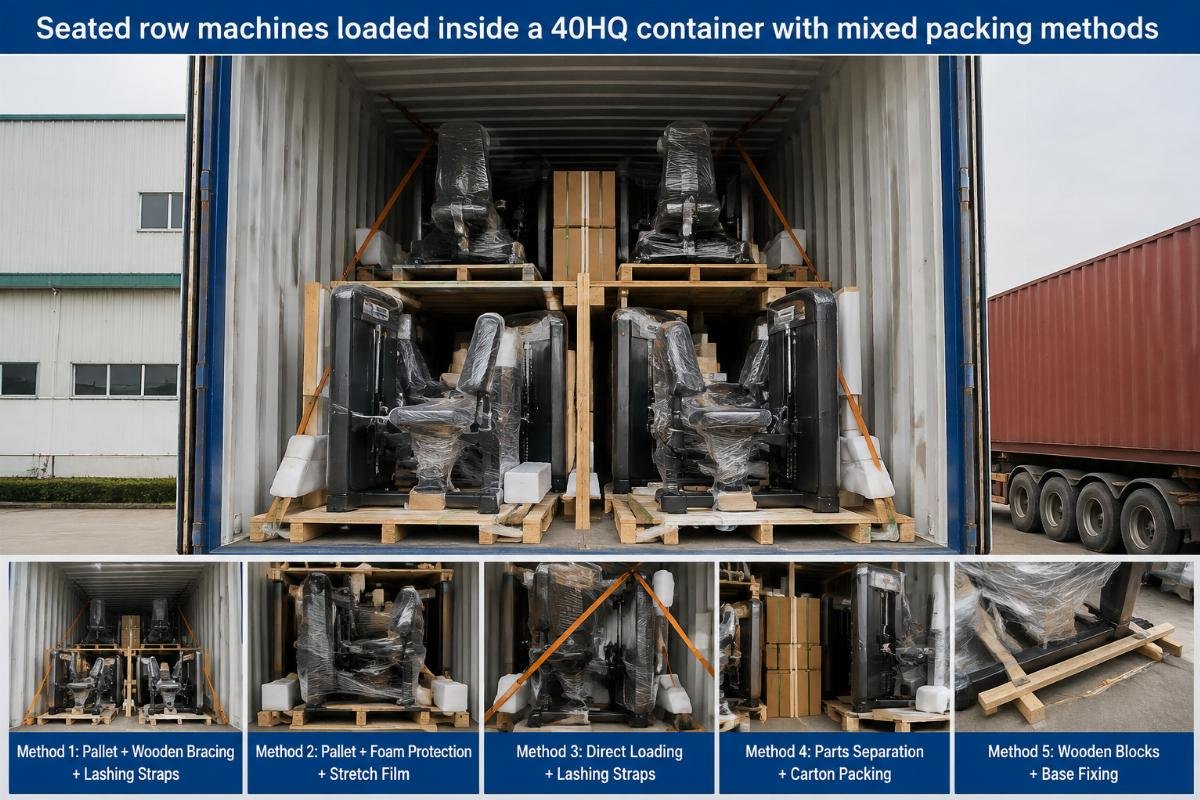

Foam Roller Pack Bulk Orders | OEM Container Loading Supplier
Maximizing cubic meters does not guarantee the lowest shipping cost per unit.
A standard 40HQ container typically achieves an 85–92% usable volume fill rate for cylindrical foam roller packs, but actual loading capacity depends entirely on carton nesting geometry, mixed-density weight distribution, and destination port customs classification of packaging materials—not just raw CBM calculations. [NEED_CITE: ISO 668 series container internal dimension specifications and usable volume benchmarks]
I learned this the hard way. Years ago, I was overseeing a full-container shipment of mixed-density foam roller sets—EVA and EPP cores bundled together—for a gym chain in the Middle East. The loading plan looked perfect on paper: cartons stacked tight, CBM utilization near the upper benchmark. But when the container hit the port weighbridge at destination, it was flagged for weight imbalance. The heavy EPP units had been clustered on one side during loading, causing a shift that triggered repacking at the terminal. The demurrage and rehandling fees ended up costing several times what was saved on freight. That was the moment I stopped treating container loading as a packing puzzle and started treating it as a pre-shipment engineering task.
From that point forward, every bulk order I handle starts with a loading configuration review before a single carton is sealed. What follows is a breakdown of the key factors that determine whether a foam roller container loading plan succeeds or becomes an expensive lesson.
How Many Foam Roller Packs Fit in a 40HQ Container?
The answer is never a fixed number—it is a range shaped by carton dimensions, nesting method, and the usable volume benchmark of the container itself.
A 40HQ container offers a theoretical internal volume of approximately 76 CBM, but the practical loading rate for cylindrical product packaging rarely exceeds the low 90s percentile. [NEED_CITE: standard 40HQ internal dimensions and usable volume per ISO container specifications] The reason is straightforward: foam roller cartons are rectangular, but the product inside is cylindrical. This creates unavoidable void space unless cartons are specifically dimensioned to nest without gaps.
For a typical bulk order, the loading capacity breaks down as follows:
| Factor | Impact on Loading Rate |
|---|---|
| Carton outer dimensions relative to container floor grid | Determines whether cartons interlock or leave aisle gaps |
| Nesting method (straight stack vs. interlocked column) | Interlocked columns reduce void space noticeably |
| Palletized vs. floor-loaded | Floor loading achieves substantially higher CBM utilization |
| Mixed pack sizes in one container | Reduces effective fill rate unless pre-planned |
A Southeast Asian importer I worked with initially assumed that maximizing CBM meant filling every cubic centimeter. The first trial order was floor-loaded to the brim. But because the cartons varied in height by a few centimeters across different foam roller SKUs, the top layer was unstable. During transit, vibration caused partial collapse of the upper tiers, damaging several boxes. The repeat order used a pre-calculated loading plan that left a controlled gap at the top, secured with inflatable dunnage. Damage dropped to zero, and the effective fill rate only decreased marginally.
The takeaway: a foam roller container loading plan must treat the container as a three-dimensional grid, not a volume bucket. [NEED_CITE: container loading optimization methods for cylindrical packaged goods]
What Loading Pattern Works Best for Mixed-Density Foam Rollers?
Alternating heavy and light columns across the container floor prevents weight-shift claims and avoids port weighbridge rejection.
Foam rollers come in different core densities—EVA is relatively light, while EPP is noticeably heavier. When a bulk order includes both types, the temptation is to load all EPP cartons on one side and EVA on the other for simplicity. This is a mistake. Concentrated weight on one side of a container creates a lateral center-of-gravity offset that triggers inspection flags at multiple ports.
The correct approach is a checkerboard or interleaved column pattern:
- Step 1: Map all carton weights before loading begins. Separate EPP-dominant cartons from EVA-dominant cartons into two staging groups.
- Step 2: Assign alternating columns from the container door to the bulkhead. Each column should contain a mix of heavy and light cartons stacked vertically.
- Step 3: Verify the loaded weight distribution against the container’s maximum payload rating and the destination port’s axle weight limits. [NEED_CITE: port authority weight-limit regulations for loaded shipping containers]
An African distributor’s first trial order was loaded with all heavy-density rollers placed near the door for easy unloading. The container was rejected at the destination weighbridge because the rear axle load exceeded the local limit. The entire container had to be stripped and reloaded at the terminal—a process that took extended service time and cost a mid-five-figure sum in penalties. The second order used a pre-drawn weight distribution map, and the container cleared the weighbridge without issue. Loading time was also reduced noticeably because the crew followed a marked floor plan.
Which Packaging Materials Trigger Customs Delays?
Buffer air columns and certain shrink-wrap films inside foam roller packs may be classified differently at destination ports, causing holds and re-inspection.
Most buyers assume foam rollers are general cargo with no classification complications. This assumption is risky. The packaging materials used to protect foam rollers during transit—particularly inflatable air-column cushions and multi-layer shrink films—can fall under different HS code categories depending on the destination country’s customs interpretation. [NEED_CITE: WCO HS code classification guidelines for plastic packaging materials used in fitness product shipments]
I have seen shipments held at port for extended periods because the air-column cushions inside the foam roller cartons were flagged for additional screening. In one case, a customs authority at the destination port reclassified the air columns as a separate commodity, requiring a revised packing list and a supplementary declaration. The delay added weeks to the delivery timeline and incurred storage fees that far exceeded the value of the packaging materials themselves.
To prevent this, the following pre-shipment checks are essential:
- Confirm the HS code for every packaging component, not just the foam roller itself. Air-column cushions, EPE foam inserts, and shrink-wrap each carry separate classification requirements in many jurisdictions.
- Request the destination broker’s classification opinion before shipment. A brief email exchange can prevent a multi-week hold.
- Declare packaging materials explicitly on the commercial invoice and packing list. Vague descriptions like "protective packaging" invite scrutiny.
A European buyer once received a foam roller container where the air columns were not declared separately. The local customs office treated the entire shipment as requiring dangerous-goods screening because the air columns contained compressed gas residue from the inflation process. The screening process took weeks, and the buyer had to provide material safety data sheets for the packaging—documents that should have been prepared before the container left the origin port.
How to Prepare a Loading Plan for OEM Bulk Orders?
A structured three-step pre-shipment checklist—carton dimension mapping, weight distribution planning, and destination port declaration review—eliminates the majority of loading and clearance failures.
This is where the foam roller container loading process transitions from reactive problem-solving to proactive planning. Every OEM bulk order should pass through the following sequence before any carton is sealed:
Step 1: Carton Dimension and Nesting Analysis
- Record the outer dimensions of every carton SKU in the order.
- Model the container floor as a grid and test nesting configurations—straight stack, interlocked column, and hybrid patterns.
- Select the configuration that achieves the highest stable fill rate without exceeding the container’s height clearance. [NEED_CITE: container loading optimization methods for rectangular carton nesting]
Step 2: Weight Distribution Mapping
- Weigh each carton or calculate unit weight from product specifications.
- Assign cartons to container positions using the alternating column method described above.
- Cross-check total loaded weight against the container’s max payload and the destination port’s axle weight regulations.
Step 3: Destination Port Declaration Review
- Confirm HS codes for the foam roller product and all packaging components with the destination customs broker.
- Prepare a customs-ready packing list that itemizes every material type, including air columns, shrink films, and cardboard dividers.
- Verify whether the destination country requires any pre-shipment certification or testing reports for fitness accessories or plastic packaging.
A Middle East gym chain’s repeat order went through this three-step process for the first time. The loading plan was finalized two weeks before production ended, and all documentation was pre-approved by the destination broker. When the container arrived, it cleared customs within days—compared to the weeks-long process on their first order. The buyer later confirmed that the total landed cost per unit dropped substantially, not because freight rates changed, but because demurrage and rehandling fees were eliminated entirely.
Conclusion
Foam roller container loading is a pre-shipment engineering discipline, not a post-production afterthought. Proper CBM utilization, weight distribution planning, and packaging material classification together determine whether a bulk order arrives on time and on budget. Buyers who invest in a structured loading configuration review before production completes consistently avoid the port delays, rehandling costs, and customs holds that plague poorly planned shipments.