Commercial Elliptical Pre-Shipment Inspection OEM Supplier
Most buyers think a pre-shipment inspection is about plugging in the machine and pedaling. It is not. It is about whether that elliptical will survive ten thousand hours on a high-traffic gym floor and still pass the eye test of a paying member walking in for the first time.
A proper commercial elliptical pre-shipment inspection covers four zones — structural welding integrity, drivetrain function, electronic module reliability, and cosmetic plus packaging finish — using AQL General Inspection Level II sampling against ISO 20957 frameworks. Functional testing is only one slice; cosmetic and packaging defects actually trigger the majority of port-side rejections in commercial fitness equipment claims. [NEED_CITE: defect category distribution in commercial fitness equipment import claims]
I remember standing on a trade show floor in Chicago, watching a Texas gym chain procurement director run his thumb along the flywheel shroud of a newly arrived elliptical. He did not care that the machine pedaled smoothly. He cared that the powder coat had a visible orange-peel texture and the seam where the upright met the base showed a hairline gap. That entire container was rejected. Not because the machine failed — because the finish failed. Years earlier, my mentor walked me through a similar situation at a Las Vegas expo: a full container of ellipticals got turned away at the destination port because the pedal grip groove depth fell outside tolerance by a fraction of a millimeter. The rework cycle and freight loss ate into margins so deeply that the buyer nearly walked away from the supplier relationship entirely.
These are not edge cases. They are the daily reality of importing commercial-grade cardio equipment at scale.
Let me break down what a real commercial elliptical pre-shipment inspection actually looks like, where the hidden risks sit, and how to structure your purchasing terms so you are not left holding a container of unsellable machines.
What Does a Commercial Elliptical Pre-Shipment Inspection Actually Cover?
A comprehensive commercial elliptical pre-shipment inspection goes far beyond turning the machine on and pedaling for thirty seconds — it systematically evaluates four distinct zones: structural welds, drivetrain components, electronic modules, and cosmetic plus packaging quality. [NEED_CITE: inspection zone breakdown per ISO 20957 framework for stationary fitness equipment]
Zone One — Structural Welding Integrity. The load-bearing frame of a commercial elliptical endures repetitive dynamic stress. Inspectors check weld penetration depth, slag inclusion, and crack formation at critical junctions — particularly where the upright column meets the base frame and where the rear roller arm mounts. Visual inspection is the baseline; for high-volume orders, magnetic particle or ultrasonic testing on a sampled percentage of welds provides deeper assurance. A weld that looks acceptable to the naked eye may harbor subsurface porosity that propagates into a structural failure after months of gym-floor use.
Zone Two — Drivetrain Function. This covers the flywheel assembly, belt or chain drive tension, bearing smoothness, and pedal arm linkage. Inspectors rotate the flywheel by hand to detect bearing grit or axial play, then run the machine under load to assess belt tracking and resistance mechanism consistency across the full range. The pedal stride path must be evaluated for lateral wobble — a defect that only manifests after extended use but can be detected early through careful measurement of arm pivot alignment.
Zone Three — Electronic Modules. Heart rate sensors, console displays, resistance control boards, and connectivity modules are tested for basic function, but the deeper concern is batch-level consistency. A single defective console is a warranty claim. A batch of consoles with soldering cold-joints that fail after weeks of operation is a recall-level event. Inspectors verify firmware version consistency across units, test sensor contact responsiveness under simulated sweat conditions, and check wire harness routing for pinch points that could cause intermittent shorts.
Zone Four — Cosmetic and Packaging Finish. This is where the majority of commercial buyer complaints originate. Powder coat thickness uniformity, surface texture consistency, decal alignment, pedal grip groove depth, and foam handle coverage all fall under scrutiny. Packaging inspection verifies that internal foam inserts properly immobilize the machine, that carton burst strength meets ocean freight requirements, and that corner protection is adequately sized. A machine that arrives with a chipped shroud because the inner foam was two millimeters too thin is a machine that never reaches the gym floor.
Which Defects Most Commonly Cause Rejection at Port?
Cosmetic and packaging defects outnumber mechanical failures in commercial elliptical rejection claims — buyers systematically over-index on functional testing and under-index on finish quality during inspection planning. [NEED_CITE: root cause analysis of fitness equipment import rejection at destination ports]
A Middle East distributor once received a full container of ellipticals that had passed functional testing at the factory. Every machine pedaled. Every console lit up. But when the units were unpacked at the destination warehouse, the flywheel shroud welds showed micro-cracking visible only under close inspection. The cracking had not been present during factory testing — it had propagated during ocean transit due to inadequate internal packaging restraint allowing the shroud to vibrate against adjacent frame members. The索赔 and replacement logistics cost multiples of what a proper pre-shipment packaging audit would have required.
The defect hierarchy in commercial elliptical rejections typically follows this pattern:
Critical defects — structural weld failures, frame cracking, load-bearing component fractures — are rare at the factory gate but catastrophic when they occur. These trigger immediate container holds and full-batch inspection demands.
Major defects — pedal grip groove depth out of tolerance, powder coat peeling or visible orange-peel texture, console display dead pixels or sensor failure, belt misalignment causing audible noise under load — are the most common rejection triggers. A single major defect on a display unit can cascade into a demand for full-batch sorting at the buyer’s expense unless the inspection protocol was contractually clear.
Minor defects — cosmetic scratches on non-visible surfaces, slight decal misalignment, carton printing errors — are typically accepted with negotiated discounts rather than triggering outright rejection. However, cumulative minor defects on a single unit can escalate it to major status depending on the buyer’s tolerance threshold.
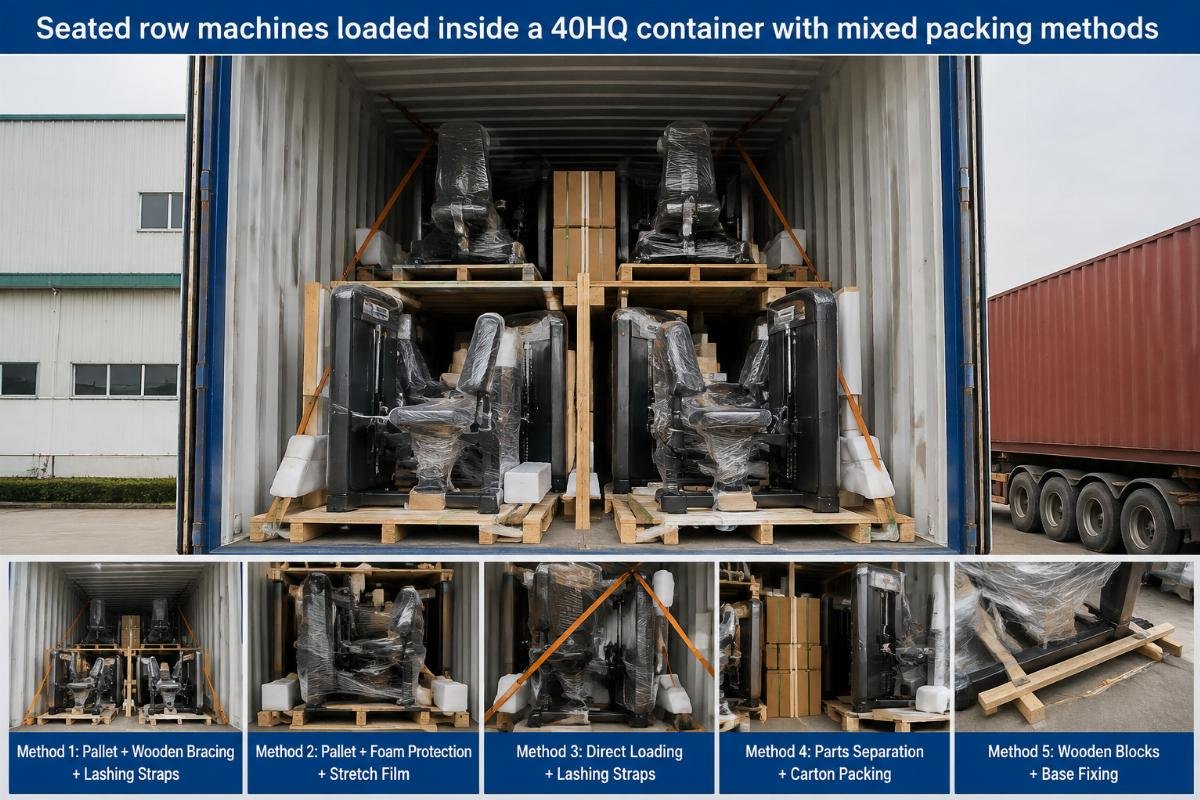
The packaging dimension deserves particular emphasis. Ocean freight subjects containers to sustained vibration, temperature cycling, and humidity exposure. Packaging that holds a machine securely in a warehouse environment may fail completely in a maritime container. Inspectors must verify that foam density and geometry are appropriate for the specific shipping route — a container going to West Africa faces different thermal and humidity conditions than one going to Northern Europe, and the packaging specification should reflect this.
When Should You Schedule the Inspection — Mid-Production or Pre-Shipment?
For first-time orders or newly developed SKUs, a mid-production inspection catches process drift before the full batch is completed; for repeat orders of proven designs, a pre-shipment inspection at full production completion is typically sufficient. [NEED_CITE: inspection timing effectiveness comparison for fitness equipment manufacturing quality control]
The logic is straightforward. On a first production run, the factory is still dialing in fixture alignment, operator familiarity with the assembly sequence, and incoming material consistency. A mid-production inspection — conducted when production is substantially underway but before the full batch is assembled — allows the inspector to identify systemic issues while there is still time to correct them without dismantling finished units. If the pedal arm pivot holes are being drilled slightly off-center due to a fixture wear issue, catching this at mid-production means the remaining units can be corrected. Catching it at final inspection means every unit needs rework or the buyer accepts a batch of non-conforming product.
For repeat orders where the production process has been validated, the risk profile shifts. The factory has demonstrated process capability, and the primary concerns become material batch variation and assembly consistency rather than fundamental process errors. A pre-shipment inspection at full completion provides adequate coverage.
As a commercial fitness equipment manufacturer based in Shandong, we run a standardized pre-shipment inspection protocol on every batch of ellipticals before container loading. The process covers structural welding, drivetrain assembly, electronic module function, and packaging integrity across all four inspection zones. We support buyer-designated third-party inspection agencies and provide complete factory inspection reports alongside CE documentation packages. The goal is simple: every container that leaves our facility should be ready to go directly from the port to the gym floor without intermediate sorting or rework.
The timing decision also interacts with production scheduling. A mid-production inspection requires the factory to pause and present partially completed units, which can disrupt assembly line flow if not scheduled in advance. A pre-shipment inspection occurs after production is complete, so the factory can present finished, packaged units ready for immediate container loading upon inspection approval. Buyers should confirm inspection timing expectations in the purchase contract to avoid scheduling conflicts.
How Do You Write Inspection Terms into Your Purchase Contract?
Inspection acceptance criteria, AQL sampling levels, and re-inspection cost allocation must be contractually defined in writing — verbal agreements on quality standards are unenforceable when disputes arise at the destination port. [NEED_CITE: contractual inspection clause requirements for international fitness equipment procurement]
The contract should specify several elements with precision:
AQL sampling level. General Inspection Level II is the standard starting point for commercial fitness equipment, with acceptable quality levels defined separately for critical, major, and minor defects. Typical thresholds are zero critical defects, a low percentage tolerance for major defects, and a slightly higher tolerance for minor defects — but these numbers must be explicitly stated in the contract, not assumed.
Inspection timing and notification. The contract should define when the buyer or their designated inspector will conduct the inspection, how much advance notice the factory requires, and what happens if the inspection is delayed. A common clause requires the factory to notify the buyer when production reaches the inspection-ready threshold, with a defined window for the buyer to schedule the inspection before the goods are released for shipment.
Re-inspection cost allocation. If the initial inspection fails, who pays for the re-inspection after the factory completes corrective action? This should be explicitly assigned. Typically, if the failure is due to factory non-conformance, the factory bears re-inspection costs and any resulting shipment delays. If the buyer changes specifications after the initial inspection, the buyer bears these costs.
Defect classification and disposition. The contract should define what constitutes a critical, major, or minor defect for the specific product, and what disposition is required for each — immediate rejection and full-batch hold for critical defects, negotiated discount or selective rework for major defects, and acceptance with documentation for minor defects. Without this clarity, a buyer may reject an entire container over a handful of minor cosmetic issues that the factory considers acceptable, leading to disputes that delay shipment and damage the business relationship.
Documentation requirements. The contract should specify which documents the factory must provide before shipment — CE test reports, material certificates for load-bearing welds, electronic component batch traceability records, and factory inspection reports. These documents serve as the evidentiary baseline if quality disputes arise after the goods reach the destination.
What Documents Should the Factory Provide Before Shipment?
CE test reports, material certificates for load-bearing welds, and electronic component batch traceability records form the minimum documentation package for commercial elliptical shipments entering regulated markets. [NEED_CITE: mandatory documentation requirements for fitness equipment import compliance in EU and international markets]
The CE documentation package should include test reports from an accredited laboratory demonstrating compliance with the relevant harmonized standards under the Machinery Directive. For commercial ellipticals, this covers mechanical safety, electrical safety for powered resistance and console systems, and electromagnetic compatibility. The test reports must reference the specific product model and configuration being shipped — a generic CE certificate that does not match the shipped product provides no compliance protection.
Material certificates for load-bearing welds provide traceability from the raw steel through the welding process. These certificates should specify the steel grade, the welding procedure specification, and the qualification status of the welding operators. For commercial fitness equipment destined for high-usage environments, this documentation supports the buyer’s liability protection and insurance requirements.
Electronic component batch traceability allows the buyer to identify which production batch a specific console, sensor, or control board came from. If a batch-level electronic defect emerges after shipment — such as a capacitor lot with reduced thermal endurance causing console failures after months of operation — the traceability records enable targeted replacement rather than blanket console swaps across the entire installed base.
Additional documentation that sophisticated buyers increasingly request includes powder coat adhesion test reports, bearing supplier certificates of conformance, and belt or chain drive material specifications. While not always legally mandatory, these documents support the buyer’s quality assurance processes and provide a basis for warranty claim validation if field failures occur.
Conclusion
A commercial elliptical pre-shipment inspection is a structured quality gate covering structural, functional, electronic, and cosmetic dimensions — not a simple power-on test. Buyers who invest in properly specified inspection protocols, contractually defined acceptance criteria, and complete documentation packages consistently receive containers that go straight from port to gym floor. Those who leave inspection terms to verbal assumptions or focus exclusively on mechanical function discover the gap between functional and acceptable only after the goods have crossed an ocean.