Container Consolidation for Bumper Plate Set with Other SKUs | Wholesale Supplier
Filling a container by volume alone is the fastest way to get it rejected at the port. When bumper plates share a box with treadmills or racks, the real constraint is not cubic meters — it is weight balance, HS code alignment, and loading sequence. Get any one of these wrong, and the container either gets turned away at the gate or held up for days of re-stuffing.
The short answer: container consolidation for bumper plates with mixed SKUs requires pre-calculated weight distribution across the container floor, separate HS code declarations for free-weight items versus machines, and a strict bottom-heavy, center-aligned loading plan. Skipping this planning stage is what triggers port rejections, customs delays, and costly rework.
I still remember a 40HQ we prepared for a gym project in the Middle East. The order included several tons of rubber-coated plates alongside Smith machine frames and a batch of spin bikes. On paper, the volume fit perfectly. But when the packed container reached the terminal gate, the weighbridge flagged an uneven axle load. The terminal operator refused entry until the container was stripped and reloaded with corrected weight distribution. The delay cost the client dearly in demurrage and re-handling fees — all because the loading plan treated the container as a volume puzzle instead of a weight puzzle. [NEED_CITE: container weight distribution standards per ISO 17363]
That kind of miss is avoidable. Below is how we now approach every mixed-SKU shipment leaving the factory floor.
Before diving into the details, it helps to understand why consolidation planning is non-negotiable for fitness equipment shipments — and what goes wrong when it is treated as an afterthought.
Why Does Weight Distribution Matter in Mixed Container Loading?
A container that is too heavy on one side or one end will be rejected at the port gate, regardless of whether the total weight is within limits. Terminal operators and shipping lines enforce strict axle-load and center-of-gravity thresholds. Bumper plates are among the densest items in any gym order — a single pallet of rubber-coated plates can weigh several times more than a pallet of resistance bands or yoga mats of the same volume.
When heavy free-weight items are loaded without a calculated plan, two problems emerge:
- Longitudinal imbalance: Too much weight toward the door end or the front end shifts the center of gravity, triggering gate rejections.
- Lateral imbalance: Uneven side-to-side weight distribution causes the container to lean, which is a safety hazard during crane handling and over-the-road transport.
A Middle East distributor once received a consolidated container where the plates were stacked exclusively on the left side, with cardio machines on the right. The container arrived with visible floor damage inside, and two treadmill cartons were crushed. The root cause was lateral imbalance combined with insufficient load-securing. [NEED_CITE: cargo securing guidelines per CTU Code of Practice]
The fix is straightforward but must be done before the forklift ever touches the first pallet:
- Map every SKU’s unit weight and total pallet weight.
- Calculate the total container payload and confirm it stays below the max gross weight minus tare weight.
- Arrange heavy items (plates, barbells, rack frames) along the center line, symmetrically left and right.
- Place lighter, bulkier items (bikes, ellipticals, flooring rolls) around and above the heavy core to fill voids without shifting the balance.
This is where container consolidation for bumper plates stops being a packing task and becomes a logistics engineering task.
How to Classify Bumper Plates and Machines for Customs Clearance?
Bumper plates and strength machines do not share the same HS code — declaring them under one heading is the most common cause of customs holds in mixed gym-equipment shipments.
Free-weight items such as bumper plates, barbells, and dumbbells are classified as articles of iron or steel, or under specific sports-equipment subheadings depending on the destination country. Strength machines — Smith machines, cable crossovers, plate-loaded stations — fall under different headings as gymnasium exercise apparatus. Cardio equipment like treadmills and ellipticals has yet another classification.
When these items are consolidated into one container, the commercial invoice and packing list must reflect each category separately. A Southeast Asian dealer learned this the hard way: their forwarder declared an entire container of mixed gym equipment under a single "fitness equipment" code to simplify paperwork. Customs flagged the shipment for inspection, reclassified the free-weight portion, and applied a higher duty rate retroactively. The resulting delay and penalty wiped out the freight savings from consolidation. [NEED_CITE: HS code classification rules for gymnasium equipment vs iron/steel articles per WCO guidelines]
To avoid this, we structure documentation in three layers:
- Detailed packing list: Each SKU listed separately with unit weight, carton dimensions, and total carton count.
- Segmented commercial invoice: Free weights, strength machines, and cardio equipment shown as separate line items with their respective HS codes.
- Weight distribution summary: A one-page diagram showing how weight is allocated across the container, useful for customs officers verifying cargo declarations against physical inspection.
For container consolidation for bumper plate sets with other SKUs, the documentation must be as carefully segmented as the physical loading plan. A single misclassified line item can hold up the entire container.
What Is the Optimal Loading Sequence for Consolidated Containers?
Load heavy first, load center first, load tight first — in that order. The sequence in which items go into the container determines whether the weight plan holds and whether the cargo survives transit without shifting.
For a typical mixed gym container — plates, racks, benches, cardio machines, and accessories — the loading sequence follows a clear hierarchy:
- Floor layer — heaviest items: Bumper plates, barbell sets, and rack frames go in first, positioned along the container’s center line and distributed evenly from front to back. These items form the stable base.
- Mid layer — medium-weight boxed items: Benches, functional trainers, and plate-loaded machines (disassembled where possible) are loaded next, filling the space around and above the floor layer.
- Upper and door-end layer — lightest and bulkiest items: Treadmills, ellipticals, spin bikes, and rolled flooring go in last. Their volume fills the remaining space without adding significant weight to the upper zones.
A South American hotel project once received a container where the loading sequence was reversed — light cardio machines went in first, and heavy plates were loaded on top. When the container reached the destination, unloading the plates required moving every machine out of the way first. The unloading time more than doubled, and two elliptical cartons were damaged during the reshuffling. [NEED_CITE: container loading best practices per ICHCA International guidelines]
Key principles we follow on the loading floor:
- No single point of concentrated weight: Even within the heavy layer, plates are spread across multiple pallet positions rather than stacked in one corner.
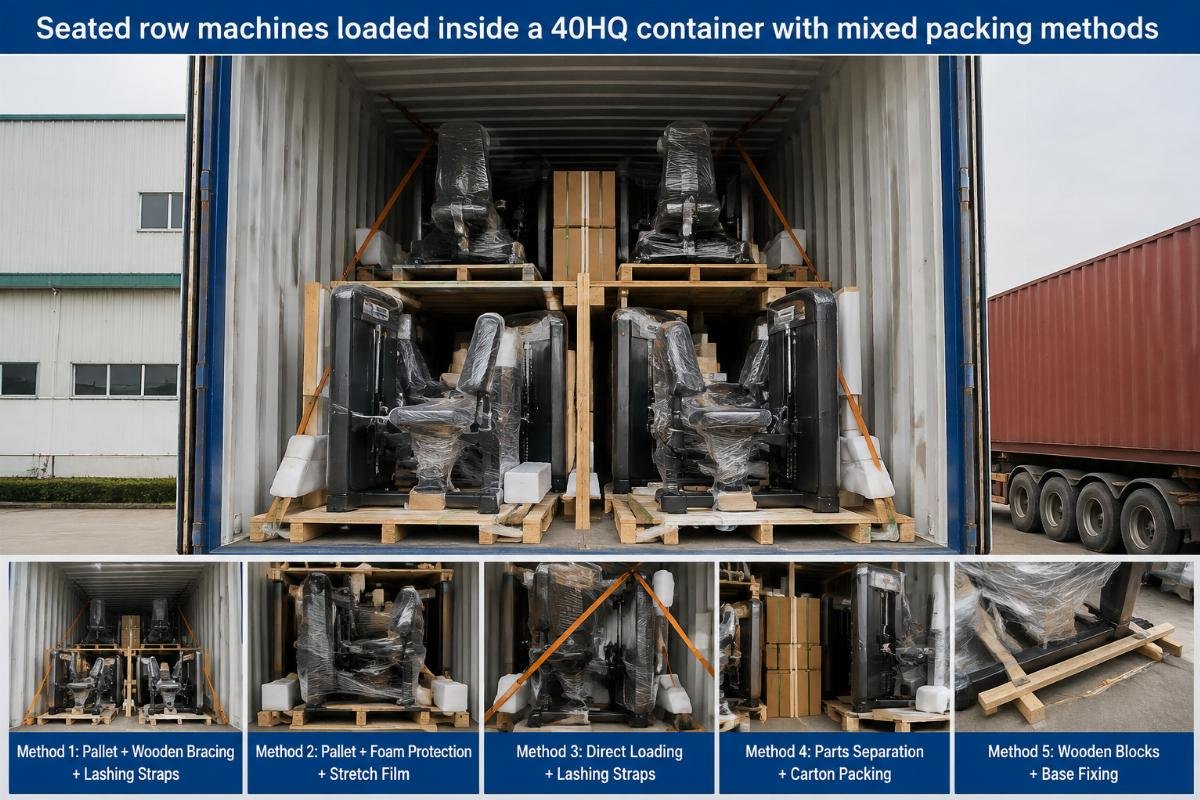
- Interlocking and bracing: Pallets of plates are strapped together and braced against the container walls to prevent lateral shift during ocean transit.
- Void filling: Airbags or timber bracing is used between mid-layer items to eliminate movement.
For container consolidation for bumper plates and mixed SKUs, the loading sequence is not just about efficiency — it is about ensuring the cargo arrives in the same condition it left the factory.
How to Calculate Whether Consolidation Saves Cost?
Consolidation saves money only when the avoided costs — re-stuffing, customs penalties, demurrage — are factored in alongside the freight savings. Many buyers focus solely on the per-CBM or per-ton freight rate and miss the hidden risk costs that come with poorly planned mixed shipments.
The cost comparison should include:
- Freight savings from consolidation: Sharing a container across multiple SKUs typically reduces per-unit freight cost compared to shipping each category separately.
- Risk cost of weight imbalance: Terminal rejection, re-stuffing fees, and potential cargo damage.
- Risk cost of HS misclassification: Customs inspection delays, retroactive duty adjustments, and storage fees at the destination port.
- Risk cost of poor loading sequence: Unloading inefficiency, product damage, and labor cost at the receiving end.
When we plan a consolidated container for a commercial gym project — say, a full package of cardio, strength, and free-weight equipment — the first step is to model the total weight and volume against the container’s payload capacity. If the weight limit is reached before the volume is full, the remaining space must be filled with lightweight accessories or flooring, not more plates. If the volume is full before the weight limit, additional heavy items cannot be added without exceeding the gross weight.
This balancing act is where container consolidation for bumper plate sets with other SKUs either delivers real savings or creates hidden losses. A well-planned consolidation can reduce total landed cost meaningfully. A poorly planned one can erase the freight savings many times over through port delays and rework.
What Documents Are Required for Mixed SKU Shipments?
Three documents form the backbone of any mixed-SKU container shipment: the detailed packing list, the segmented commercial invoice, and the weight distribution plan. Missing or incomplete documentation is the most common reason for customs holds — not the cargo itself.
The required document set includes:
- Detailed packing list: Must list every SKU, carton count, carton dimensions, gross weight per carton, and net weight per carton. For bumper plates, the material composition (e.g., iron core with rubber coating) should be specified.
- Segmented commercial invoice: Each product category with its own HS code, unit price, total value, and Incoterms reference. Free weights, machines, and accessories must not be lumped under a single description.
- Weight distribution plan: A visual diagram showing the placement of heavy and light items within the container, with weight totals per zone. This is not always requested by customs, but having it ready speeds up inspection resolution when questions arise.
- Certificate of origin and any destination-specific compliance certificates: CE marking for European markets, SASO for Saudi Arabia, SONCAP for Nigeria, etc.
A buyer in West Africa once faced a multi-week delay because the packing list described "gym equipment" as a single line item without breaking down the plate sets from the machine frames. Customs could not verify the weight declaration and ordered a full physical inspection. The delay and inspection cost far exceeded any documentation shortcut saved. [NEED_CITE: customs documentation requirements for mixed cargo per WCO Customs Data Model]
For container consolidation for bumper plates and mixed fitness equipment, the documentation must mirror the physical reality of the container — itemized, segmented, and weight-verified.
Conclusion
Mixed-SKU container consolidation is a weight-engineering problem, not a volume-filling exercise. Bumper plates and other heavy fitness items demand pre-planned weight distribution, accurate HS code segmentation, and a disciplined loading sequence — supported by documentation that reflects every detail of the cargo. When these elements are in place, consolidation delivers real cost savings and smooth port clearance. When they are not, the hidden costs of rework, delay, and damage quickly outweigh any freight discount.