Buy Commercial Treadmill for Distributors
Peak horsepower numbers on spec sheets are marketing fiction; continuous horsepower, frame steel gauge, and running belt layering are what actually determine whether your end-users renew or churn.
Distributors sourcing commercial treadmills must prioritize CHP ratings over peak HP claims, verify frame steel thickness and running belt construction, negotiate motor and frame warranty terms that match daily usage intensity, and confirm OEM flexibility with spare parts supply agreements—because hidden after-sales costs from motor burnout and frame fatigue routinely erase the margin gained from chasing the lowest unit price.
I still remember standing on the show floor in Chicago, watching a procurement director from a Texas gym chain flip our treadmill spec sheet upside down as if the real answer was printed on the back. He tapped the peak horsepower figure and said, "This number means nothing to me." Then he asked three questions in sequence: what is the continuous horsepower under load, how many layers is the running belt, and what is the frame warranty in years. I answered honestly—three years on the motor, standard frame coverage—and he walked away. That conversation rewired how I approach every commercial treadmill distributor conversation since. The lesson was not about specs; it was about matching warranty architecture to the actual usage rhythm of a high-traffic gym floor [NEED_CITE: commercial treadmill failure mode distribution by component type].
Let me walk you through what actually matters when you are building a commercial treadmill line for resale.
What specs do commercial treadmill distributors actually need to verify?
Continuous horsepower, frame steel gauge, and running belt layering determine real-world durability far more than the peak horsepower figure printed on the box.
Most first-time commercial treadmill distributors get pulled into the peak horsepower trap because it looks impressive on a spec sheet. Peak HP is a momentary surge rating—what the motor can sustain for seconds, not hours. Continuous horsepower, or CHP, is what the motor delivers during sustained running at commercial pace. A treadmill advertised at peak 4.0 HP may only deliver 2.5 CHP under continuous load, which is insufficient for a gym where the belt runs sixteen hours a day [NEED_CITE: CHP versus peak HP testing methodology per IHRSA equipment guidelines].
Here is how the critical specs break down for distributor evaluation:
| Specification | What to Verify | Why It Matters for Resale |
|---|---|---|
| Motor CHP | Sustained output under load, not peak surge | Determines whether the motor survives daily commercial cycles |
| Frame Steel Gauge | Thickness and welding pattern of the main frame | Dictates long-term structural integrity and warranty credibility |
| Running Belt Layers | Number of ply and surface treatment | Controls wear resistance and user comfort over extended service |
| Deck Reversibility | Whether the deck can be flipped | Extends maintenance intervals and reduces replacement cost |
| Incline Motor Rating | Separate CHP for lift mechanism | Prevents incline system failure under heavy user loads |
A distributor in the Middle East once ordered a container of treadmills based purely on peak HP claims and unit price. Within months, gym operators reported motor overheating during afternoon peak hours. The root cause was a CHP rating that could not sustain the thermal load of continuous operation in a high-ambient-temperature environment [NEED_CITE: motor thermal derating factors in high-ambient gym environments]. The replacement cost and shipping logistics wiped out the margin the distributor had gained from the lower purchase price.
When you evaluate a commercial treadmill for your market, ask for the CHP rating at sustained belt speed with a standard user load, not the marketing peak figure. Request frame steel thickness documentation and running belt ply count. These are the parameters your end-users will feel—and complain about if they fall short.
How flexible is MOQ for first-time distributors testing the market?
Single-unit orders through full-container loads are both viable, with mixed-SKU container consolidation available for distributors building a complete product line.
Many new commercial treadmill distributors assume they must commit to a full container of a single model to get factory pricing. That assumption is outdated. Modern manufacturing arrangements in Shandong and surrounding fitness equipment clusters support flexible MOQ structures precisely because distributors entering new markets need to test demand before committing volume.
The typical flexibility tiers work like this:
- Sample or single-unit orders for showroom display or end-user pilot testing, priced at a modest premium over bulk rates.
- Partial container loads mixing treadmill models with other cardio or strength equipment, allowing distributors to fill a container with a diversified SKU range.
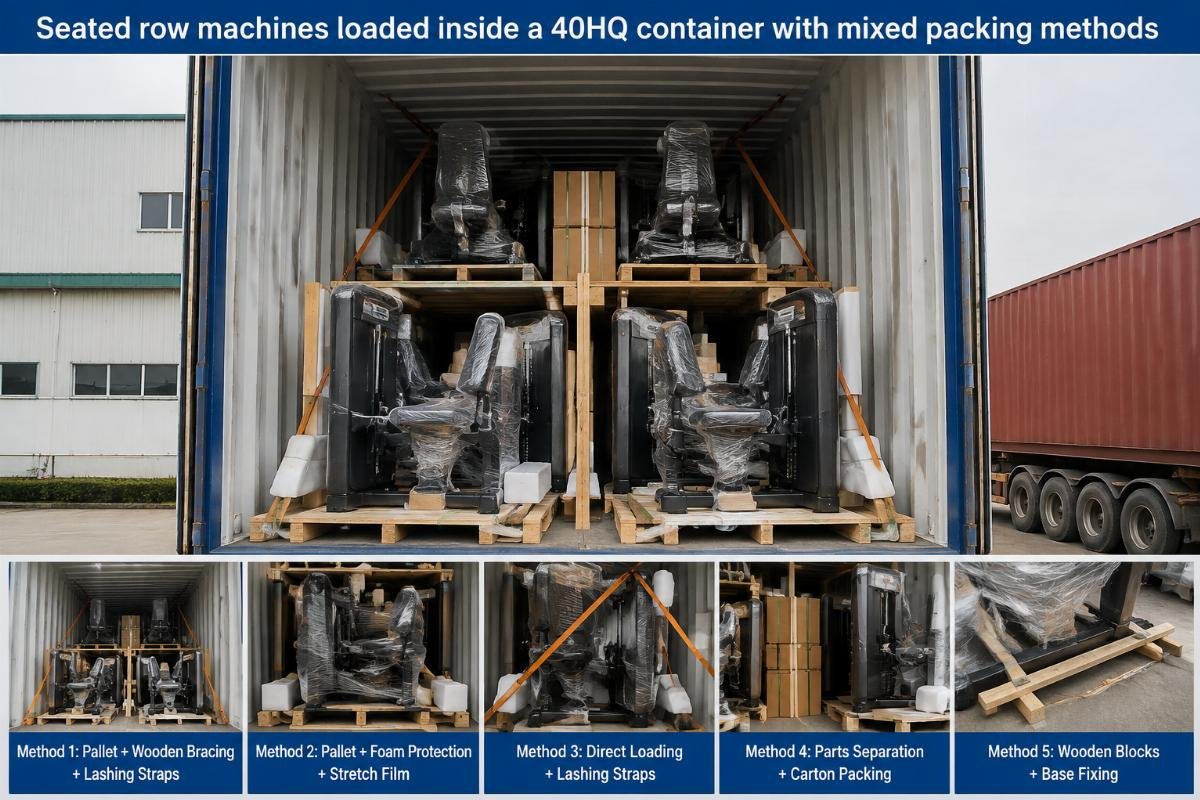
- Full container consolidation where treadmills are loaded alongside ellipticals, spin bikes, strength machines, and free weights in a single shipment, optimizing freight cost per unit.
A buyer in Southeast Asia came to us wanting to test three treadmill models across different price tiers before committing to a brand positioning strategy. We consolidated a single container with units from each tier, plus a selection of matching strength equipment, so the buyer could present a complete gym solution to prospective gym owners [NEED_CITE: container consolidation best practices for mixed fitness equipment shipments]. The buyer used the initial container to gauge market response, then placed a follow-up order focused on the two best-performing models.
The risk to watch is not MOQ flexibility itself—it is whether the supplier can maintain consistent build quality across small-batch and large-batch production runs. Ask for production batch traceability and confirm that the same quality inspection protocol applies regardless of order size. A commercial treadmill distributor who receives inconsistent quality between a sample order and a repeat container order will lose credibility with gym operators faster than any price advantage can rebuild it.
What warranty terms protect distributor margins long-term?
Motor warranties of extended duration, lifetime frame coverage, and formalized spare parts supply agreements are the three pillars that shield distributor margins from after-sales erosion.
The most expensive component of distributing commercial treadmills is not the purchase price—it is the after-sales cost when a motor fails or a frame cracks outside of warranty. Distributors who negotiate only on unit price routinely discover that warranty gaps consume their profit within the first year of operation.
A structured warranty approach for commercial treadmill distributors should cover three layers:
- Motor warranty aligned to the expected daily usage hours of your target market. A commercial gym running twelve to sixteen hours daily needs a motor warranty that reflects that intensity, not a generic residential-style coverage period [NEED_CITE: warranty duration benchmarking for commercial gym equipment by usage tier].
- Frame warranty providing lifetime or extended coverage, because frame fatigue is a structural failure that destroys end-user trust and creates liability exposure.
- Spare parts supply agreement with guaranteed availability windows and pricing locks, so that when a console board or incline motor needs replacement years after the initial sale, the distributor can source it without renegotiating from scratch.
A distributor in Latin America learned this the hard way. The initial purchase price was attractive, but the supplier had no formal spare parts agreement. When console failures began appearing after extended service, the distributor spent months trying to source replacement boards, during which several gym clients switched to competing brands. The lost recurring revenue far exceeded the initial unit-price savings [NEED_CITE: spare parts availability impact on distributor client retention rates].
When you negotiate with a commercial treadmill supplier, insist that warranty terms and spare parts availability be documented in the supply agreement—not left as verbal assurances. The cost of a motor replacement shipped internationally is a multiple of the original motor cost; the cost of a lost gym client is incalculable.
Can distributors build their own brand with OEM and ODM services?
Full private-label branding, custom console design, and tailored packaging are available from Shandong-based manufacturers, enabling distributors to build differentiated brand identity rather than reselling generic products.
The commercial treadmill market in emerging regions is crowded with identical machines carrying different stickers. Distributors who simply relabel a generic unit compete only on price—a race to the bottom. The distributors who build lasting margin are those who use OEM and ODM capabilities to create a product that matches their market’s specific expectations.
OEM and ODM services for commercial treadmill distributors typically include:
- Private-label branding on the console, frame, motor cover, and packaging, with custom color schemes matched to the distributor’s brand identity.
- Console customization including language options, workout program configuration, and connectivity features tailored to regional user preferences.
- Packaging design with the distributor’s branding, compliance markings, and assembly instructions in the target market language.
- Certification alignment ensuring the product carries the marks required for import and sale in the destination country, including CE marking for European markets and other regional compliance standards [NEED_CITE: CE certification requirements for commercial fitness equipment import].
A distributor in North Africa wanted to position a premium treadmill line for hotel and upscale gym clients. Rather than importing a generic model, they worked with the manufacturer to develop a custom console interface with Arabic and French language support, a frame finish matched to their brand palette, and packaging that reflected a premium unboxing experience. The resulting product commanded a price point meaningfully above competing generic imports, and the distributor secured exclusive territory arrangements that protected their investment [NEED_CITE: OEM private-label pricing premium versus generic resale margins in emerging fitness markets].
The key is to treat OEM and ODM as a brand-building tool, not just a labeling exercise. A commercial treadmill distributor who invests in genuine product differentiation—console features, finish quality, certification completeness—creates a product that gym operators recognize and trust, which is the foundation of repeat orders and referral-based growth.
Conclusion
Unit price is the least important number on a commercial treadmill purchase order; warranty architecture, spare parts commitment, and OEM capability are the levers that determine whether a distributor thrives or merely survives.
Distributors evaluating commercial treadmill sourcing should verify CHP ratings against actual usage intensity, leverage flexible MOQ and container consolidation to test markets efficiently, negotiate warranty and spare parts terms that protect long-term margin, and use OEM capabilities to build a differentiated brand rather than competing on price alone. The commercial treadmill distributor who treats these four dimensions as an integrated sourcing strategy—rather than negotiating each in isolation—will consistently outperform competitors who focus only on the invoice total.