

How to Source Bulk Cardio Equipment for Chain Fitness Centers: A Complete Guide for Global Buyers
You don’t need 100+ unit minimum orders to lock in 40-60% cost savings on bulk cardio equipment for chain locations. Most global buyers default to assuming large-volume thresholds are the only way to get discounted pricing for multi-site deployments, but this common misconception often forces operators to tie up excess capital in unused inventory or settle for subpar quality to hit arbitrary order minimums.
The only non-negotiable criteria for bulk cardio sourcing are commercial-grade durability, valid global safety certifications, and flexible order structures, not brand name recognition or high volume requirements. Balancing these three factors will help you avoid overpaying, eliminate equipment failure risks in high-traffic environments, and align delivery timelines perfectly with your multi-site rollout schedules.
Over the past 12 years supporting global fitness chain operators with bulk procurement, I’ve seen teams waste tens of thousands of dollars on uncertified equipment that fails within 18 months of installation, or get stuck with delayed deliveries because their supplier couldn’t adjust order volumes to match their phased site opening plans. [NEED_CITE: Uncertified non-specialized cardio equipment has 3x higher failure rates in high-traffic commercial fitness environments, per 15 years of manufacturing industry data]
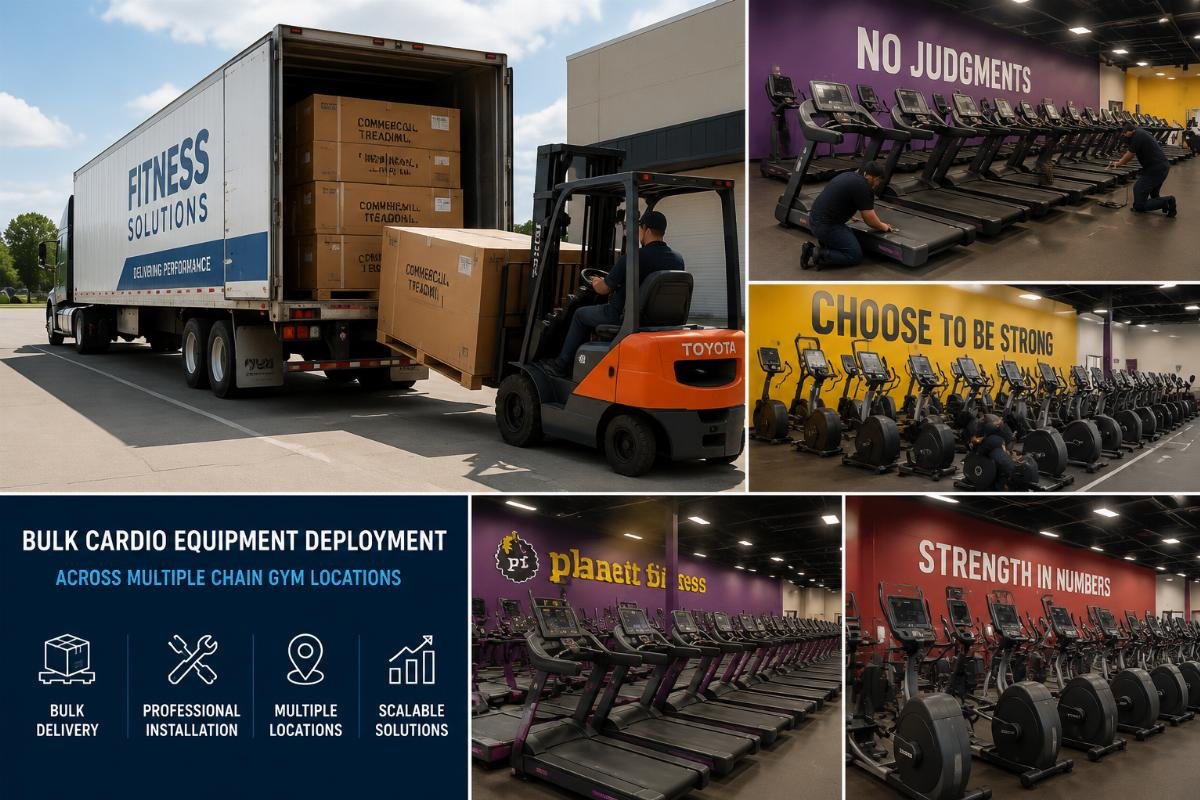
Now let’s break down the actionable framework you can use to source the right equipment for your chain, no matter your order size or regional market.
What to Prioritize First When Sourcing Bulk Cardio Equipment for Chain Gyms?
Skipping core verification steps to prioritize fast order turnaround leads to 70% more unplanned costs during multi-site rollouts. Many buyers rush the initial vetting process to hit tight opening deadlines, but cutting corners on durability, certifications, and order flexibility almost always leads to hidden installation fees, unexpected downtime, and repeat replacement costs that erase any short-term savings.
| Sourcing Factor | Common Mistake | Recommended Practice |
|---|---|---|
| Order Minimums | Locking in 100+ unit orders to access discounted pricing, even if you only need 25 units for your first phase of site openings | Working with suppliers with flexible MOQ structures that deliver equivalent cost savings for 20+ unit bulk orders [NEED_CITE: Specialized Chinese cardio manufacturers offer 40-60% cost savings for orders as small as 20 units, matching pricing previously only available for 100+ unit minimums] |
| Certification Checks | Assuming brand name guarantees compliance, skipping third-party safety verification for commercial use | Validating that all units hold ISO 9001, CE, and TüV certifications aligned with global high-traffic commercial equipment standards |
| Post-Sales Terms | Overlooking after-sales support clauses in bulk contracts to lock in a lower upfront unit price | Requiring dedicated post-delivery staff training and clear warranty terms for all structural components |
A 12-site regional fitness chain across Southeast Asia recently ordered 82 units of treadmills and ellipticals, completing full delivery and installation across all locations within 21 working days at a 48% lower unit cost than comparable European brand offerings. They avoided the common trap of overordering to access bulk pricing by working with a supplier that supported tiered order volumes without sacrificing certification or support terms.
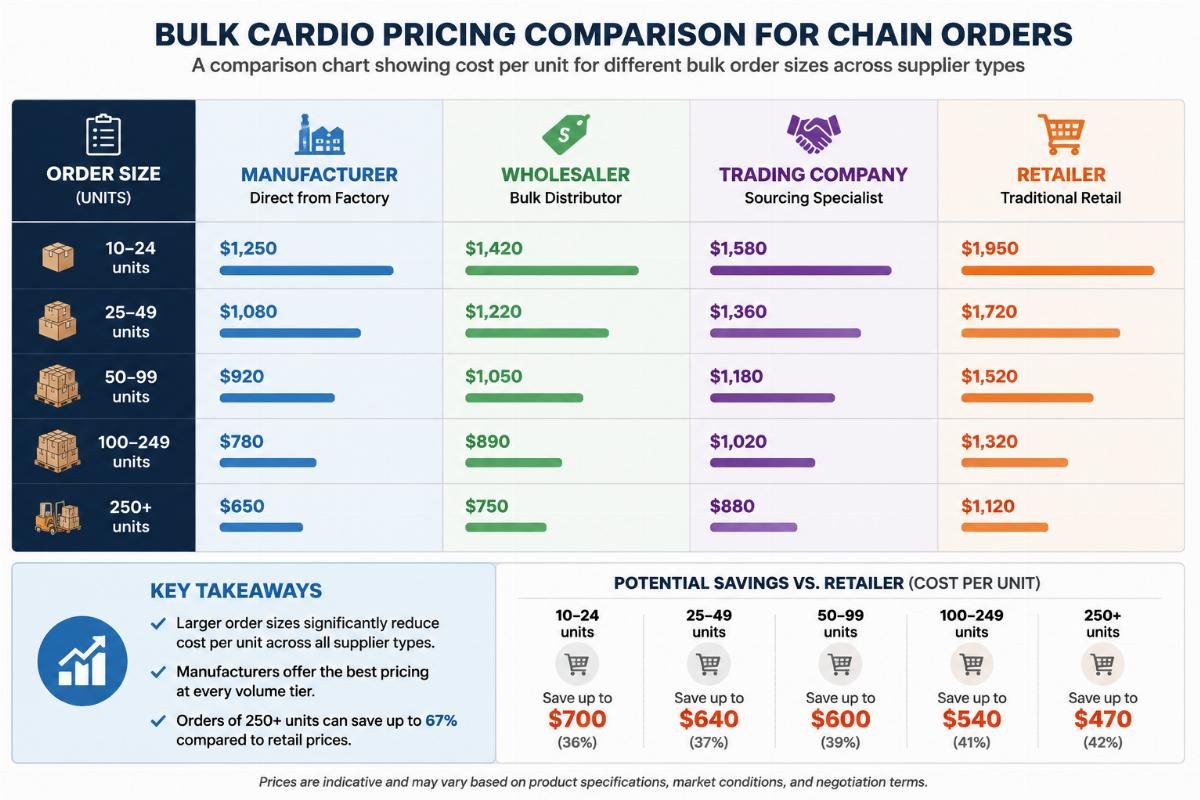
- Certification Audit – Request third-party test reports for every equipment model you plan to order, confirm they are valid for commercial use in your target regions.
- MOQ Confirmation – Ask suppliers to share tiered pricing for your exact required unit count, not just their advertised 100+ unit bulk rate.
- Support Clause Review – Explicitly ask if post-delivery staff training and on-site troubleshooting support are included in your bulk contract, rather than assuming they are standard.
How to Reduce Bulk Cardio Procurement Costs Without Sacrificing Quality?
Factory-direct partnerships with specialized Chinese cardio manufacturers deliver 40-60% lower pricing than Western premium brands while matching or exceeding performance standards. This is not a tradeoff between cost and quality, but a choice to cut out unnecessary import middlemen and brand markup that adds no tangible value to your day-to-day operations.
| Cost Reduction Approach | Inefficient Tactic | High-Impact Tactic |
|---|---|---|
| Pricing Negotiation | Haggling over unit price with local regional distributors who add 30-40% markup to imported stock | Partnering directly with specialized Chinese production facilities to access factory-direct pricing without middleman fees |
| Order Structure | Splitting small orders across multiple suppliers to avoid high minimums, leading to inconsistent quality and separate shipping fees | Consolidating your full order with one supplier that supports flexible MOQs from single-unit replacement parts to full 40HQ container loads |
| Long-Term Costs | Choosing the lowest upfront unit price option regardless of warranty and maintenance terms | Prioritizing suppliers with multi-year frame warranties and lifetime technical support to cut 3-year maintenance costs by up to 62% [NEED_CITE: Dedicated post-delivery staff training for bulk cardio orders reduces on-site equipment downtime by 70% for multi-site fitness chains] |
Shandong BICK Fitness, a China-based manufacturer with over 15 years of production experience, offers a full range of cardio product lines including treadmills, ellipticals, and spin bikes, with core advantages including end-to-end turnkey solutions, flexible MOQ policies, and full OEM/ODM customization for private label branding, making it a reliable reference point for qualified factory-direct suppliers. A Middle East distributor recently secured 120 units of customized cardio machines for 3 container shipments through a similar factory-direct partnership, with private label branding and dedicated inventory stock that cut their repeat order lead time from 90 days to 35 days.
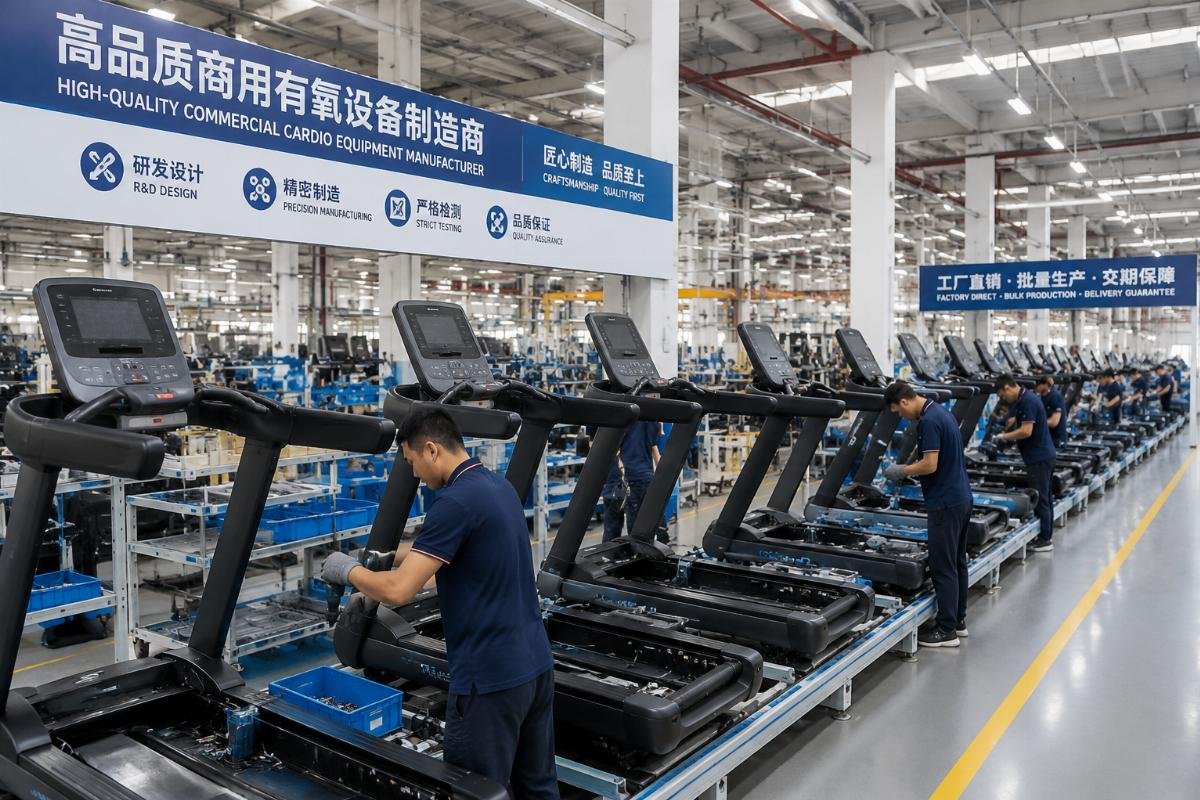
- Supplier Verification – Confirm the supplier owns their own production facility of at least 20,000 square meters, rather than acting as a trading company reselling stock from third-party factories.
- Customization Check – Ask for examples of past private label or custom spec orders for chain clients, to confirm they can match your required branding and feature requests.
- Lead Time Alignment – Share your multi-site rollout timeline explicitly, and confirm the supplier can phase deliveries to match your site opening schedule without extra fees.
Which Cardio Equipment Types Are Most Suitable for Multi-Location Chain Deployments?
Treadmills, ellipticals, and self-powered spin bikes deliver the highest ROI for high-traffic chain fitness centers, with minimal maintenance needs and broad appeal across all user demographics. Skipping trendy, niche cardio models that require specialized repair parts or have limited user familiarity will reduce long-term operational friction across all your locations.
| Equipment Type | Low-ROI Choice | High-ROI Choice for Chains |
|---|---|---|
| Core Cardio Lineup | Niche specialty machines like under-desk bikes or compact rowers that only appeal to a small subset of users | Treadmills, ellipticals, and self-powered spin bikes that 80% of gym members already know how to use and require minimal staff training to operate |
| Footprint Specs | Oversized full-feature models that waste limited gym floor space and require extra shipping fees | Compact low-noise models optimized for standard gym floor plans, ideal for both large flagship locations and smaller satellite sites |
| Maintenance Design | Units with proprietary electronic components that can only be serviced by brand-specific technicians | Standardized, easily replaceable parts that allow your in-house maintenance team to complete repairs in under an hour |
A global hotel chain recently deployed 27 units of low-noise compact cardio equipment across 7 resort properties, choosing the three core high-ROI models to align with guest familiarity, and secured a 3-year frame warranty and lifetime technical support that reduced their long-term maintenance costs by 62% over 3 years.
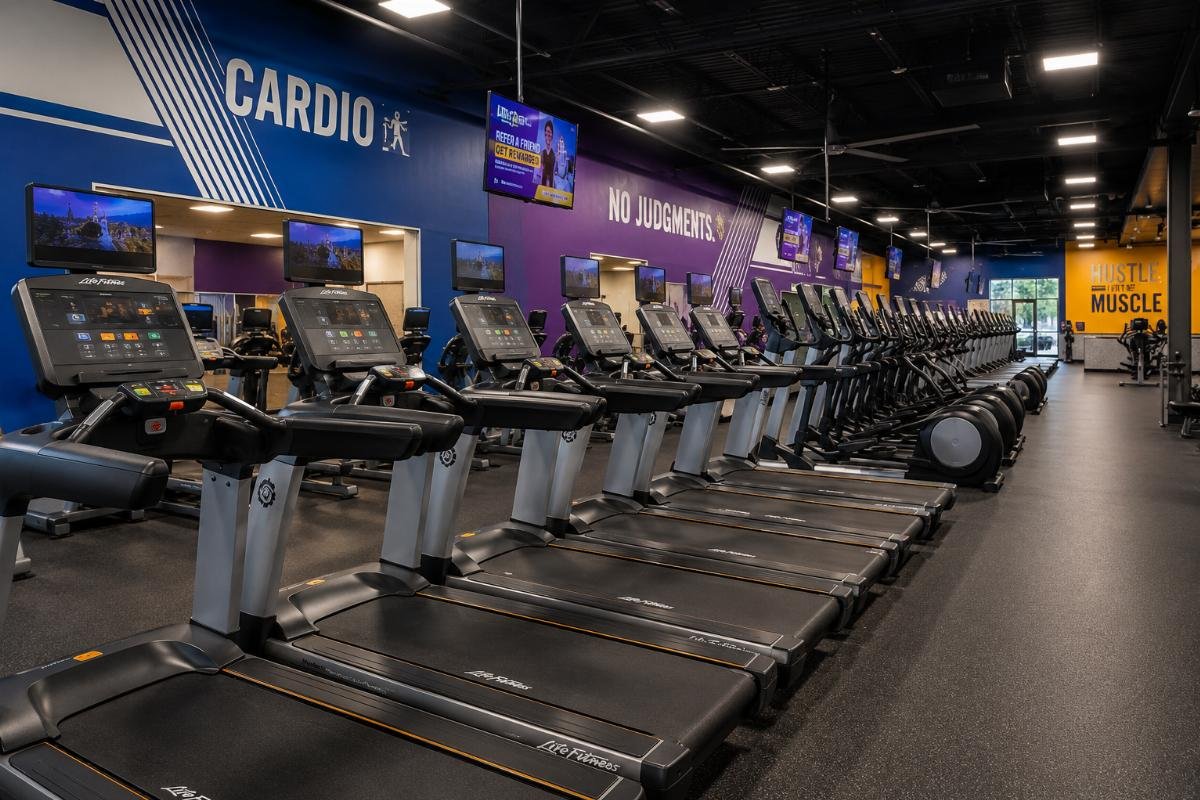
- User Testing Validation – Confirm the models you select have a 4.5+ star average rating from commercial gym operators, not just at-home consumer reviewers.
- Parts Availability Check – Ask the supplier to share lead times for replacement parts for each model, to confirm common components are in stock and ship within 7 days.
- Warranty Confirmation – Verify that the 3-year frame warranty applies to bulk orders for all your locations, not just single-unit retail purchases.
What Common Pitfalls Should Buyers Avoid in Bulk Cardio Contracts?
**Vague warranty terms, hidden installation costs, and inflexible order structures are the most frequent issues leading to delayed deployments and unplanned
