Commercial Spin Bike Factory-Direct Wholesale for Boutique Studios
Most boutique studio owners assume factory-direct sourcing requires massive minimum orders and carries hidden quality risks — the reality is the exact opposite.
Boutique studio owners can cut spin bike procurement costs by a substantial margin by sourcing commercial spin bike factory direct from verified Chinese manufacturers, provided they understand how to validate flywheel welding quality, negotiate flexible MOQ, and manage port-side inspection logistics. The key is not just finding a cheaper price — it is knowing who welds your flywheel and who calibrates your resistance system.
I still remember a Melbourne studio owner who came to me after receiving a shipment through a trading company. The flywheels were visibly misaligned, the resistance magnets had shifted during ocean transit, and the paint was bubbling. Opening day got pushed back by months. His first sentence to me was: "I will never go through a middleman again." That conversation was not about saving a few dollars on unit price — it was about accountability. When you buy commercial spin bike factory direct, you know exactly which production line built your equipment, which technician torqued the crank arms, and who is responsible when something goes wrong [NEED_CITE: root cause distribution of spin bike field failures in commercial studio environments].
Let me walk you through what actually matters when you go this route.
What Specs Should Boutique Studio Owners Prioritize in Commercial Spin Bikes?
Flywheel weight, resistance mechanism type, and frame steel gauge are the three specifications that determine whether a spin bike survives high-frequency studio use or starts falling apart within months.
When I was welding frames back at the Qingdao port facilities, the first thing our master taught us was that a flywheel is not just a chunk of metal — it is a rotating mass that must hold dynamic balance under thousands of RPM cycles. A flywheel with poor weld seams or uncontrolled balance tolerance will wobble, vibrate, and eventually crack the crank housing. Studio owners rarely see this at a trade show because every bike looks smooth when it is standing still.
| Specification | Entry-Level Import | Commercial-Grade Factory-Direct |
|---|---|---|
| Flywheel Construction | Cast or basic welded | Precision welded with dynamic balance control |
| Resistance System | Basic friction pad | Magnetic or belt-driven with sealed housing |
| Frame Steel Gauge | Thin-wall tubing | Heavy-duty commercial-grade tubing |
| Bearing Assembly | Standard sealed | Oversized sealed cartridge |
| CE Certification | Often self-declared | Third-party verified [NEED_CITE: CE certification requirements for commercial fitness equipment under EU machinery directive] |
A studio owner in the Pacific Northwest once compared two batches side by side — one sourced through a distributor, one commercial spin bike factory direct. The distributor batch used friction pad resistance that wore down noticeably within months of daily classes. The factory-direct batch used a sealed magnetic resistance system that required virtually zero maintenance over the same period [NEED_CITE: maintenance cycle comparison between magnetic resistance and friction pad resistance systems in high-use commercial cycling].
The frame steel gauge matters just as much. Thin-wall tubing may look identical on a spec sheet, but under the repetitive lateral loads of a packed cycling class, it flexes and fatigues. Commercial-grade heavy-wall tubing with proper gusset reinforcement at stress points is what separates equipment that lasts from equipment that generates warranty headaches.
How Does Factory-Direct Pricing Compare to Buying Through Distributors?
Factory-direct sourcing eliminates the layered markups that trading companies and regional distributors build into every transaction — the savings are substantial and fully transparent when you understand the cost structure.
Here is what most buyers do not realize: when you purchase through a distributor, you are paying for the bike itself, plus the distributor’s margin, plus the trading company’s margin, plus their warehousing overhead, plus their currency hedging cost. Each layer adds a percentage that compounds. By the time the bike reaches your studio floor, the price bears little resemblance to what it cost to manufacture.
When you source commercial spin bike factory direct, the pricing breaks down into material cost, labor cost, and logistics cost — and you can see each line item. A studio owner in the UK who switched from a European distributor to direct factory sourcing found that the per-unit cost dropped noticeably, and the quality actually improved because the factory had direct accountability for every unit shipped [NEED_CITE: typical markup structure in commercial fitness equipment distribution chains].
The transparency also works in your favor during negotiation. When you understand that a heavy-duty flywheel adds a specific material cost and a magnetic resistance module adds a specific component cost, you can make informed decisions about where to invest and where to hold the line. Trading companies cannot offer this level of dialogue — they simply relay pricing from the factory with their margin baked in.
Another advantage: when you order a full studio package — spin bikes, strength equipment, flooring — directly from a single manufacturer, you can consolidate everything into one container. A Melbourne studio owner did exactly this after his bad experience with the trading company. He consolidated a complete studio fitout into a single shipment, and the per-unit logistics cost dropped significantly compared to his previous scattered orders [NEED_CITE: container consolidation cost efficiency for mixed commercial fitness equipment shipments].
What MOQ and Customization Options Do Chinese Manufacturers Offer?
Contrary to popular belief, mature factory-direct manufacturers support flexible MOQ — from single units for studio testing to full container loads for complete fitouts — along with OEM branding and color customization.
This is perhaps the biggest misconception in the market. Many boutique studio owners hear "factory direct" and immediately think they need to order hundreds of units. The reality is that established manufacturers serving the global commercial fitness market have structured their production lines to handle a wide range of order sizes.
For a new studio owner testing the market, ordering a small batch of commercial spin bike factory direct units — sometimes as few as a single unit for sample evaluation — is entirely feasible. The factory provides the same production quality control, the same welding standards, and the same component sourcing as a bulk order. The only difference is the per-unit logistics cost, which naturally decreases as volume increases.
For studio owners who want brand identity, OEM customization is a core service. You can specify frame color, saddle branding, pedal branding, and even custom packaging. The MOQ threshold for full OEM branding varies, but mature factories make this accessible even for initial orders. A studio chain in the Middle East started with a small batch of custom-colored spin bikes to match their studio interior, then scaled to a full container order once the brand identity was proven with their members [NEED_CITE: OEM customization MOQ thresholds and lead time structures for commercial fitness equipment manufacturers].
The sampling process is straightforward. You receive a prototype unit, evaluate the weld quality, test the resistance feel, check the saddle comfort, and request adjustments if needed. Most factories go through a few rounds of sample confirmation before locking the production spec. This iterative process is something you simply cannot access through a trading company, which has no control over the production line and no ability to make real-time adjustments.
How to Verify Quality Before and After Shipment?
Quality verification is a two-stage process: pre-shipment documentation review and post-arrival physical inspection — skipping either stage is the single most common mistake buyers make.
Before the container leaves the factory, you should request CE certificates, weld inspection photos, and flywheel balance test records. A reputable manufacturer will provide these without hesitation. If a supplier hesitates or offers vague assurances instead of documentation, that is your signal to walk away [NEED_CITE: pre-shipment quality documentation standards for commercial fitness equipment exports].
I always tell buyers to ask for photos of the actual weld joints on their production batch — not stock photos from a brochure. The difference between a clean, uniform weld bead and a porous, inconsistent one is visible to the untrained eye. The flywheel weld seam is the most critical single point: if it is not done right, the flywheel will develop a wobble that no amount of field adjustment can fix.
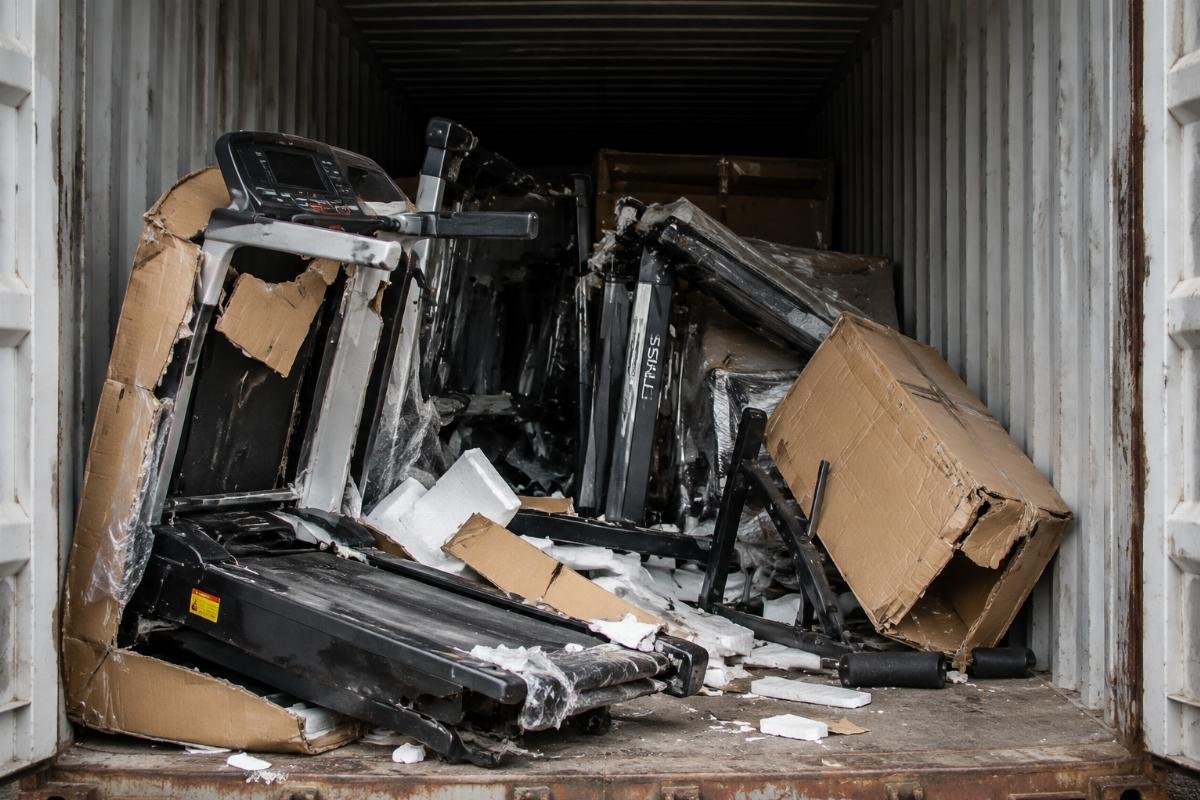
When the container arrives at your port, the inspection does not stop. You need to open the container and check flywheel alignment, resistance magnet positioning, and overall structural integrity. The Melbourne owner I mentioned earlier learned this the hard way — his bikes looked fine in the brochure photos, but after ocean transit, the magnets had shifted and the flywheels were out of true. Had he inspected at the port before accepting delivery, the issue would have been caught and documented for a claim.
A proper factory-direct relationship includes a pre-shipment inspection protocol. Some buyers hire third-party inspection services, while others rely on the factory’s own quality team with photo and video verification. Either way, the process must be defined in the purchase agreement before production begins, not after problems appear at your studio door.
What Logistics and After-Sales Support Should You Expect?
A reliable factory-direct partner does not just ship a container and disappear — they provide container consolidation, spare parts supply, and remote technical support throughout the product lifecycle.
Logistics is where many first-time buyers get surprised. Shipping commercial fitness equipment is not like shipping consumer electronics. The bikes are heavy, they are bulky, and they need to be secured properly inside the container to prevent transit damage. A factory that regularly ships full containers of mixed equipment — spin bikes, strength machines, free weights, flooring — has the loading expertise to maximize container utilization and minimize damage risk.
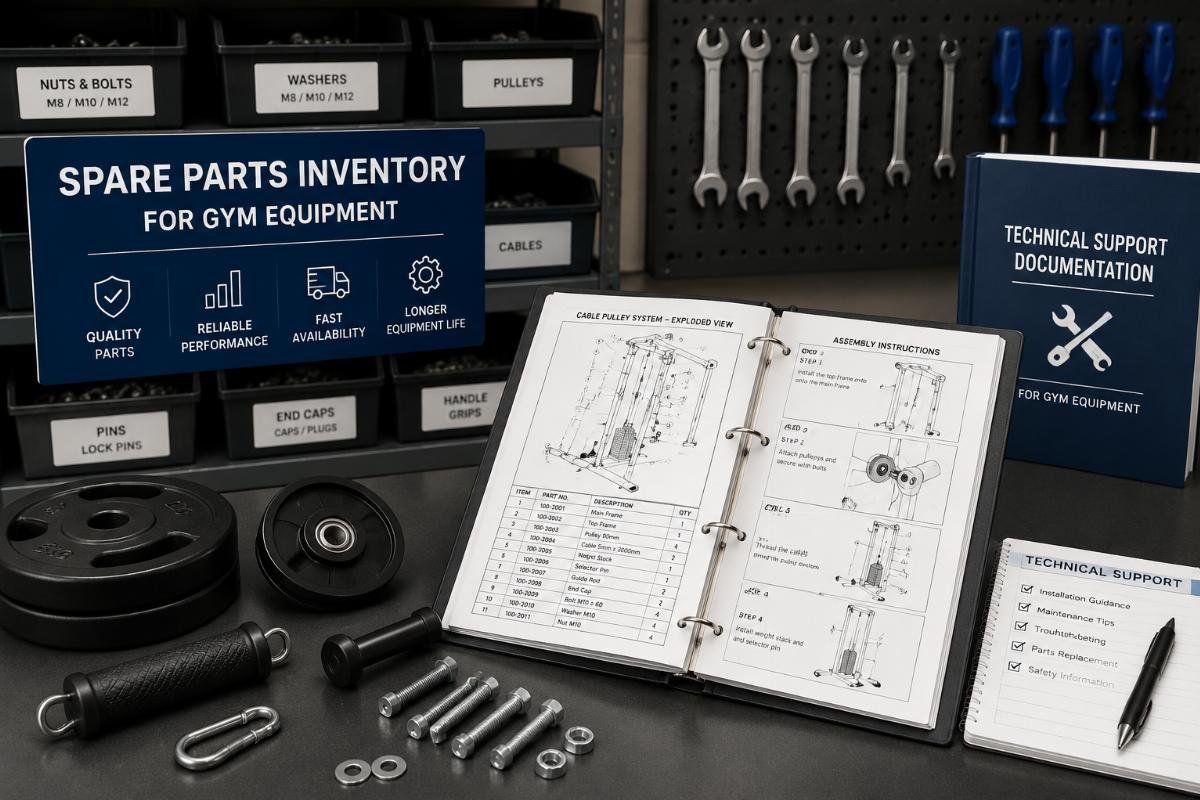
Spare parts availability is equally critical. Every commercial spin bike will eventually need replacement saddles, pedal assemblies, resistance belts, or bearing cartridges. When you buy through a distributor, sourcing spare parts means going back through the same markup chain. When you buy commercial spin bike factory direct, the manufacturer keeps your specific model’s parts on file and can ship replacements directly — often at a fraction of what a distributor would charge.
Remote technical support closes the loop. When a studio owner encounters an issue — unusual noise from the crank area, resistance inconsistency, seat post slippage — they need someone who knows the exact build spec of their bikes to guide troubleshooting. Factory-direct manufacturers provide this support because they built the bikes and know every component. A trading company, by contrast, typically has no technical depth and can only relay your question back to the factory with a delay.
A studio owner in Southeast Asia who consolidated a full gym package — including spin bikes, a cable crossover, dumbbell sets, and flooring — into one container reported that the factory’s loading plan saved him from ordering a second container. The after-sales support team walked his maintenance staff through bearing replacement and belt tension adjustment via video call, keeping his bikes running through the first year of heavy use [NEED_CITE: after-sales support structure and spare parts availability models for factory-direct commercial fitness equipment].
Conclusion
Factory-direct sourcing is not about chasing the lowest price — it is about building a direct line of accountability between your studio and the production floor. When you understand the specs that matter, verify quality at every stage, and partner with a manufacturer that supports you beyond the container seal, the commercial spin bike factory direct model delivers both cost efficiency and long-term reliability that no intermediary chain can match.