Freight Insurance for Power Rack to Sydney – Wholesale Supplier
Buying freight insurance does not guarantee a payout. The policy only pays out if the coverage scope, deductible, HS Code, and packing clauses all align with what actually arrives at the port.
When shipping a full container of power racks to Sydney, freight insurance must explicitly cover warehouse-to-warehouse transit under ICC(A) terms, match the declared HS Code on the commercial invoice, and include a survey-ready packing clause—otherwise, even visible column deformation at the destination will be rejected.
I still remember a 40HQ we loaded in Shandong a couple of years back, bound for a CrossFit box in western Sydney. The buyer arranged his own broker for customs clearance, and the broker classified the power racks under a generic "steel structure" code instead of the correct sports-equipment heading. The container sat at Port Botany for over a week. Demurrage and examination fees piled up to a sum that nearly wiped out the buyer’s margin on the entire order. He called me furious, assuming the insurance would cover it. It didn’t. The insurer pointed to the HS Code mismatch on the policy declaration and denied the claim outright. That single paperwork gap cost him far more than the insurance premium would have covered in a year of shipments. [NEED_CITE: Australian Border Force classification guidelines for strength-training equipment]
Freight insurance for a power rack shipment to Sydney is not a set-and-forget line item. It requires the same attention you give to product specs or container loading plans. Below I break down what the policy must actually cover, who is responsible for buying it under different trade terms, what documents you need to file a claim, why most claims get rejected, and how to verify the policy before the container doors are sealed.
Getting the coverage right starts with understanding exactly what the policy does and does not pay for.
What Does Freight Insurance Actually Cover for a Power Rack Shipment to Sydney?
Not all marine cargo policies treat a bent upright column the same way. The Institute Cargo Clauses system divides coverage into three tiers, and the gap between them determines whether your claim lives or dies.
Under ICC(C), the narrowest tier, only major casualties are covered—vessel sinking, grounding, fire, or collision. If the container shifts during a rough crossing through the Tasman Sea and two uprights bend against the door, ICC(C) will almost certainly exclude it. ICC(B) adds coverage for overturning and earthquake but still excludes breakage from inadequate stowage. ICC(A) is the only tier that covers all risks of physical loss or damage unless specifically excluded, making it the practical baseline for heavy gym equipment like power racks. [NEED_CITE: Institute Cargo Clauses A/B/C coverage scope comparison per Lloyd’s Market Association]
A power rack is not fragile in the traditional sense, but it is heavy, geometry-sensitive, and vulnerable to point-load damage. The J-hooks, safety straps, and pull-up bar brackets can bend under sustained pressure if the rack is not braced inside the container. Weld seams on the uprights can crack if the container is dropped during crane handling. These are all physical damage scenarios, but they only qualify for payout under ICC(A) or a specifically endorsed ICC(B) policy.
Deductibles also vary by tier. ICC(A) policies typically carry a deductible expressed as a percentage of the claim amount, often in the low single digits. ICC(C) deductibles tend to be higher because the coverage itself is narrower. If your policy carries a deductible that exceeds the value of the damaged components, filing a claim becomes pointless.
Which Incoterm Determines Who Buys the Insurance?
Under FOB, the buyer carries the risk from the moment the goods cross the ship’s rail at the loading port—yet many buyers assume the seller’s insurance covers them all the way to Sydney.
This is one of the most persistent misunderstandings in gym equipment procurement. When a shipment is booked under FOB Shandong or FOB Qingdao, the seller’s responsibility ends once the container is loaded on board. The seller may offer to arrange insurance as a courtesy, but the policy is usually issued in the seller’s name and may only cover port-to-port transit, not warehouse-to-warehouse. If the container is damaged during inland trucking from Sydney port to the buyer’s gym, there is no coverage unless the buyer holds a separate policy or the seller’s policy explicitly extends to the final destination.
Under CIF Sydney, the seller is contractually obliged to procure insurance covering the buyer’s risk. However, Incoterms 2020 only requires the seller to obtain minimum cover—ICC(C)—unless the parties agree otherwise. [NEED_CITE: Incoterms 2020 insurance obligation under CIF per International Chamber of Commerce] A buyer who wants ICC(A) coverage must request it explicitly and be prepared to pay the premium difference.
I have seen buyers receive a CIF quote, assume full protection, and then discover at the claim stage that the policy was ICC(C) with a warehouse-exclusion clause. The rack arrived with a cracked weld on the main upright, and the insurer refused because the damage was not caused by a listed peril. The buyer had no standing to claim under a policy issued in the seller’s name.
The practical fix is simple: regardless of whether you buy FOB or CIF, request a copy of the insurance certificate before the container leaves China. Verify the insured party, the coverage tier, the transit scope, and the deductible. If the seller cannot or will not provide it, treat that as a red flag.
What Documents Are Required to File a Freight Claim?
A freight claim without a surveyor’s report is a request, not a claim. Insurers require a documented chain of evidence from loading to delivery.
The core document set includes the original bill of lading, the commercial invoice, the packing list, and the insurance policy or certificate. These establish the contract of carriage, the value of the goods, the contents of the container, and the coverage in force. Missing any one of them gives the insurer grounds to delay or deny.
Beyond these basics, a survey report from an independent marine surveyor is almost always required for damage claims above a minimal threshold. The surveyor inspects the container at the destination, photographs the damage, checks the seal number against the bill of lading, and issues a report attributing the likely cause—improper stowage, inadequate packaging, external impact, or water ingress. Without this report, the insurer has no objective basis to assess liability. [NEED_CITE: marine cargo claim documentation requirements per International Association of Loss Adjusters]
Photographs taken by the buyer at the moment of unstuffing are also critical. The container door should be photographed before opening, showing the seal intact. The interior should be photographed before any equipment is moved, showing the bracing, strapping, and pallet condition. Any visible damage to the rack—bent uprights, cracked welds, scratched powder coating—should be photographed in context, with a measuring tape or reference object for scale.
A gym owner in Melbourne once called me after finding three cable crossover machines with bent guide rods. He had photos of the damaged machines but no photos of the container interior, no surveyor report, and no record of the seal number. The insurer denied the claim because he could not prove the damage occurred during transit rather than during unloading. The loss ran into the thousands.
What Are the Most Common Reasons Claims Get Rejected?
The majority of rejected freight claims for gym equipment trace back to four preventable gaps: packaging non-compliance, over-declaration of value, late notification, and documentation mismatch.
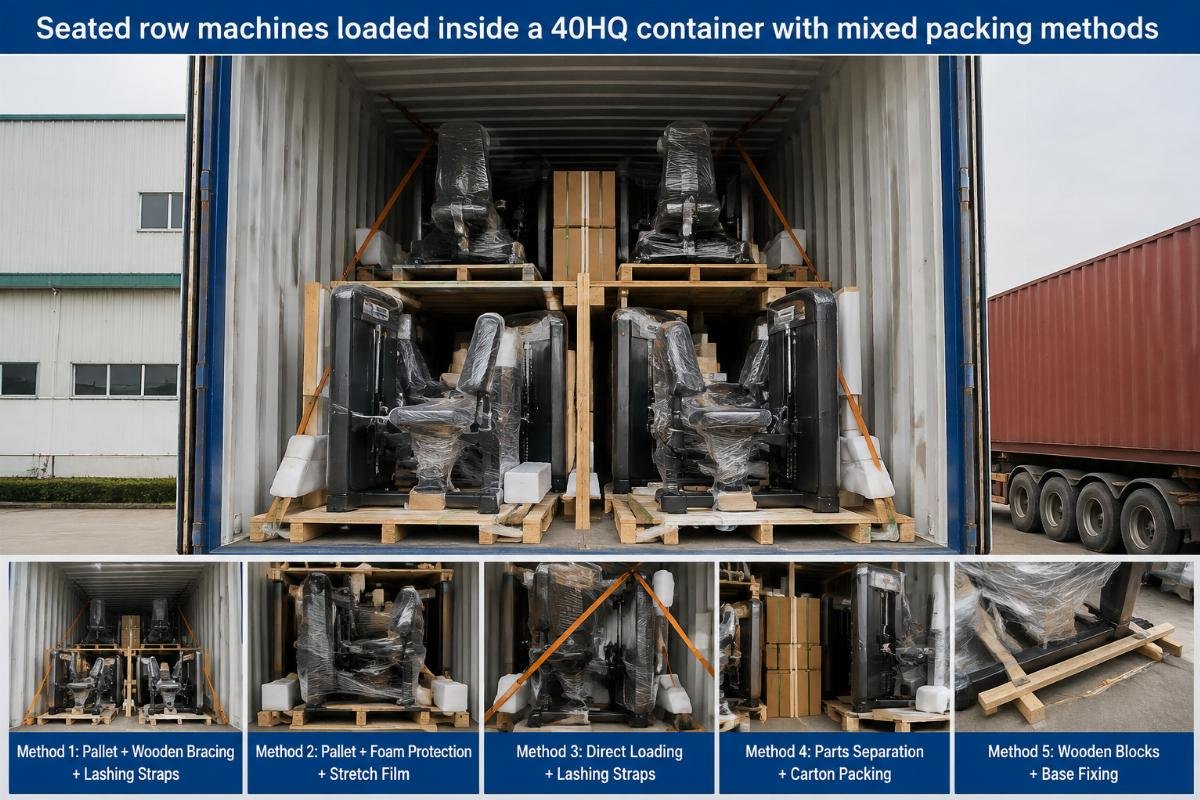
Packaging is the single most contested issue. Power racks are heavy steel structures, and insurers expect them to be secured on treated wooden pallets with steel banding, corner protectors, and internal bracing to prevent shifting. If the surveyor finds that the rack was loaded without adequate bracing or that the pallets were not ISPM-15 compliant—which is a mandatory requirement for Australian customs—the claim will be denied on grounds of improper packing. [NEED_CITE: ISPM-15 wood packaging material standard per International Plant Protection Convention] Australian Biosecurity is particularly strict on this point, and non-compliant pallets can trigger fumigation orders or even container rejection at port.
Over-declaration of value is another common trap. Some buyers assume that declaring a higher cargo value will result in a larger payout. In reality, insurers apply the principle of indemnity—the payout cannot exceed the actual financial loss. If the declared value is significantly above the invoice value, the insurer may apply average clauses, reducing the payout proportionally, or reject the claim entirely on grounds of misrepresentation.
Late notification is a procedural failure. Most policies require the insured to notify the insurer or their local agent within a set period after discovering damage—often within a few days. If the buyer waits weeks before reporting, the insurer can argue that the delay prevented a proper survey and deny the claim.
Documentation mismatch covers HS Code errors, weight discrepancies, and description inconsistencies between the policy, the invoice, and the bill of lading. Even a small discrepancy—such as the policy describing "gym equipment" while the invoice lists "power rack, model PR-5000"—can give the insurer grounds to question the validity of the declaration.
When we prepare a shipment, we walk the buyer through the packing standard before the container is loaded. We photograph every rack in the container, record the seal number, and ensure the HS Code on the commercial invoice matches the one on the insurance certificate. These steps take an extra hour at the factory but eliminate the most common claim-rejection triggers.
How to Verify Your Insurance Policy Before the Container Leaves Shandong?
The only safe time to check your insurance policy is before the container is sealed—not after it arrives in Sydney.
Request the insurance certificate from the seller or your own broker as soon as the shipment is booked. Check the following items against your commercial invoice and packing list:
- Insured party: The certificate should name the buyer or the buyer’s nominated entity, not just the seller. If the seller is the sole insured party, the buyer may have no standing to claim.
- Coverage tier: Confirm that ICC(A) is stated. If the certificate says ICC(C) or simply "marine insurance," request clarification in writing.
- Transit scope: The certificate should state "warehouse to warehouse" or explicitly cover the inland segment from Sydney port to the final delivery address. "Port to port" coverage leaves the last leg uninsured.
- Deductible: Confirm the deductible amount or percentage. If it is higher than the likely value of partial damage, the coverage is effectively useless for minor claims.
- Cargo description and value: The description should match the invoice line items, and the declared value should align with the invoice total plus freight and insurance cost—typically around one hundred and ten percent of the CIF value. [NEED_CITE: standard cargo valuation practice per Institute Time Clauses Hulls]
- HS Code: If the policy or the underlying declaration includes an HS Code, verify that it matches the code on the commercial invoice and the one your customs broker will use.
We provide our buyers with a pre-shipment document pack that includes the draft insurance certificate, the commercial invoice, the packing list, and loading photographs. The buyer can cross-check every field before the container doors close. If anything is inconsistent, we correct it on the spot. This is not a sales pitch—it is the same process we use for our own shipments, and it has prevented claim disputes that would have cost both sides time and money.
Conclusion
Freight insurance for a power rack shipment to Sydney only works if the policy, the paperwork, and the packing all tell the same story. Verify the coverage tier, confirm the transit scope, align every document before loading, and treat the survey report as non-negotiable. The premium is a small fraction of the cargo value, but the payout depends entirely on what you check before the ship sails.