Direct Import Air Bike for Philippines PT Studio Owners | Bick Manufacturer
Most PT studio owners think an air bike is just a fan on a frame. It isn’t. The fan bearing and chain assembly endure extreme torque spikes during every HIIT interval, and residential-grade units disintegrate under that abuse within a single quarter.
For Philippine PT studio owners, sourcing a commercial air bike directly from a Chinese factory cuts per-unit cost by a substantial margin versus buying from local dealers, while unlocking OEM branding, spec customization, and container-load consolidation with strength equipment. The trade-off lies in navigating Manila port customs compliance, selecting true commercial-grade drivetrain specs, and planning after-sales spare parts logistics before the first container leaves Qingdao. [NEED_CITE: cost comparison between factory-direct and local distributor pricing for imported fitness equipment in Southeast Asia]
I’ve stood in the Qingdao port inspection hall more times than I can count, watching containers of fitness gear get held up because a single HS code digit was wrong. One shipment of commercial spin bikes bound for Manila sat stuck for weeks, burning daily storage fees while the buyer scrambled to reclassify paperwork. That kind of headache doesn’t show up on a quotation sheet.
Let me walk you through what actually matters when you’re importing this equipment for a high-traffic studio environment.
Why Direct Import Air Bikes Makes Sense for PH PT Studios?
Factory-direct procurement eliminates multiple middlemen layers that inflate landed cost, while giving studio owners control over specifications that local dealers simply cannot offer.
When a Manila-based PT studio owner walks into a local fitness equipment showroom, the air bike on the floor has already passed through the importer, the regional distributor, and possibly a sub-dealer. Each layer adds margin, warehousing cost, and handling time. By the time the unit reaches the studio, the price has multiplied noticeably compared to the original factory quotation. [NEED_CITE: fitness equipment distribution markup structure in Southeast Asian markets]
Direct import changes that equation entirely. Studio owners who work with a manufacturer like Bick can specify frame color, saddle type, drive system preference, and even branded console panels—all within the same production run. A boutique PT clinic in Makati recently ordered a batch of air bikes with custom upholstery matching their brand palette, something no local dealer inventory could ever accommodate.
The OEM flexibility extends beyond cosmetics. Studios operating in coastal areas like Cebu or Subic need enhanced corrosion resistance on chain drives and pedal cranks. Factory-direct orders allow buyers to request stainless-steel fasteners and sealed bearing assemblies as standard, rather than accepting whatever the dealer happens to have in stock.
Container consolidation is where the economics become truly compelling. A PT studio rarely needs only air bikes. The functional training zone requires kettlebells, battle ropes, plyo boxes, and flooring. The free-weight section demands racks, barbells, and plates. Sourcing cardio and strength equipment from a single manufacturer who can load everything into one container dramatically reduces per-unit freight cost. [NEED_CITE: container consolidation cost benefits for mixed fitness equipment shipments]
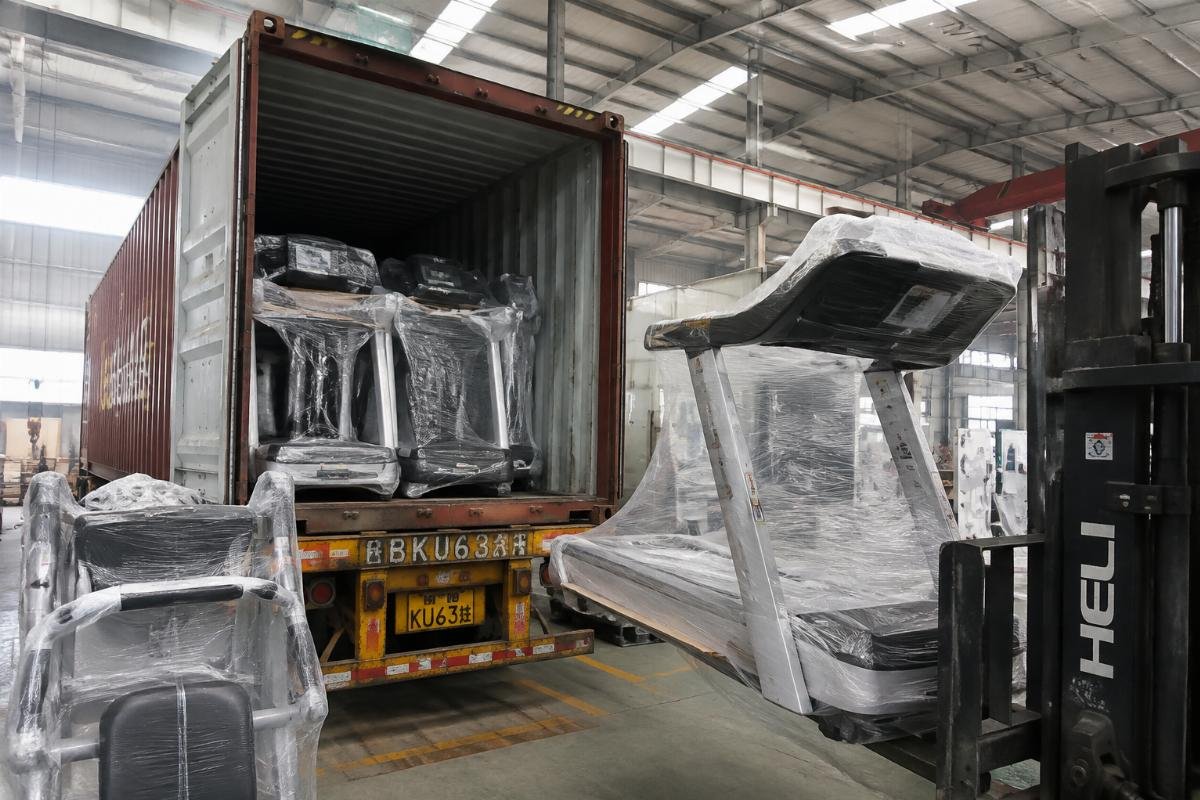
I’ve loaded countless mixed containers at Qingdao—air bikes strapped alongside power racks, rowing machines nested between plate-loaded stations. The volume utilization math works out far better than shipping multiple LCL consignments from different suppliers.
What Specs Should PT Studio Owners Prioritize?
Commercial-grade frame construction, belt-drive silence, and adjustable resistance are non-negotiable for PT studios running back-to-back HIIT sessions all day.
Not all air bikes are built equal. The market is flooded with residential models dressed up with "commercial" marketing language, but the engineering differences become painfully obvious after a few months of studio use. Here’s what matters:
| Specification Parameter | Residential Grade | Light Commercial | True Commercial Grade |
|---|---|---|---|
| Frame Weight Capacity | Basic rating | Moderate rating | Heavy-duty certified rating |
| Drive System | Chain, unsealed | Chain, basic seal | Belt-drive, sealed |
| Fan Bearing | Standard | Reinforced | Industrial-grade sealed |
| Pedal Crank Material | Stamped steel | Cast aluminum | Forged alloy |
| Console Adjustability | Fixed | Tilt only | Multi-axis adjustable |
| Resistance Control | Fan-only | Fan + basic magnetic | Fan + progressive magnetic |
[NEED_CITE: commercial fitness equipment durability testing standards per EN957]
The fan bearing is where most budget air bikes fail silently. During a HIIT class, users go from zero to maximum effort in seconds. That sudden torque transfer hammers the bearing with shock loads that residential units simply aren’t engineered to survive. I’ve seen bearings on light-duty units develop play and noise within a single quarter of studio operation. True commercial units use sealed industrial bearings designed for continuous high-torque cycling.
Belt-drive versus chain-drive is another critical distinction. In a PT studio environment, multiple air bikes run simultaneously in close proximity. Chain drives generate noticeable noise and require regular lubrication. Belt-drive systems operate quietly and maintenance-free—essential when you’re running six or eight units in a single training space. [NEED_CITE: noise level comparison between chain-drive and belt-drive fitness equipment]
Frame weight capacity tells you more about engineering philosophy than any marketing brochure. A true commercial air bike should support substantially higher user weight than residential models, with reinforced weld points at high-stress junctions. Look for frames built from heavy-gauge steel tubing with gusseted joints at the seat post and handlebar clamp areas.
The console and resistance system matter for client experience. PT studios need equipment that allows smooth, incremental resistance adjustment—not just "fan speed" that jumps between vague levels. Progressive magnetic resistance paired with fan drag gives trainers precise control over workout intensity.
How to Avoid HS Code Traps at Manila Port?
Misclassified HS codes are the single most common reason fitness equipment shipments get stuck at Manila port, turning a routine delivery into an expensive ordeal.
The Philippines Bureau of Customs maintains strict documentation requirements, and fitness equipment sits in a classification gray zone that trips up inexperienced importers regularly. Air bikes don’t fit neatly into obvious categories—are they bicycles? Exercise equipment? Something else entirely?
The correct HS code for commercial air bikes falls under exercise apparatus categories, not under bicycle or vehicle classifications. [NEED_CITE: Philippine Bureau of Customs tariff classification for fitness exercise equipment] Getting this wrong triggers immediate red flags during document review, leading to physical inspection holds that can stretch into weeks.
I’ve watched importers try to classify air bikes under pedal-cycle headings to chase a lower duty rate. That approach backfires every time. Customs officers at Manila port are familiar with fitness equipment imports and will flag mismatches between declared product descriptions and actual cargo. The result isn’t just a reclassification—it’s extended storage fees, potential penalties, and delayed equipment arrival that disrupts studio opening timelines.
The key is alignment between your supplier’s commercial invoice, packing list, and your customs broker’s classification before the vessel departs. A reliable manufacturer provides detailed product specifications, photographs, and technical descriptions that support accurate classification. Don’t assume your broker knows what an air bike is—send them spec sheets, images, and a clear product description well in advance.
BPS (Bureau of Philippine Standards) certification requirements also factor into the import process. While most commercial fitness equipment doesn’t require mandatory BPS certification for clearance, certain components or product categories may trigger additional scrutiny. [NEED_CITE: BPS compulsory certification product list for imported fitness equipment] Your customs broker should confirm current requirements before shipment, not after the container arrives.
Documentation completeness is equally critical. Missing certificates of origin, incomplete commercial invoices, or vague product descriptions all increase inspection probability. I recommend preparing a complete document package—including product catalogs, technical drawings, and material certifications—and sharing it with your broker for pre-shipment review.
A Southeast Asian gym owner once told me his first import attempt took nearly a month longer than planned because his broker classified the equipment incorrectly. The storage fees alone consumed a significant portion of his budget. Now he works with his broker to pre-clear classifications on every new product category before ordering.
Can You Consolidate Air Bikes with Other Gym Gear?
Absolutely—and smart studio owners use container consolidation to transform equipment sourcing from a piecemeal headache into a streamlined one-stop process.
A PT studio doesn’t open with just air bikes. The functional training zone needs kettlebells, medicine balls, battle ropes, and plyo boxes. The strength section requires power racks, cable machines, and adjustable benches. The free-weight area demands dumbbells, barbells, plates, and storage racks. Flooring, mirrors, and accessories complete the picture.
Sourcing all of this from separate suppliers means managing multiple production timelines, coordinating separate shipping schedules, and paying freight costs on multiple LCL (Less than Container Load) shipments. The logistics complexity multiplies quickly, and the freight cost per unit becomes inefficient.
Container consolidation solves this by loading equipment from a single manufacturer into one full container. Air bikes can be disassembled and packed efficiently alongside flat-packed power racks, boxed dumbbell sets, and palletized flooring. The volume utilization improves dramatically compared to shipping each product category separately. [NEED_CITE: container loading optimization for mixed fitness equipment shipments]
Bick specializes in exactly this kind of comprehensive gym package sourcing. Their product range spans the full spectrum—cardio equipment including air bikes, treadmills, ellipticals, and rowing machines; strength machines from Smith machines to cable crossovers; free weights covering every dumbbell, barbell, and plate size; functional training gear from battle ropes to plyo boxes; and complete gym flooring solutions.
A boutique studio owner in Manila recently consolidated an entire facility setup into a single container order: air bikes for the HIIT zone, a functional trainer and cable crossover for strength work, a complete dumbbell set with storage rack, kettlebells, medicine balls, and rubber flooring tiles. Everything arrived together, coordinated by one supplier, loaded into one container. The freight cost per piece of equipment dropped substantially compared to sourcing each item separately.
The consolidation approach also simplifies quality control and warranty management. When everything comes from one manufacturer, you have a single point of contact for technical support, spare parts, and warranty claims. If an air bike console develops an issue or a cable machine needs adjustment, you’re not tracking down five different suppliers across different time zones.
Container loading requires planning, though. Air bikes pack relatively efficiently when disassembled, but bulky items like power racks and cable machines need strategic placement to maximize space. Experienced manufacturers provide loading plans that optimize container volume while ensuring equipment arrives without damage. [NEED_CITE: container loading best practices for fitness equipment]
What After-Sales Support Is Needed for High-Usage Equipment?
Commercial air bikes in PT studios operate under extreme usage conditions, making spare parts availability and technical support access critical to minimizing downtime.
A PT studio running multiple classes daily puts air bikes through punishing use cycles. Unlike a home user who might ride thirty minutes a day, studio equipment endures back-to-back sessions with different users, constant resistance adjustments, and high-intensity torque loads. Components that would last years in residential use may need replacement within a single year of commercial operation.
The manufacturer’s spare parts policy becomes a make-or-break factor. Some suppliers sell equipment and disappear—good luck finding replacement fan bearings, console boards, or pedal assemblies six months later. Others maintain spare parts inventory and can ship replacements quickly when needed.
Bick provides comprehensive after-sales support including spare parts supply and remote technical guidance. When a studio owner encounters an issue—whether it’s a worn drive belt, a malfunctioning console sensor, or a loose crank arm—they can contact the manufacturer directly for troubleshooting assistance and parts ordering. [NEED_CITE: commercial fitness equipment after-sales support best practices]
Spare parts kits are particularly valuable for high-usage environments. Ordering a package of commonly worn components—drive belts, pedal straps, console cables, bearing seals—at the time of initial equipment purchase ensures you have replacements on hand before failures occur. The cost is minimal compared to the revenue lost when equipment sits idle waiting for parts to ship internationally.
Technical documentation also matters. Detailed assembly manuals, maintenance schedules, and troubleshooting guides empower studio staff to handle routine maintenance and minor repairs without waiting for external technicians. Manufacturers who provide comprehensive documentation reduce dependency on specialized service calls.
Remote technical support via video calls or messaging platforms has become standard practice. When an issue arises, studio owners can share photos or videos with the manufacturer’s technical team for real-time diagnosis. This approach resolves many problems quickly without requiring on-site visits.
Warranty terms should be clearly documented before purchase. Understand what components are covered, what the claim process involves, and how long replacement parts take to arrive. A manufacturer confident in their product quality will offer transparent warranty terms and responsive support.
Conclusion
Direct importing air bikes from China to the Philippines delivers substantial cost savings and customization flexibility for PT studio owners willing to navigate the logistics. The keys to success are selecting true commercial-grade specifications, aligning HS code classifications with customs brokers before shipment, consolidating equipment orders into full containers, and securing reliable after-sales support with spare parts availability. Factory-direct sourcing transforms equipment procurement from a fragmented, expensive process into a streamlined operation that supports studio growth.