Commercial Spin Bike Container Consolidation with Other SKUs Bulk
Most buyers think container consolidation is just about stuffing everything in until the doors close. The real bottleneck is destination customs logic for mixed-category classification.
You can legally consolidate commercial spin bikes with strength machines, free weights, and cardio SKUs in one container, provided you separate HS codes by resistance type and function, distribute weight to match declared line items, and prepare category-specific compliance documents before the vessel sails.
I still remember a shipment out of Qingdao Qianwan Port where a buyer in West Africa ordered three containers of commercial spin bikes alongside Smith machines. The forwarder lumped everything under a single fitness equipment code. Customs flagged it immediately. The containers sat on the terminal for nearly two weeks, and the detention charges ended up eating into the margin on the entire order. That kind of misclassification does not just cost money in port fees; it burns trust with the buyer and delays gym opening timelines by weeks. Since then, I personally review every mixed-SKU packing list and HS code split before cargo leaves the factory floor. [NEED_CITE: WCO HS nomenclature classification rules for exercise cycles versus strength training machines]
The lesson is simple: consolidation works, but only when you treat each SKU category as a separate customs entity inside the same steel box. Below is how to do it right.
What SKUs Can Be Safely Consolidated with Commercial Spin Bikes?
Commercial spin bikes consolidate cleanly with plate-loaded strength machines, cable crossovers, power racks, free weights, benches, and most cardio equipment like ellipticals and rowing machines. Avoid mixing them with consumer electronics, lithium battery packs, flammable gym flooring adhesives, or hazardous cleaning chemicals.
The reason is straightforward. Fitness equipment shares a common structural DNA: steel frames, rubber grips, plastic shrouds, and mechanical resistance systems. Customs authorities across most importing countries recognize these as a coherent product family under the broader fitness machinery heading. [NEED_CITE: FIGFA international trade guidelines on fitness equipment shipment categorization]
However, certain items trigger entirely different regulatory pathways. Lithium battery packs for electronic consoles fall under dangerous goods classification. Rubber flooring rolls with chemical adhesives may require material safety declarations. Mixing these with a container full of commercial spin bikes forces the entire shipment into a more complex inspection queue.
A distributor in the MENA region once requested we load commercial spin bikes alongside a batch of LED display panels and battery-powered resistance bands in a single container. We flagged the risk immediately. The battery items alone would have required IMDG documentation, and the mixed declaration would have invited a full physical inspection at Jebel Ali. We restructured the order into two separate shipments: one for the mechanical fitness equipment and one for the electronic components. The buyer saved on inspection fees and avoided a potential two-week hold.
Items that consolidate well with commercial spin bikes:
- Plate-loaded and selectorized strength machines
- Smith machines and power racks
- Cable crossover units
- Dumbbells, barbells, kettlebells, and weight plates
- Adjustable and flat benches
- Ellipticals, rowing machines, and manual treadmills
- Functional training rigs and plyo boxes
Items to ship separately:
- Lithium battery packs and powered electronic consoles
- Chemical adhesives and flooring compounds
- Aerosol cleaning products
- Flammable lubricants
How to Classify HS Codes Correctly for Mixed Fitness Containers?
Commercial spin bikes must be declared under the cycle ergometer subheading, while strength machines require a separate classification based on their resistance mechanism. You cannot use a single blanket fitness equipment code for a mixed container.
This is where most consolidation shipments fail. The World Customs Organization nomenclature draws a clear line between exercise cycles with adjustable resistance mechanisms and other strength training apparatus. [NEED_CITE: WCO Harmonized System heading 9506 subheading differentiation between cycle ergometers and other strength training equipment]
Commercial spin bikes, whether they use magnetic resistance, brake pad resistance, or generator-based systems, fall under the cycle ergometer classification. Strength machines: Smith machines, plate-loaded leg presses, cable crossovers, and selectorized stacks: carry their own subheading based on function. Free weights like dumbbells and barbells often require yet another line item.
A gym owner in Southeast Asia ordered a full commercial package: commercial spin bikes, power racks, plate-loaded machines, and a full set of dumbbells. The supplier declared everything under one generic code to simplify paperwork. At the destination port, customs officers noticed the weight declaration did not match the expected profile of a pure cycle ergometer shipment. The container was held for physical inspection. The reclassification and penalty processing added nearly two weeks of delay, and the buyer had to pay a licensed customs broker to file amended entries for each SKU category.
The correct approach requires line-by-line separation on the commercial invoice:
- Line 1: Commercial spin bikes, cycle ergometer classification, with unit count and total net weight
- Line 2: Strength training machines, separate subheading, with unit count and total net weight
- Line 3: Free weights, distinct code, with total weight in kilograms
- Line 4: Benches and accessories, their own classification if applicable
Each line must match the packing list breakdown. If the commercial invoice shows four distinct product categories, the packing list must show four distinct packaging groups with corresponding weights and volumes. Any mismatch between declared weight ratios and actual cargo composition invites inspection. [NEED_CITE: China Customs export declaration rules for multi-SKU fitness equipment shipments]
What Is the Optimal Loading Plan for a Mixed Gym Equipment Container?
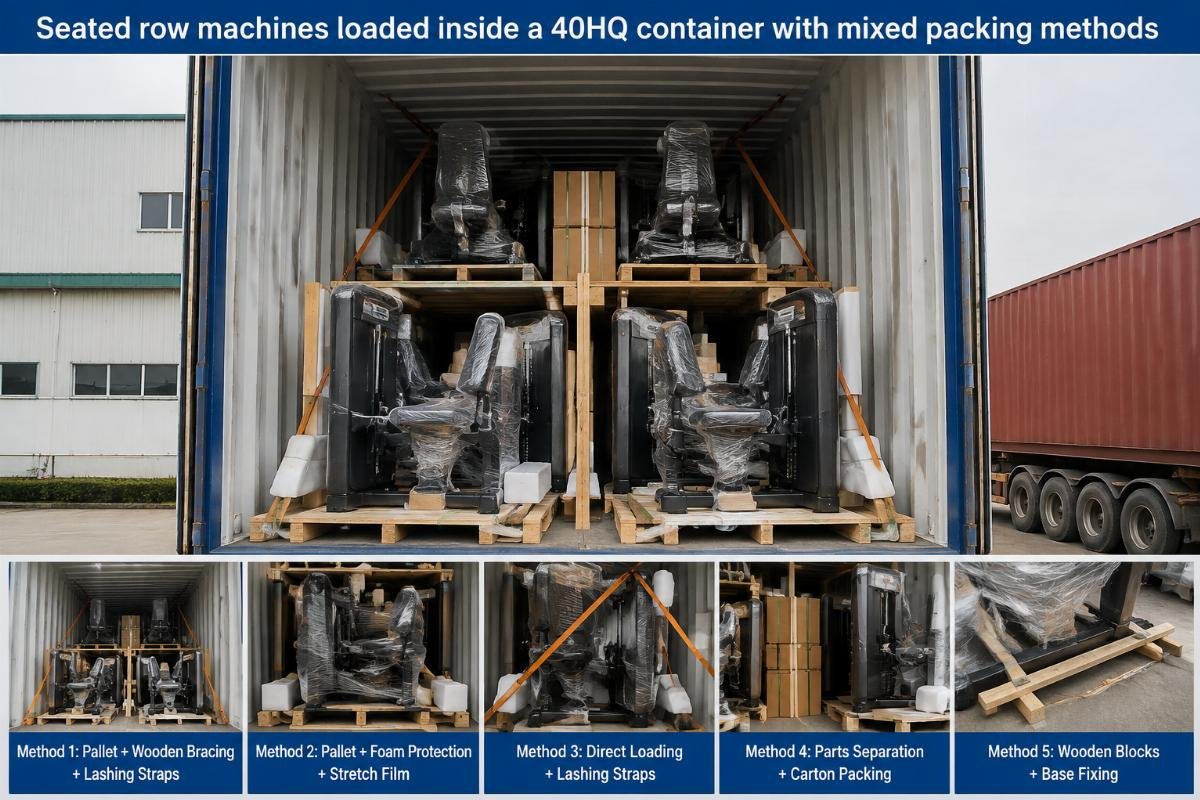
Heavy steel strength frames go on the bottom, caged commercial spin bikes occupy the middle layer, and loose accessories plus boxed free weights fill the top and gap spaces. The goal is to match the weight distribution to your declared line-item ratios while maximizing cubic meter utilization.
A container is not a puzzle where you just jam pieces together. It is a weight-bearing structure with axle limits, door-side balance requirements, and center-of-gravity constraints. When you mix commercial spin bikes with plate-loaded strength equipment, the weight disparity is significant. A single plate-loaded leg press can weigh several times more than a commercial spin bike. If you stack all the heavy machines on one side, the container tilts, and the forklift operator at the destination cannot safely unload it.
We once prepared a full gym package for a hotel project in Southeast Asia. The order included commercial spin bikes, power racks, plate-loaded machines, and a complete dumbbell set, all going into a single high-cube container. The loading sequence was planned in advance: the heaviest plate-loaded units were positioned against the bulkhead, commercial spin bikes were loaded upright and secured inside the power rack frames to use otherwise dead space, and boxed dumbbells filled the remaining gaps near the doors. This approach saved a meaningful percentage of otherwise wasted volume and kept the weight balanced across the container floor.
Key loading principles for mixed fitness containers:
- Bottom layer: Heaviest items first. Plate-loaded machines, Smith machine frames, and bundled weight plates go directly on the container floor, positioned symmetrically left and right of the centerline.
- Middle layer: Commercial spin bikes, loaded upright in their protective cages. If power racks are in the shipment, spin bikes can be loaded inside the rack frames to use internal volume that would otherwise be empty.
- Top and gap fill: Boxed free weights, benches, resistance bands, and accessory cartons. These fill the spaces between larger items and prevent shifting during transit.
- Door side: Lighter boxed items only. Never stack heavy machines against the doors; they create a collapse hazard when the doors are opened at destination.
The packing list must reflect this sequence. If customs inspects the container and finds the heaviest items declared on line three sitting on top of lighter items declared on line one, it raises questions about whether the declaration was accurate to begin with. [NEED_CITE: Container loading weight distribution best practices per international shipping guidelines]
Which Documents Prevent Customs Delays on Mixed Fitness Shipments?
A line-item-separated commercial invoice, a category-broken packing list, and SKU-specific compliance certificates like CE or EN test reports for each product family are the minimum documentation package to clear a mixed fitness container without delay.
Documentation is where consolidation either succeeds or collapses. You can load the container perfectly and classify every HS code correctly, but if the paperwork does not mirror the physical cargo breakdown, customs will treat it as a discrepancy.
The commercial invoice must show each product category on its own line with its own HS code, unit quantity, unit price, total value, and total net weight. Do not combine commercial spin bikes and strength machines into a single line that reads "gym equipment, one lot." That phrasing is a red flag for customs officers trained to look for undervaluation or misclassification. [NEED_CITE: International chamber of commerce commercial invoice preparation guidelines for multi-category shipments]
The packing list must break down by category as well: how many cartons or crates for spin bikes, how many for strength machines, how many pallets for free weights, and the gross and net weight of each group. If the invoice says the spin bikes weigh a certain total and the packing list says something different, the shipment gets flagged.
Compliance certificates must be organized per SKU family. If the destination country requires CE marking for fitness equipment, you need test reports that specifically cover the commercial spin bike model and separate reports for the strength machine models. A single blanket certificate that says "fitness equipment" without specifying product types will not satisfy most rigorous customs authorities.
A distributor in Latin America received a container where the supplier had provided one CE certificate covering all items. The local customs authority rejected it because the certificate did not explicitly list the commercial spin bike model or the specific strength machines in the shipment. The buyer had to request revised certificates from the manufacturer, which took several weeks of back-and-forth communication while the container sat in a bonded warehouse accruing storage fees.
Essential document checklist:
- Commercial invoice with line-item HS code separation
- Packing list with category-level weight and volume breakdown
- Bill of lading matching the invoice line structure
- CE or EN test reports per product family, explicitly naming the models shipped
- Certificate of origin if required by the destination country trade agreement
- Fumigation certificate if wooden packaging or pallets are used
How to Verify Your Supplier’s Consolidation Capability Before Ordering?
Request loading photos from previous mixed-SKU shipments, detailed CBM calculations for your specific order, and redacted bill of lading samples showing how the supplier handled HS code separation on past containers.
Not every fitness equipment factory understands the difference between shipping a single product line and consolidating a full gym package. Some suppliers will happily accept your order for commercial spin bikes, strength machines, and free weights, then load everything into a container with no regard for weight distribution, HS code alignment, or documentation structure. You only discover the problem when the container gets held at destination.
Before committing to a large mixed-SKU order, ask the supplier three things. First, request photos or video from a recent container where they loaded commercial spin bikes together with strength equipment. Look at how the heavy items are positioned, whether the spin bikes are secured properly, and whether the load looks balanced. A supplier who cannot produce this evidence has likely never done a proper mixed consolidation.
Second, ask for a CBM calculation sheet for your specific order. The supplier should be able to tell you exactly how many cubic meters your commercial spin bikes occupy, how many the strength machines take, and what the total utilization rate will be in a standard or high-cube container. If the numbers do not add up to a realistic fill rate, you are either paying to ship empty air or the supplier has not actually planned the load.
Third, request a redacted bill of lading or customs declaration from a past mixed-SKU shipment. This shows you whether the supplier has experience separating HS codes by product category and whether their documentation structure matches what destination customs expects. A supplier who has successfully cleared mixed fitness containers through multiple countries is far less likely to make classification errors on your order.
Bick has been shipping mixed cardio and strength orders from Qingdao port to destinations across multiple regions for years. Every full gym package, whether for a commercial facility, a hotel fitness center, or a distributor warehouse, goes through a container loading plan review before cargo is released. The team prepares CBM calculations, verifies HS code separation, and organizes compliance documentation by product family before the container is sealed.
Conclusion
Container consolidation for commercial spin bikes with other fitness SKUs saves freight costs, but only when HS codes are separated by product function, weight distribution is planned before loading, and compliance documentation mirrors the physical cargo breakdown. Treat every product category as its own customs entity inside the same container, and the shipment will clear smoothly. Ignore these details, and the port detention fees will erase whatever freight savings the consolidation was supposed to deliver.