Buy Olympic Bench for Sale | Bick Commercial Gym Manufacturer
Thicker steel does not mean a longer-lasting bench. Foam density, upholstery temperature resistance, and weld integrity decide whether an Olympic bench survives commercial use or ends up cracked in a shipping container.
When sourcing an Olympic bench for sale, prioritize foam density ratings, upholstery heat tolerance, frame cross-section geometry, and rack sleeve compatibility over raw weight claims and tube thickness alone.
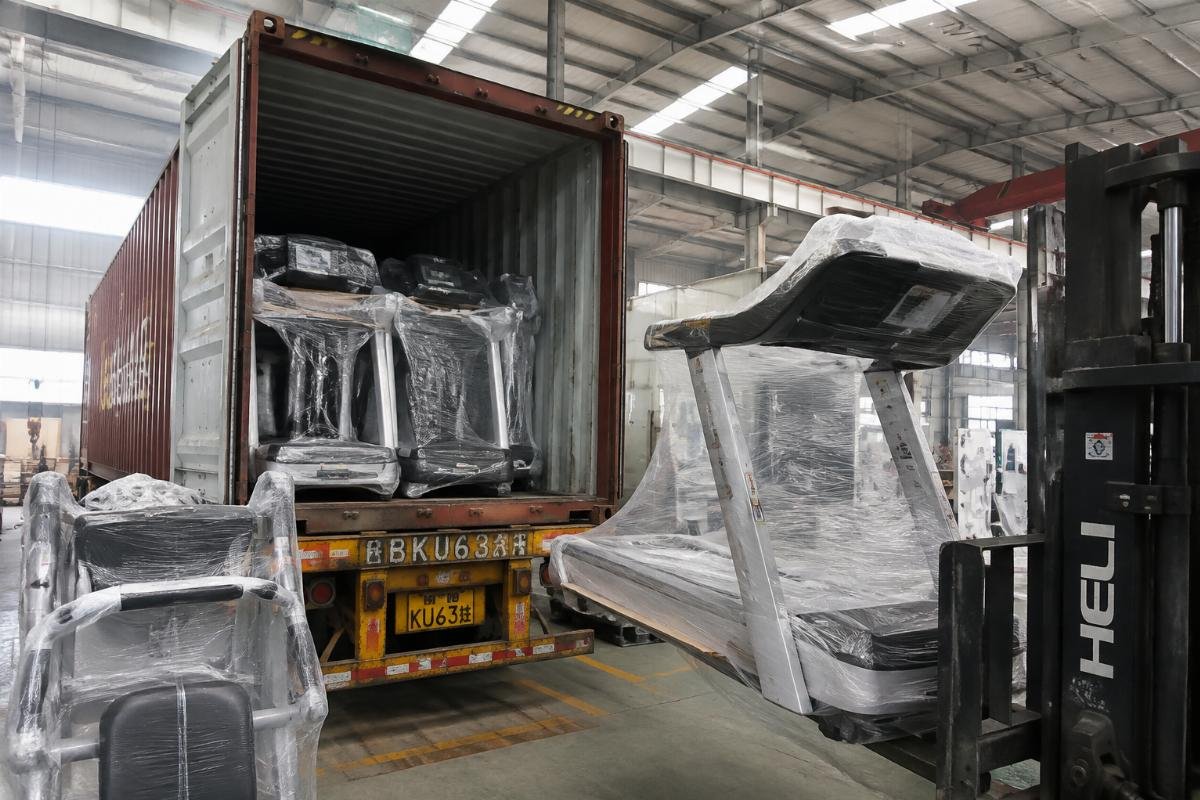
I spent two weeks on-site at a newly opened high-end gym in Riyadh supervising installation. The flat benches arrived, and the owner immediately noticed the upholstery was already splitting across the seat pads. The container had been sitting in port under direct Middle Eastern sun for over a month, with internal temperatures soaring well beyond what standard PU leather can handle. At the time, I had recently moved from a quality inspection role at the factory into trade, and I assumed having full CE documentation meant the product was bulletproof. The client pointed at the cracked pads and demanded a full replacement. The round-trip ocean freight alone cost several times the value of the benches themselves. That single shipment reshaped how I evaluate every piece of padded equipment leaving the factory floor. [NEED_CITE: commercial gym equipment failure root cause distribution by component type]
Let me walk you through the specs that actually determine whether an Olympic bench for sale will hold up in a real commercial environment.
What Specs Actually Matter When Buying an Olympic Bench?
Load capacity ratings are merely the entry threshold. Foam density, upholstery thermal resistance, and weld penetration depth are the true predictors of commercial lifespan.
Most spec sheets lead with maximum user weight and frame load. Those numbers matter, but they tell you almost nothing about what fails first in daily commercial use. The seat pad compresses. The vinyl cracks. The welds develop hairline fractures under repetitive loading. These are the failure modes that generate warranty claims and replacement costs.
| Spec Category | What Most Buyers Check | What Actually Determines Longevity |
|---|---|---|
| Foam | Hardness feel by hand press | Density rating and compression set resistance |
| Upholstery | Color and stitch appearance | Thermal tolerance range and abrasion rating |
| Frame | Wall thickness claim | Cross-section geometry and weld penetration |
| Base | Overall weight | Footprint distribution and non-slip pad material |
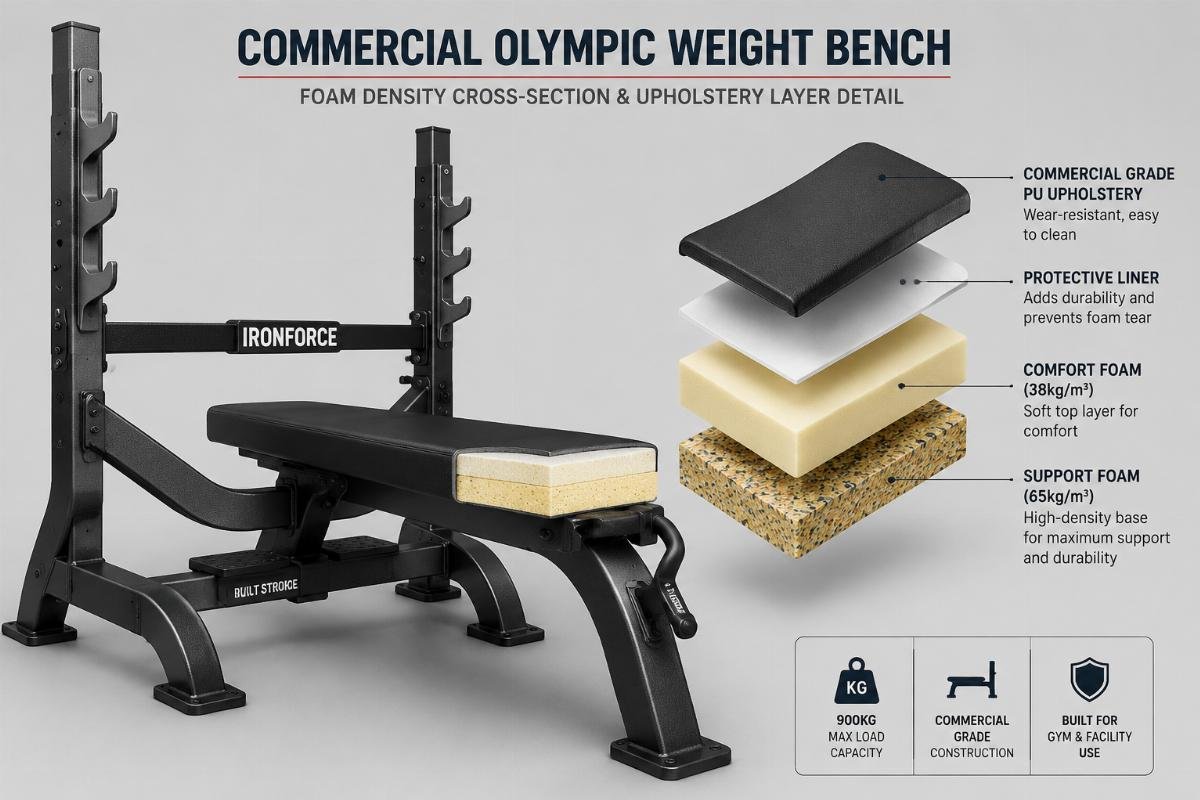
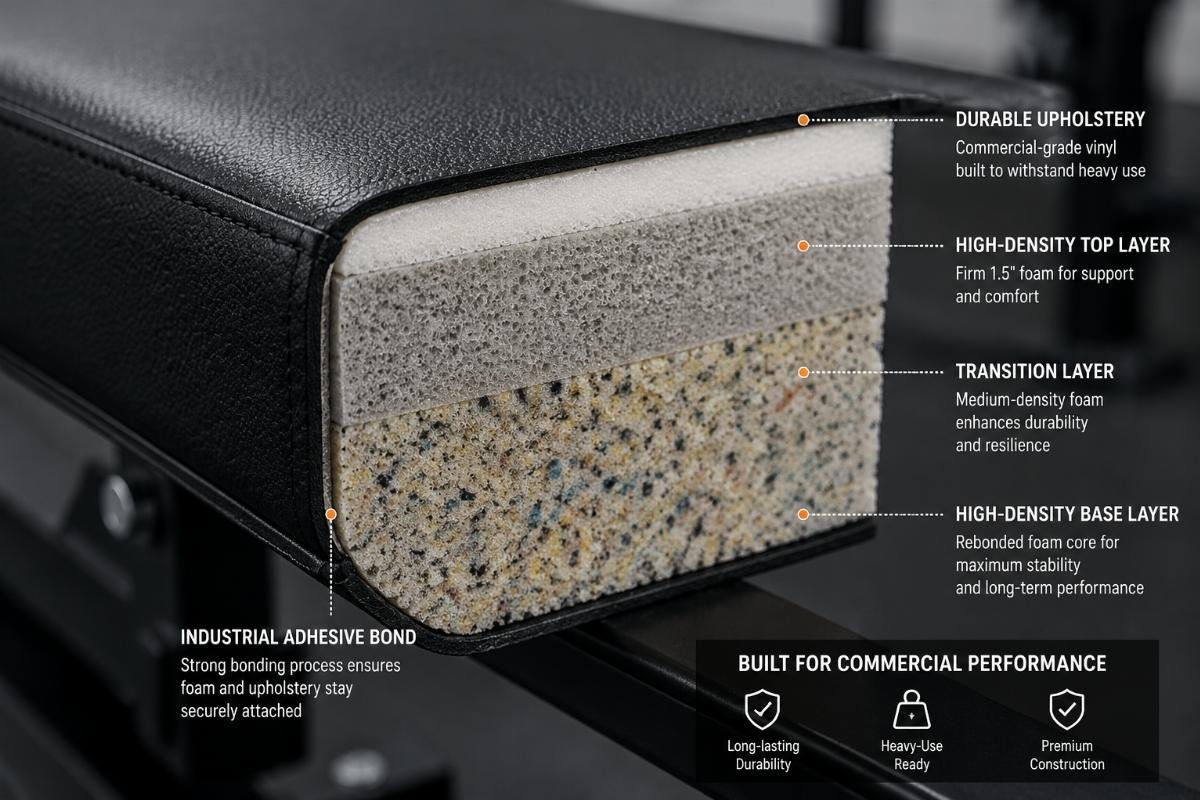
Foam density sits at the top of the list for a reason. A commercial Olympic bench in a high-traffic gym may see dozens of users per day, every single day. Low-density foam compresses permanently within months, leaving users bottoming out on the steel support plate beneath. The fix is expensive and the reputation damage is worse. [NEED_CITE: foam compression set testing standards for commercial fitness upholstery]
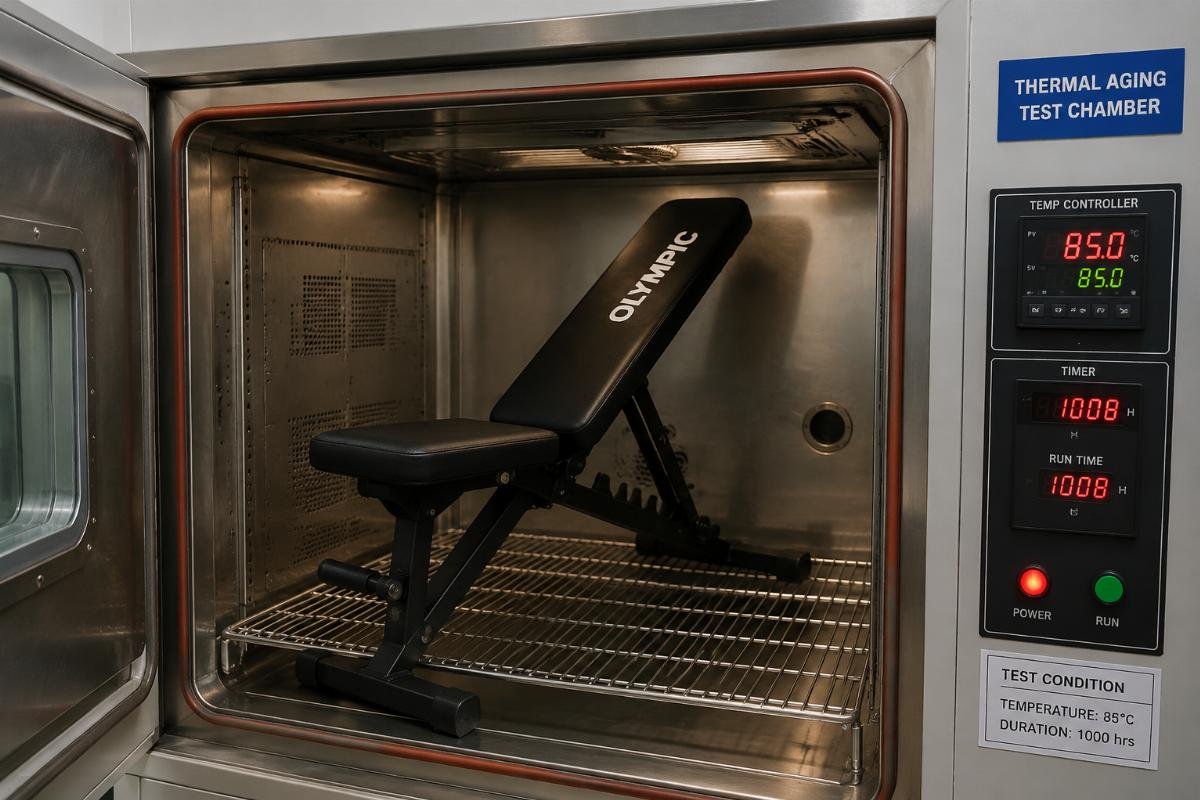
Upholstery thermal resistance matters far more than most buyers realize, especially for shipments to hot climates. Standard PU leather begins to degrade at sustained elevated temperatures, losing plasticizers and becoming brittle. If your Olympic bench for sale is headed to the Middle East, West Africa, or Latin America, you need upholstery rated for significantly higher thermal thresholds.
When we prepare commercial Olympic bench orders for high-heat destination markets, we run accelerated aging tests on the upholstery material and provide the test reports alongside the shipment. This is not an upsell, it is basic risk management. A container sitting on a dock in Jeddah or Lagos can reach internal temperatures that destroy standard vinyl in weeks.
How to Verify Foam Density and Upholstery Durability?
Request third-party foam density test reports and upholstery thermal cycling data from the factory. Visual inspection and hand-press tests are unreliable for commercial-grade assessment.
Here is the verification process I follow for every padded commercial Olympic bench for sale we ship:
-
Foam density certificate review. Ask for the kg per cubic meter rating with a test method reference. Commercial-grade padding should sit in the higher density range. Anything below that threshold will show visible permanent deformation under sustained commercial use. [NEED_CITE: recommended foam density ranges for commercial fitness equipment seating per industry guidelines]
-
Compression set data. Density alone is not enough. The foam must also resist permanent deformation after repeated compression cycles. Request compression set test results, which measure how much height the foam loses after a standardized compression hold.
-
Upholstery thermal tolerance range. Ask for the temperature range the vinyl can withstand without cracking, peeling, or losing flexibility. For tropical and desert climates, the upper threshold needs to be substantially higher than standard indoor ratings.
-
Abrasion resistance rating. Commercial benches see constant contact with sweat, clothing friction, and occasional equipment contact. The upholstery surface needs to resist surface wear over extended periods.
-
Stitch pattern and thread specification. Double-stitched seams with bonded nylon thread outperform single-stitch construction dramatically. Ask for stitch-per-inch counts and thread material specs.
A distributor in West Africa once received a full container of adjustable benches from a previous supplier. Within months, the seat pads on the commercial Olympic bench units had flattened noticeably, and several units showed upholstery splitting along the seam lines. The supplier had provided CE certificates but no material test data. The replacement cost, including reverse logistics and re-shipping, ran into mid-five figures. [NEED_CITE: case documentation of commercial fitness equipment material failure in tropical climates]
The lesson is straightforward: certificates prove regulatory compliance, not material durability. For an Olympic bench for sale destined for heavy commercial use, material test reports are the documents that actually protect your investment.
Why Does Frame Thickness Mislead Buyers?
Tube wall thickness alone does not determine frame rigidity. Cross-section shape, gusset placement, and weld penetration depth matter equally or more.
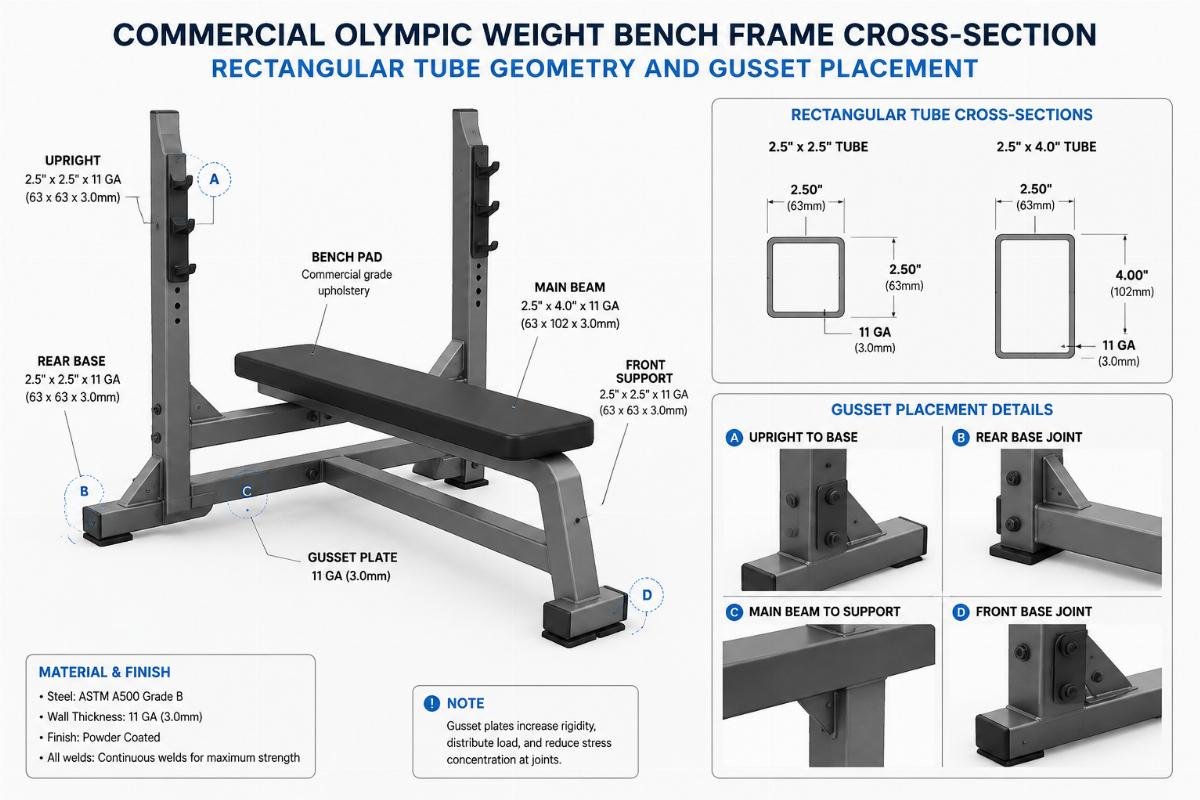
The first question most buyers ask about frame specs is wall thickness. It is an intuitive metric, and it is also deeply misleading when used in isolation. A rectangular tube with thicker walls but a smaller cross-section can be less rigid than a larger tube with moderately thick walls. The moment of inertia, which governs resistance to bending, depends on the overall geometry of the cross-section, not just the wall dimension.
| Frame Factor | Common Buyer Assumption | Engineering Reality |
|---|---|---|
| Wall thickness | Thicker equals stronger | Cross-section geometry governs bending resistance |
| Tube shape | Round and rectangular perform equally | Rectangular sections resist multi-axis loading more effectively for bench frames |
| Weld type | All welds are equivalent | Full penetration welds at stress points prevent fatigue cracking |
| Gusset presence | Optional reinforcement | Essential at joint intersections for Olympic bench with rack for sale configurations |
At stress concentration points, particularly where the seat support meets the base frame and where rack uprights attach, full penetration welds are non-negotiable. Surface-level tack welds may look clean in photos but will develop fatigue cracks under repetitive commercial loading. [NEED_CITE: welding inspection standards for commercial fitness equipment structural frames]
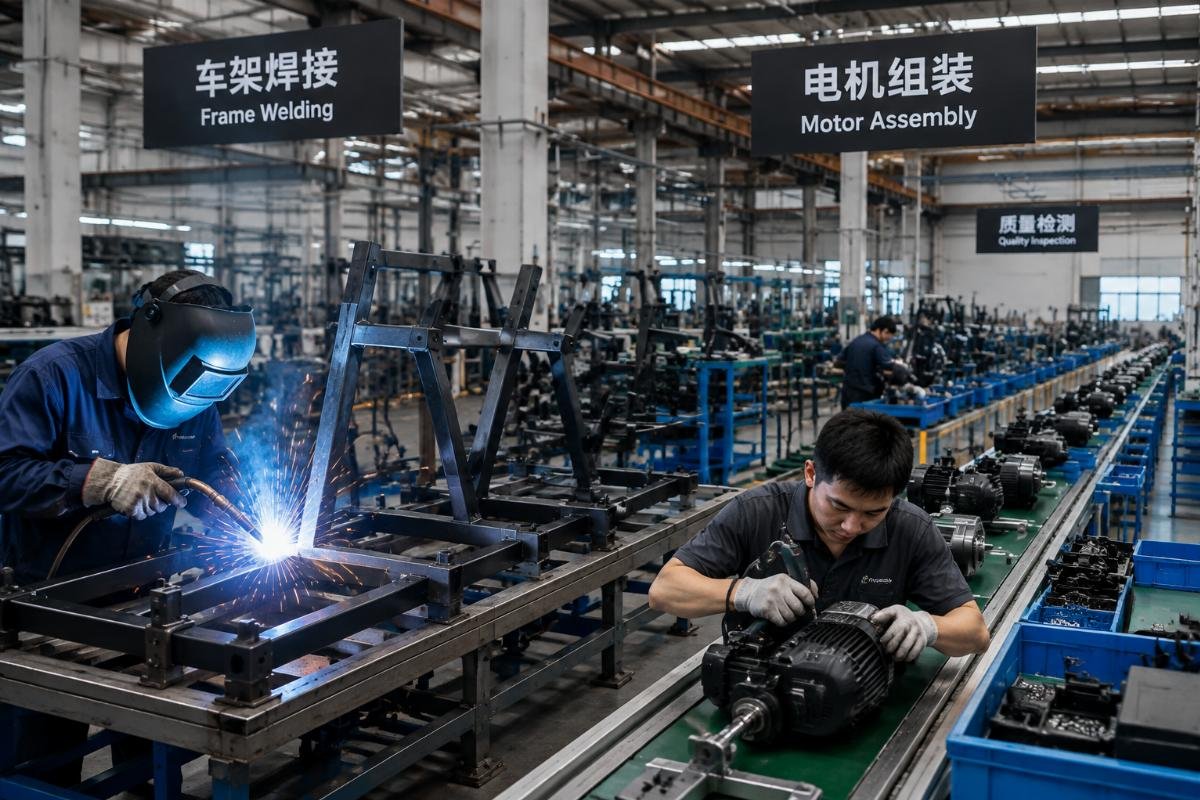
When evaluating an Olympic flat bench manufacturer, request cross-section drawings and close-up weld photographs at joint intersections. A factory confident in its welding process will provide these without hesitation. If the response is vague or defensive, that is your signal to look elsewhere.
For an Olympic bench with rack for sale, the rack mounting interface deserves particular attention. The junction between the bench frame and the rack uprights carries eccentric loads during heavy pressing movements. Inadequate gusseting or shallow weld penetration at this junction is a structural failure waiting to happen.
How to Ensure Olympic Barbell and Rack Compatibility?
Confirm sleeve diameter tolerance, J-cup spacing alignment, and rack hole pitch before placing the order. Mismatched dimensions turn a new bench into an unusable paperweight.
Compatibility sounds like a basic concern, yet it generates a surprising volume of post-delivery complaints. The most common issues involve the barbell sleeve sliding loosely in the J-cups or catching on the rack hole edges during re-racking. These problems stem from dimensional tolerances that were never verified before shipment.
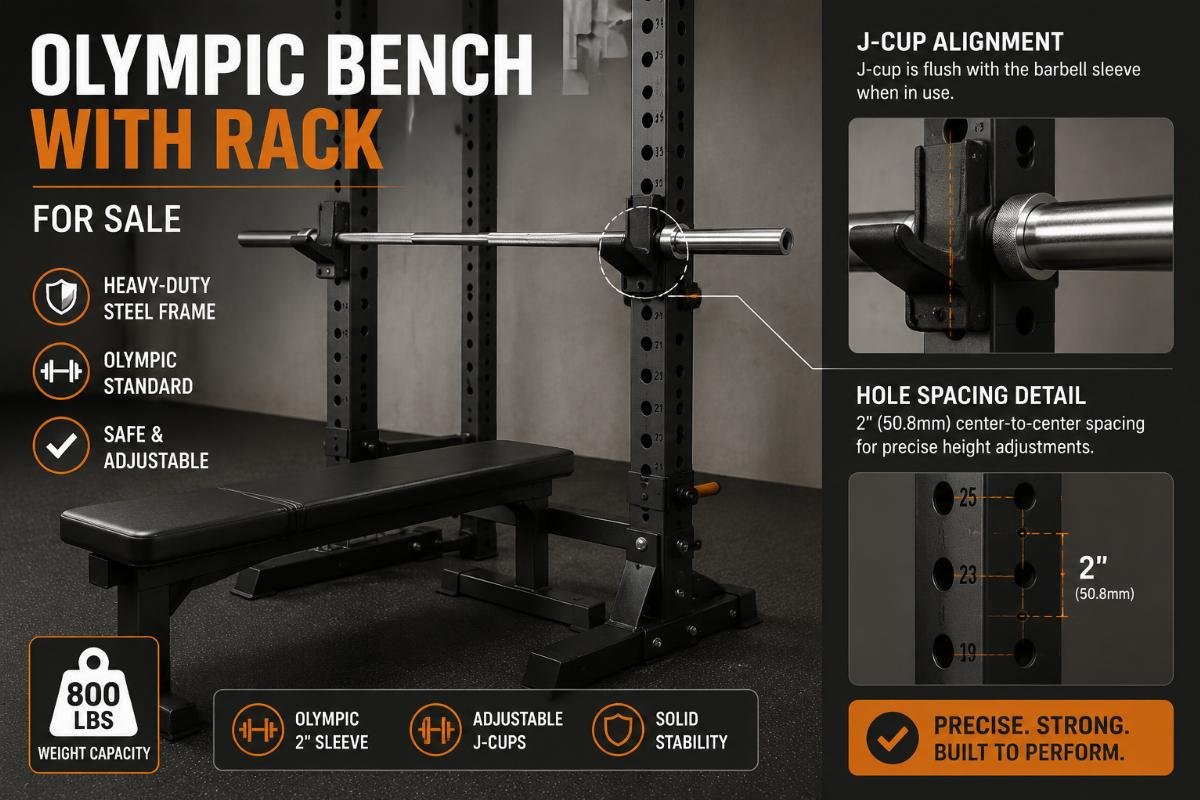
The Olympic barbell sleeve standard diameter is well established, but manufacturing tolerances vary across producers. A sleeve at the upper end of the tolerance range may fit snugly in one set of J-cups and bind in another. Similarly, rack hole spacing that deviates even slightly from the expected pitch can leave the barbell resting at an awkward angle or prevent the J-cups from aligning with the sleeve at all.
For any Olympic bench for sale intended to pair with a power rack or half rack, verify the following before ordering:
- Sleeve diameter compatibility range. Confirm the J-cup width accommodates the full tolerance band of Olympic sleeves, not just the nominal dimension.
- Hole spacing standard. Verify the rack hole pitch matches the spacing expected by the bench-mounted or standalone J-cup set. Mismatched hole spacing is the single most common cause of rack-bench incompatibility. [NEED_CITE: standard hole spacing specifications for commercial power racks and Olympic bench rack interfaces]
- J-cup mounting interface. Confirm whether the J-cups attach via pin-and-hole, weld-on, or bolt-through methods, and that the chosen method aligns with your rack system.
- Clearance under load. The bench pad should not interfere with barbell path during the press movement, particularly at the catch point. Pad height relative to J-cup position needs to be verified for your specific setup.
We maintain a compatibility verification checklist for every Olympic bench with rack for sale configuration we ship. The checklist covers sleeve tolerance, hole pitch, J-cup type, and pad-to-cup clearance. It takes minutes to complete and prevents problems that would otherwise surface only after the container has been unloaded at the destination.
What Should You Ask the Supplier Before Placing an Order?
Request material test reports, thermal aging data, weld process documentation, and a rack compatibility verification checklist. CE certificates alone do not cover commercial durability.
Before committing to an order for an Olympic bench for sale, compile a supplier questionnaire that goes well beyond catalog specs and pricing. The questions below separate factories that build for commercial longevity from those that build to a price point.
- Can you provide foam density test certificates with test method references? A factory running commercial-grade production will have these on file.
- What is the upholstery thermal tolerance range, and do you have accelerated aging test data? This is critical for shipments to hot climates.
- Can you share cross-section drawings and weld photographs at frame joint intersections? Weld quality at stress points is a structural concern, not a cosmetic one.
- Do you provide a rack compatibility verification checklist for Olympic bench with rack for sale configurations? If they do not have one, ask how they ensure fitment.
- What is your process for handling dimensional tolerance variations in Olympic barbell sleeves? A competent supplier has already thought about this.
- Can you accommodate OEM branding and custom upholstery color matching for container-load orders? For distributors building a private-label lineup, this capability is essential. [NEED_CITE: OEM customization capabilities and MOQ flexibility in commercial fitness equipment manufacturing]
A supplier who answers these questions with documentation and clear processes is a supplier who understands commercial-grade manufacturing. A supplier who deflects or provides only marketing brochures is a supplier who will cost you far more in warranty claims and reputation damage than you save on the purchase price.
For buyers assembling a full gym setup, the ability to consolidate multiple product categories into shared container loads significantly reduces per-unit shipping costs. A manufacturer with a broad product range covering strength equipment, free weights, cardio machines, and functional training gear can support complete facility outfitting from a single source, simplifying logistics and ensuring spec consistency across the floor.
Conclusion
An Olympic bench for sale that survives commercial use is defined by foam density, upholstery thermal resistance, frame geometry, and rack compatibility, not by load capacity claims or tube thickness alone. Verify material test data before ordering, confirm dimensional compatibility for rack configurations, and treat CE certificates as the regulatory floor rather than the durability ceiling. The benches that fail in the field are almost never the ones that were too light, they are the ones whose soft components and structural details were never properly validated.