Olympic Barbell Import to Uzbekistan: Landed Cost & Wholesale Supplier Pricing
Most buyers assume ocean freight is the biggest line item. In reality, inland rail and transit handling through Central Asia often eclipses the sea leg entirely.
The landed cost of Olympic barbells into Uzbekistan comprises four pillars: FOB price, ocean freight plus insurance, Central Asian transit and transshipment charges, and import duties tied to the correct HS classification. Getting the HS code wrong or skipping pre-clearance certification at Almaty or Khorgos can trigger warehouse demurrage that dwarfs the original freight quote.
I still remember a container of free-weight gear I helped route through Almaty a few seasons back. The buyer had a clean CIF quote and thought the job was done. What they did not budget for was the rail swap at the dry port, the mandatory weight-equipment certification paperwork, and three weeks of storage fees while the broker sorted the HS classification. By the time the barbells reached Tashkent, the inland segment and penalties had quietly doubled the original freight estimate. That kind of surprise does not happen because anyone was careless; it happens because the Uzbekistan barbell import duties and transit structure are layered in ways that Western-style CIF quotes simply do not capture. [NEED_CITE: Uzbekistan Customs Committee tariff classification principles for sports and gym equipment]
Let me walk you through how the cost stack actually builds up, where the hidden charges hide, and how to structure the order so the final warehouse price stays predictable.
What Is the Landed Cost Structure for Olympic Barbell Import into Uzbekistan?
The landed cost formula for Olympic barbells entering Uzbekistan follows a fixed sequence: FOB + ocean freight + marine insurance + transit-port handling + inland rail or truck freight + customs duty + VAT. Each layer has its own trigger points, and skipping one usually means paying for it later in the form of delays or penalties.
The ocean leg from a Chinese port such as Qingdao or Lianyungang to a Caspian or Central Asian gateway is only the opening move. From there, the cargo typically moves through a transshipment hub—Almaty in Kazakhstan or the Khorgos dry port on the Kazakh-Chinese border—where containers are either stripped and reloaded onto gauge-changing rail wagons or transferred to trucks for the final run into Tashkent. [NEED_CITE: FIATA multimodal transit standards for landlocked Central Asian destinations]
Here is how the layers typically stack:
- FOB price: The factory invoice for the barbells themselves, including packaging and palletization.
- Ocean freight and insurance: The sea leg to the nearest accessible gateway; insurance is usually a small fraction but non-negotiable for heavy steel goods prone to shifting.
- Transit-port handling: Terminal lifting, container scanning, temporary storage if the rail connection is not immediate, and the physical swap of containers or cargo between transport modes.
- Inland freight: Rail or road haul from the transit hub to Tashkent. This segment is where costs become volatile, because rail slot availability and cross-border truck permits fluctuate seasonally.
- Customs duty and VAT: Calculated on the CIF value at the point of entry into Uzbekistan, based on the declared HS code.
- Brokerage and certification fees: Customs broker charges plus any mandatory conformity documentation for sports equipment.
A gym owner in Tashkent once told me he received a quote that looked extremely competitive on paper. The supplier had quoted CIF Tashkent, which sounded complete. But the quote assumed the buyer would handle all Uzbek import clearance independently, and the supplier had not arranged the required conformity paperwork in advance. The cargo sat at the border crossing for weeks, and the storage invoices kept accumulating. [NEED_CITE: Uzbekistan customs clearance documentation requirements for imported gym and fitness equipment]
The takeaway is simple: a CIF quote to Tashkent is not a landed-cost quote. True landed cost must include every charge from the factory floor to your warehouse door, and for a landlocked destination like Uzbekistan, the inland segment is where budgets usually break.
How to Determine the Correct HS Code for Weight Equipment?
Olympic barbells and most free-weight gym equipment fall under HS heading 9506.91, which covers general physical exercise and gymnasium articles. Getting this classification right at the declaration stage is the single most impactful step in controlling Uzbekistan barbell import duties, because a wrong code can trigger either an overpayment or, worse, a customs hold for re-inspection.
The HS system is structured hierarchically. Chapter 95 covers toys, games, and sports requisites. Heading 9506 covers articles for general physical exercise, gymnastics, athletics, and other sports. Subheading 9506.91 narrows it down to articles for general physical exercise and gymnasium use. Olympic barbells, bumper plates, and standard weight plates all sit comfortably under this code when declared as gym-use equipment. [NEED_CITE: World Customs Organization HS 2022 nomenclature for heading 9506 subheadings]
Here is where mistakes tend to creep in. Some buyers or their brokers attempt to declare barbells under a generic steel or iron articles heading, reasoning that the product is essentially a machined steel bar. That approach is risky for two reasons. First, the duty rate under a steel heading may actually be higher than under 9506.91, defeating the purpose. Second, Uzbek customs officers reviewing the declaration will see a mismatch between the product description and the code, which invites physical inspection and delays.
Another common trap is bundling barbells together with rubber-coated plates or gym flooring in a single line item. Each distinct product category should carry its own HS line, because the duty rates and certification requirements can differ. Mixing them into one line forces the broker to guess at a single classification, and guessing at customs is never a sound strategy.
I worked with a Central Asian distributor who had been importing adjustable dumbbell sets under a heading reserved for industrial machinery parts. It had gone unnoticed for several shipments because the duty differential was small. Then a new customs officer flagged the mismatch during a routine audit, and the entire shipment history for the past year came under review. The retroactive reclassification and penalty were far more expensive than the original duty difference would have been. [NEED_CITE: Eurasian Economic Union customs classification dispute resolution procedures]
The practical rule is to declare Olympic barbells explicitly under 9506.91, with a clear product description referencing gymnasium or physical exercise use. Keep the commercial invoice description aligned with the HS wording. If your broker suggests an alternative code, ask for a written explanation of the duty rate difference and the compliance risk before agreeing.
What Are the Transit and Customs Clearance Hurdles?
The most expensive part of importing Olympic barbells into Uzbekistan is not the sea freight; it is the inland transit chain and the customs clearance process at the border, where documentation gaps trigger storage fees that compound daily.
Uzbekistan is a doubly landlocked country, meaning that any cargo reaching it by sea must first pass through at least one other landlocked nation. The most common transit corridors run through Kazakhstan, either via the Khorgos gateway on the Chinese border or through the port of Aktau on the Caspian Sea. Each transit node introduces handling events, and each handling event is a potential cost point.
At Khorgos or Almaty, containers often need to be transferred from Chinese-gauge rail wagons to CIS-gauge wagons. This gauge change requires either a physical container lift or a cargo strip-and-reload operation. Both options carry terminal charges. If the onward rail slot into Uzbekistan is not pre-booked, the container sits in the dry port yard, and daily storage fees begin to accrue. [NEED_CITE: CIS railway gauge transition procedures and terminal handling charges at Khorgos dry port]
On the customs side, Uzbekistan requires that imported sports and gym equipment be accompanied by conformity documentation confirming that the products meet applicable safety and labeling standards. If this paperwork is not prepared before the cargo arrives at the border, the shipment cannot clear, regardless of whether the duty has been paid. The cargo then moves into a bonded warehouse, where storage costs are calculated per cubic meter per day. For a heavy product like Olympic barbells, the weight-based storage tariffs add up quickly.
I have seen cases where the storage invoice at the transit dry port exceeded the original ocean freight cost. The root cause was never the product itself; it was always a missing certificate or an HS code that the customs officer wanted clarified.
Here is a practical risk checklist for the transit and clearance phase:
- Confirm that the transit route and rail slots are pre-booked with the forwarding agent before the vessel departs.
- Verify that the conformity certificate for gym equipment is prepared and submitted electronically before the cargo reaches the border.
- Ensure the commercial invoice, packing list, and certificate of origin all use product descriptions that match the HS 9506.91 wording exactly.
- Request a written breakdown of all transit-port handling charges from your forwarder, including storage free-days and the daily rate after the free period expires.
- If using a transit hub like Almaty, confirm whether the forwarder offers bonded warehouse consolidation, which can reduce per-unit handling costs for multi-SKU shipments.
How to Optimize Shipping Volume for Cost Efficiency?
The cost-per-unit of Olympic barbells drops significantly when shipping in full container loads versus less-than-container-load consignments, and the breakeven point comes sooner than most buyers expect.
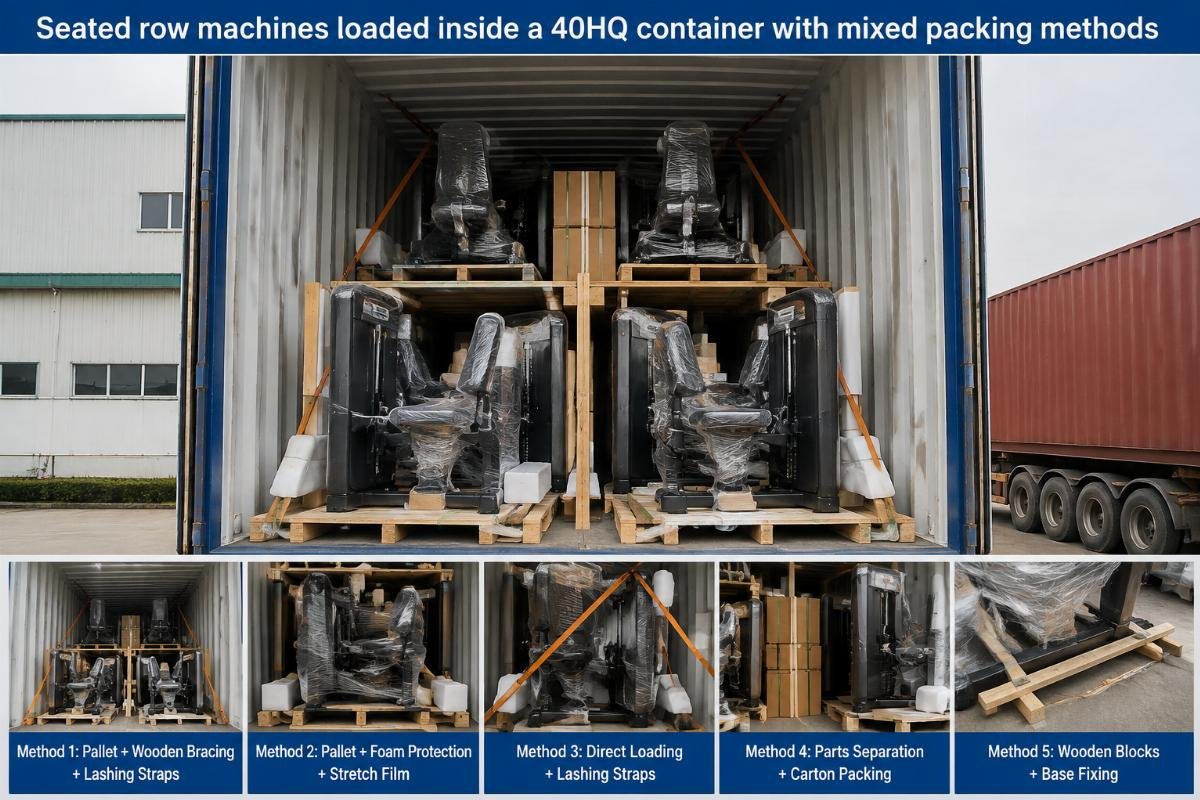
A standard 40-foot high-cube container can hold a substantial volume of barbells and plates, given that the products are dense and stack efficiently on pallets. The fixed costs of the transit chain—customs clearance, broker fees, conformity certification, and the minimum rail booking charges—are spread across every unit in the container. In an LCL shipment, those fixed costs are shared among multiple shippers, but you also pay per cubic meter for the space you occupy, and your cargo is handled more times during consolidation and deconsolidation at the transit hub.
For a commercial gym outfitting a full facility, the math almost always favors a full container. The barbells, plates, and benches can be loaded together, maximizing weight utilization and minimizing the number of handling events. A single container also means a single customs declaration, a single conformity certificate batch, and one transit booking instead of several fragmented LCL slots.
For smaller buyers—boutique studios, CrossFit boxes, or retailers testing a new product line—an LCL shipment may be the only practical option initially. The key is to understand that the per-unit cost will be noticeably higher, and to plan the next order with container-load volume in mind once the initial batch validates market demand.
One practical optimization I have seen work well is consolidating multiple product categories into a single container. A buyer ordering only barbells may not fill a container by weight or volume. But adding rubber plates, dumbbells, and a few benches into the same shipment brings the container closer to its maximum payload, and the fixed transit and clearance costs are then amortized across a broader product range. [NEED_CITE: container load consolidation best practices for mixed gym equipment shipments]
At Bick Fitness, we regularly structure container-load orders that combine Olympic barbells with complementary free-weight and strength products. The loading plan is designed at the factory stage, so the weight distribution is balanced, the pallet pattern is optimized for the transit chain, and the customs documentation covers all product lines under a single shipment file. For buyers in the Central Asian and CIS region, we also coordinate with logistics partners experienced in the Almaty and Khorgos transit corridors, so the rail booking and clearance paperwork are aligned before the cargo leaves the factory floor.
Conclusion
Importing Olympic barbells into Uzbekistan is a multi-layered cost exercise where inland transit and customs compliance matter more than the ocean freight rate. Accurate HS classification under 9506.91, pre-arranged conformity documentation, and full-container consolidation are the three most effective levers for keeping the final warehouse cost predictable and avoiding the storage penalties that catch unprepared buyers at the border.