Medicine Ball Set Wholesale Supplier China: Bulk Pricing & OEM
The unit price on a medicine ball set means almost nothing if the weight gradient, filling density, and packaging tiers do not match how your end users actually train.
When sourcing a medicine ball set wholesale from China for exclusive regional distribution, the real profit driver is not the per-kilo cost—it is the precision of weight-step configuration, the durability-to-cost ratio of the filling material, and the packaging segmentation that fits retail, group-class, and personal-training channels. A mismatch in any one of these parameters can wipe out an entire container’s margin through returns, repacking labor, or dead stock.
I still remember a hotel gym project in Lagos. The medicine ball set arrived at the site, and the client opened the first carton only to find a 3 kg to 15 kg range in five-piece sets. Their program called for 1 kg to 10 kg in ten-piece sets. Every single ball had to be unwrapped, re-sorted, and re-packed on the warehouse floor. The repacking labor alone consumed the profit that the full container was supposed to generate. That job taught me to treat every parameter in a medicine ball set as a line item that can either protect or destroy margin. [NEED_CITE: failure root causes in imported fitness equipment relate to specification mismatch rather than manufacturing defects]
Getting the specification right before the goods leave the factory floor is what separates a repeatable distribution business from a one-off shipment headache. Let me walk through the four decisions that actually determine whether a medicine ball set wholesale order will sell through or sit in a container.
What Weight Gradient Configuration Suits Your Regional Market?
A medicine ball set that ignores regional training habits will not move off the shelf, no matter how low the price is.
Most buyers assume heavier balls carry higher perceived value and therefore sell faster. The reality on the ground is the opposite: the weight steps that match the dominant user profile in your market determine the sell-through rate. A set built around advanced strength athletes will stall in a market where the primary buyers are boutique studios running high-repetition metabolic circuits.
| Weight Range | Primary User Profile | Typical Application | Demand Signal |
|---|---|---|---|
| 1 kg – 4 kg | Rehabilitation, youth, group cardio | High-rep circuits, mobility drills | Noticeably rising in SE Asia and Latin America |
| 3 kg – 8 kg | General fitness, hotel gyms | Functional training, core work | Standard baseline across multiple regions |
| 6 kg – 15 kg | Strength athletes, CrossFit boxes | Slam balls, rotational power | Concentrated in North America and MENA |
| 10 kg – 20 kg+ | Elite performance, strongman | Heavy throws, loaded carries | Niche, low volume, high margin |
[NEED_CITE: regional fitness participation data by activity type from international health club industry reports]
A distributor in the Middle East once ordered a standard five-piece set ranging from 4 kg to 12 kg. The retail channel moved the lighter three weights within weeks, but the two heavier pieces sat for months. The inventory turnover cycle stretched well beyond what the warehouse could sustain. When we restructured the same number of SKUs into a lighter gradient—2 kg to 8 kg—and split the packaging into a three-piece retail pack and a separate two-piece add-on, the same shelf space turned inventory multiple times faster.
The takeaway is straightforward: before you lock in a medicine ball set wholesale order, pull the training-program data from your top ten accounts. If most of them run group classes with balls under 6 kg, a set weighted toward the upper range is a dead-end purchase regardless of how attractive the per-unit quote looks.
Which Filling Material Delivers Durability vs. Cost Balance?
The cheapest filling material on paper often becomes the most expensive choice once warranty claims and replacement shipments are counted.
A medicine ball set is only as good as what is inside the shell. The filling material determines weight density, feel during dynamic throws, resistance to deformation over time, and ultimately the complaint rate your end customers will generate. Different training environments place fundamentally different demands on the fill.
| Filling Material | Density Feel | Deformation Risk | Best-Fit Scenario | Cost Tier |
|---|---|---|---|---|
| Sand | Soft, shifts under impact | Noticeably higher in hot climates | Light-duty, low-impact use | Basic |
| Iron sand | Firm, consistent | Low under normal use | Mid-weight functional training | Standard |
| Gel / compound | Uniform, premium hand feel | Very low | Hotel gyms, premium retail | Controlled premium |
| Solid rubber core | Dense, slam-rated | Robust | CrossFit, outdoor training | Robust |
[NEED_CITE: material degradation patterns in filled fitness equipment under varying temperature and usage frequency]
I watched a chain gym in West Africa go through two batches of sand-filled medicine balls within a single year. The local climate—high heat and humidity—caused the sand to compact unevenly. Balls that left the factory round developed flat spots within months. The complaint rate climbed until the chain switched to an iron-sand fill with a reinforced inner bladder. The per-unit cost was higher, but the replacement frequency dropped so sharply that the total cost of ownership fell noticeably.
When you evaluate a medicine ball set wholesale supplier, ask for the fill specification sheet and the shell-to-bladder construction method. A supplier who can explain the inner-bladder design and the fill-density tolerance range is one who understands why the fill matters beyond the price tag. [NEED_CITE: quality control checkpoints for filled fitness products per international sporting goods manufacturing standards]
How Should Packaging Be Tiered for Different End-User Channels?
One packaging format for all channels is the fastest way to kill inventory turnover in a regional distribution business.
Retail buyers, group-class studio owners, and personal trainers purchase medicine ball sets for fundamentally different reasons, and they expect different packaging. A retail customer walking into a sports store wants a compact, visually clean box with a single ball or a matched pair. A studio owner running twenty-person classes wants a rack-ready set of six to ten balls in a single shrink-wrapped bundle. A personal trainer carrying equipment to client homes wants a carry-case with two or three gradient balls.
| Channel | Typical Pack Size | Packaging Expectation | Turnover Characteristic |
|---|---|---|---|
| Retail walk-in | 1-piece or 2-piece | Branded box, hang-tag, weight label visible | Fast on light weights, slow on heavy |
| Group-class studio | 6-piece to 10-piece set | Shrink wrap or carton, stackable, rack-compatible | Bulk purchase, slow reorder cycle |
| Personal trainer | 2-piece to 3-piece set | Carry bag or compact carton | Moderate volume, repeat purchases |
[NEED_CITE: fitness equipment packaging preferences by buyer type from trade buyer surveys]
A distributor in North Africa originally took delivery of a medicine ball set wholesale order packed uniformly in five-piece cartons. The retail channel could not sell five-piece packs—customers wanted singles. The studio channel loved the five-piece pack but wanted a heavier weight range than what was inside. The result was a warehouse full of cartons that fit neither channel cleanly. We reworked the packaging into three tiers: single-piece retail boxes, five-piece studio sets, and a two-piece trainer pack. The same total unit count moved through the warehouse in a fraction of the time.
If you are building an exclusive distribution agreement, the packaging conversation must happen before the production order is placed. A medicine ball set wholesale supplier who offers flexible packaging tiers—and is willing to run mixed-SKU containers—is a supplier who understands distribution economics, not just factory output.
What OEM Flexibility and MOQ Terms Support Exclusive Distribution?
Exclusive distribution lives or dies on the supplier’s willingness to support small-batch branding trials and mixed-container logistics.
Securing a regional exclusive deal requires more than a signed territory agreement. It requires the ability to test the market with a branded sample batch before committing to a full container, to adjust weight configurations based on early sell-through data, and to consolidate a medicine ball set wholesale order with other functional-training gear into a single mixed container. A supplier who insists on rigid MOQs and single-SKU containers will force you into inventory positions you cannot defend.
The OEM process for a medicine ball set typically involves logo placement on the shell, custom color matching to your brand palette, tailored packaging artwork, and weight-sticker specification. The critical question is not whether the supplier can do these things—most can—but whether they will do them at a MOQ that lets you test before you scale.
| OEM Capability | Why It Matters for Exclusive Distribution |
|---|---|
| Low-MOQ branded trial batch | Validate market response before full commitment |
| Mixed-SKU container loading | Match inventory to actual channel demand |
| Custom weight gradient configuration | Align product to regional training habits |
| Flexible packaging tier options | Serve retail, studio, and trainer channels simultaneously |
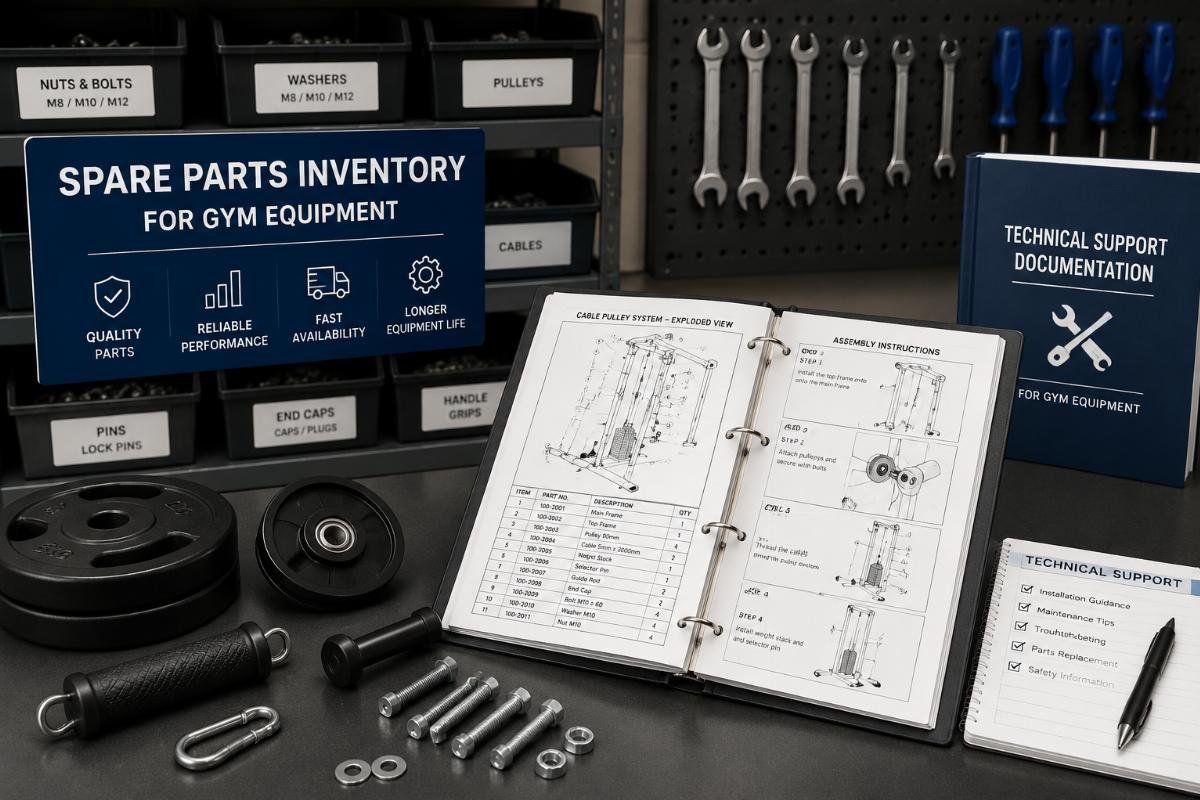
| Spare-part and warranty support | Protect your reputation after the sale |
[NEED_CITE: OEM engagement models and MOQ flexibility benchmarks in the commercial fitness equipment manufacturing sector]
A buyer in Southeast Asia wanted to launch a private-label medicine ball set across three countries simultaneously. Each country had a different dominant weight preference. The supplier they initially engaged required a single-SKU, full-container MOQ per weight—meaning six containers for six weights. The capital requirement was unsustainable for a market-entry trial. By switching to a supplier who supported mixed-weight, mixed-packaging container consolidation, the buyer launched in all three markets with a single container, gathered sell-through data over several months, and then scaled the weights that moved fastest.
This is where the conversation about a medicine ball set wholesale supplier shifts from price to partnership depth. A factory that can run a branded trial batch of a few hundred pieces, consolidate it with kettlebells and battle ropes into one container, and then ramp to full-container volume once the data is in—that factory is building your distribution business, not just filling your purchase order.
Conclusion
A medicine ball set wholesale order is a specification exercise, not a price exercise. Weight gradient must match your market’s training profile, filling material must survive your climate and usage intensity, packaging tiers must reflect your channel structure, and OEM flexibility must let you test before you commit. Get these four parameters right, and the unit price becomes a secondary conversation. Get them wrong, and no amount of negotiating will save the margin.