How Fitness Chain Procurement Buyers Deploy Stair Climber
Higher horsepower does not guarantee longer service life in tropical environments. The real killer is thermal management and corrosion resistance under sustained humidity.
Fitness chain procurement buyers deploy stair climber units successfully only when they treat environmental compatibility, spatial flow, spare parts distribution, and total cost of ownership as a unified system—not as isolated line items on a purchase order.
I still remember standing in a warehouse outside Jakarta during monsoon season, watching a chain owner point at three freshly unboxed machines with seized motors and rusted chains. The humidity gauge on the wall read ninety-something. The procurement team had selected units based purely on step-rate specifications and unit price, without asking a single question about IP ratings or cooling airflow design. That mistake cost them an entire quarter of revenue while replacements were sourced. Across multiple regions in Southeast Asia, I have seen the same pattern repeat: buyers focus on the spec sheet while the building envelope silently destroys the equipment. [NEED_CITE: root cause distribution of cardio equipment failures in tropical climates per IHRSA facility reports]
The lesson is straightforward. Deploying these machines at scale requires a framework that starts long before the container arrives at the dock.
How to Assess Environmental Compatibility Before Procurement?
Environmental compatibility assessment must precede any technical spec review, because tropical heat and humidity dictate motor insulation class, chain treatment, and electronic board conformal coating requirements.
When a fitness chain procurement buyer evaluates a stair climber for a chain of facilities in Southeast Asia or the Middle East, the first question should never be "what is the maximum step per minute." It should be "what is the ambient temperature and relative humidity profile of the installation site, and how does the machine’s cooling system handle continuous load under those conditions." [NEED_CITE: ISO standard requirements for indoor stationary training equipment safety in high humidity environments]
In one project across multiple locations in Indonesia, the procurement team specified units with powerful drive motors but ignored the ventilation design of the motor compartment. Within a short period, the majority of units in non-air-conditioned facilities experienced thermal shutdowns during peak afternoon hours. The root cause was not the motor itself—it was the absence of adequate airflow channels and the use of standard-grade insulation rather than tropical-rated materials.
A proper environmental assessment covers several dimensions:
- Ambient temperature range and peak daily exposure
- Relative humidity levels and seasonal variation
- Dust and particulate load in the surrounding area
- Availability of air conditioning or mechanical ventilation in the equipment zone
- Floor loading and drainage in case of condensation or cleaning
For stair climber deployment in fitness chain facilities located in coastal or monsoon-affected regions, buyers should request documentation on motor insulation class, conformal coating on control boards, and chain or belt treatment specifications. Units designed for temperate European or North American climates will fail prematurely if deployed without modification in tropical settings. [NEED_CITE: comparative failure rate analysis of cardio equipment in tropical versus temperate gym environments]
Manufacturers who serve tropical markets routinely offer enhanced cooling designs, sealed electronics compartments, and corrosion-resistant drive components as standard or optional configurations. A buyer who does not ask about these features is essentially purchasing a machine rated for a different planet.
What Layout Principles Maximize Member Usage?
Spatial layout determines member usage far more than the number of machines purchased, because sightlines, traffic flow, and perceived privacy drive whether members actually step onto the equipment.
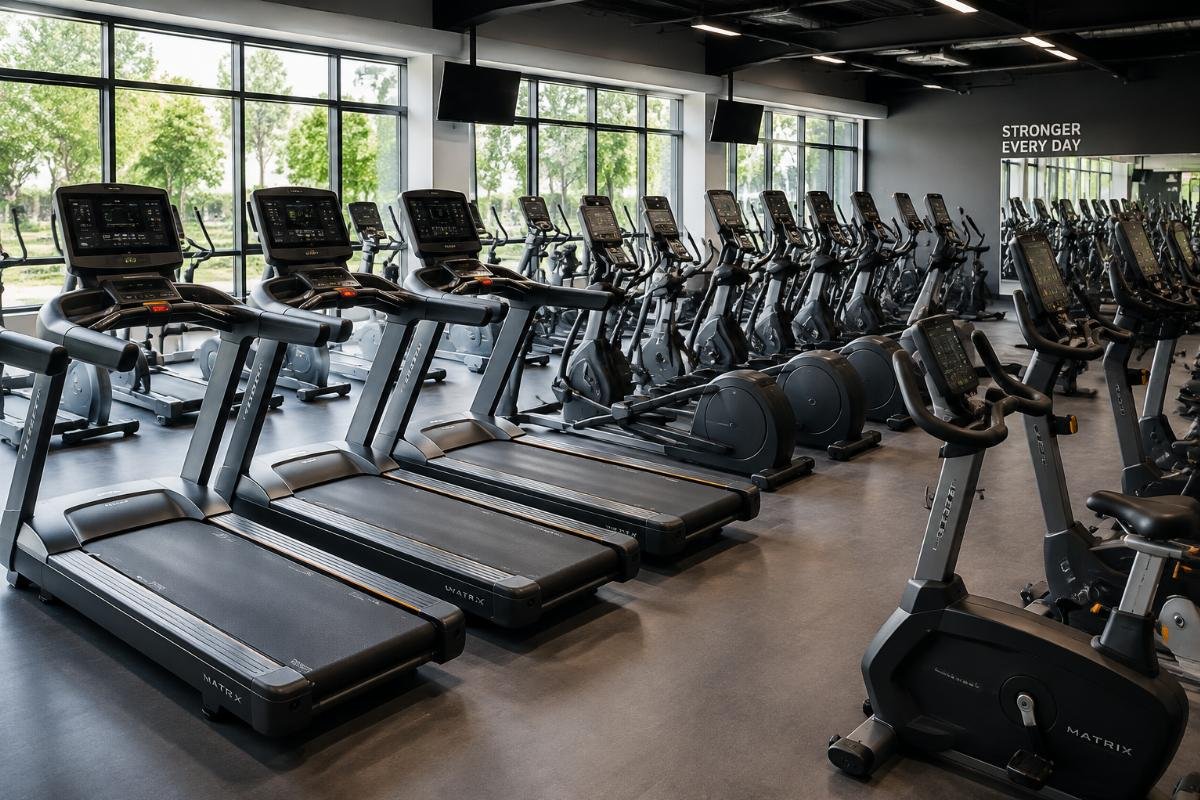
A common mistake in fitness chain procurement is to treat the stair climber as a standalone unit and pack as many as possible into the cardio zone. This approach ignores the behavioral reality that most members avoid equipment that feels exposed, blocks traffic, or creates congestion during peak hours.
In a flagship facility in central Jakarta, the original floor plan placed a row of stair climber units against a solid wall with no visual connection to the rest of the gym. Members reported feeling trapped and self-conscious while using them. Usage rates dropped noticeably compared to an earlier layout where the same number of units faced an open corridor with mirrored walls. The redesign cost almost nothing in capital terms but recovered the lost usage within weeks. [NEED_CITE: member behavior studies on cardio zone layout and equipment utilization rates]
Effective layout planning for stair climber deployment in a fitness chain follows a few core principles:
- Maintain clear sightlines from the entrance so members can see available units immediately
- Provide adequate side clearance for safe mounting and dismounting, typically aligned with ISO safety spacing guidelines
- Avoid placing units in narrow corridors where passing traffic creates discomfort for the user
- Group units in clusters of two to four rather than long single rows, which creates natural pacing and reduces perceived crowding
- Position units near other high-engagement cardio equipment to create a visible energy zone that attracts new users
For multi-store chains, the layout must also account for differences in floor plate size and member demographics. A boutique studio in a high-rise may need a compact two-unit cluster, while a big-box facility can accommodate a larger zone. Standardizing the exact same layout across every location is a false economy—what works in a suburban mall facility will fail in a dense urban studio.
How to Build a Spare Parts Strategy for Multi-Store Chains?
A centralized spare parts model creates unacceptable downtime in multi-store fitness chains, because response time directly correlates with member churn and complaint volume.
When a chain operates multiple locations across a city or region, the instinct is to consolidate spare parts inventory at a single central warehouse to reduce carrying costs. This logic works for slow-moving items like frame components, but it fails catastrophically for high-wear parts on stair climber units—drive belts, step chains, pedal bearings, and control board modules.
In one chain with multiple facilities in Thailand, a single central spare parts store served all locations. When a drive component failed at one site, the technician had to travel to the central warehouse, collect the part, and return. The total downtime per incident stretched well beyond acceptable limits. Member complaints rose sharply, and the brand reputation of the chain suffered. [NEED_CITE: fitness equipment downtime impact on member retention per IHRSA operational benchmarks]
The solution is a distributed spare parts model calibrated to failure probability and response time targets:
- Identify the top high-wear components for stair climber units based on manufacturer data and field experience
- Calculate the required buffer stock per location using historical failure frequency and desired maximum response time
- Pre-position critical spare parts at each facility or at regional hubs within a short travel radius
- Establish a replenishment trigger system so that local stock is automatically reordered after each consumption event
- Maintain a central warehouse only for low-frequency, high-value components like motor assemblies or main control boards
For a stair climber deployment across a fitness chain, this approach typically reduces equipment downtime by a substantial margin. The carrying cost of local spare parts inventory is modest compared to the revenue impact of a machine sitting idle for days. Manufacturers who support multi-store chains often provide recommended spare parts lists and regional stocking guidelines based on fleet size and usage intensity. [NEED_CITE: spare parts inventory optimization models for multi-site fitness equipment fleets]
Technician training is equally important. A distributed spare parts strategy only works if local maintenance staff can diagnose faults accurately and replace components correctly. Chains that invest in certified training programs for their in-house technicians see noticeably faster resolution times and lower reliance on external service calls.
When Should Buyers Prioritize TCO Over Unit Price?
Total cost of ownership analysis consistently reveals that the lowest unit price often produces the highest long-term cost, because maintenance, energy consumption, and premature replacement dominate the lifecycle expense of a stair climber.
Procurement teams in fitness chains are under constant pressure to minimize capital expenditure per unit. This pressure leads to decisions that favor the lowest quoted price, often from suppliers who achieve that price through inferior materials, minimal testing, or absent after-sales support. The consequence is a machine that appears cheap on day one but becomes expensive by year two.
A proper total cost of ownership framework for stair climber deployment in a fitness chain must account for all cost elements over the expected service life:
- Initial purchase price and import duties
- Shipping, installation, and commissioning costs
- Energy consumption under typical daily usage patterns
- Scheduled maintenance labor and consumable parts
- Unscheduled repair costs and associated downtime revenue loss
- Expected service life before major overhaul or replacement
- Residual value or disposal cost at end of life
When these elements are modeled over a realistic service horizon, the picture changes dramatically. A unit purchased at a modest premium but built with heavy-duty components, tropical-rated insulation, and backed by a responsive spare parts supply chain will typically deliver a substantially lower total cost than a cheaper alternative that requires frequent repairs and early replacement. [NEED_CITE: total cost of ownership comparison frameworks for commercial fitness equipment per industry analysis]
For example, a fitness chain procurement buyer comparing two stair climber options—one priced at a budget level and one at a mid-range level from a manufacturer with proven tropical deployment experience—should model the five-year cost including at least two major component replacements on the budget unit versus routine maintenance on the mid-range unit. The result almost always favors the mid-range option by a wide margin, even before accounting for the intangible cost of member dissatisfaction during downtime.
Manufacturers who offer factory-direct pricing at a meaningful discount relative to premium global brands, while maintaining commercial-grade construction and comprehensive warranty support, represent the optimal middle ground for chains seeking to control capital costs without sacrificing reliability. [NEED_CITE: comparative pricing and quality analysis of commercial stair climber brands in emerging markets]
Conclusion
Successful stair climber deployment in a fitness chain is an engineering and operational challenge, not a purchasing transaction.
Buyers who treat environmental compatibility, spatial layout, spare parts distribution, and total cost of ownership as an integrated system will deploy equipment that performs reliably, satisfies members, and delivers predictable economics over its service life. Those who focus only on unit price will learn the same expensive lesson that countless chains have already learned across tropical markets worldwide.