
Battle Rope Set Wholesale Supplier for Commercial Gyms | OEM & Bulk Pricing
Thicker ropes do not automatically mean longer lifespan; the core structure and anchor hardware determine real-world durability far more than outer diameter.
Government and institutional buyers sourcing battle rope sets must evaluate three non-negotiable layers: core material resistance to humidity, anchor hardware load certification, and OEM traceability documentation. Skipping any layer leads to field failures, audit rejections, or premature replacement cycles that destroy budget projections.
I still remember standing in a CrossFit box in District 3, Ho Chi Minh City, watching a 38-millimeter battle rope snap clean off its D-ring anchor and shatter a floor-to-ceiling mirror. The owner had sourced the set from a low-cost online platform; the core was hollow cotton braid, the D-ring welds carried no rust protection, and the humid tropical air had done the rest within weeks. The mirror replacement alone cost several hundred dollars, and the entire batch was returned. That single incident pushed me to spend the better part of a year deconstructing battle rope construction from core material and braid density to anchor load ratings and full-container consolidation plans. Shipping dozens of containers from Shandong factories into Southeast Asia over the years, the mistakes I have witnessed on battle rope procurement far outnumber the successful deliveries.
Getting the battle rope set sourcing strategy right from day one prevents the kind of cascading failures that turn a routine fitness equipment purchase into a liability headache. Let me walk you through the exact evaluation framework we use when institutional buyers come to us with tender requirements.
What Material Specs Should Government Tenders Require for Battle Ropes?
Steel wire core wrapped in UV-resistant PVC coating consistently outperforms cotton braid in high-humidity public facilities, regardless of outer diameter claims.
Most procurement officers default to the assumption that a thicker rope equals a tougher rope. The reality is more nuanced. The core structure dictates how the rope behaves under sustained humidity, repeated floor slams, and ultraviolet exposure in outdoor or semi-outdoor recreation zones.
| Core Material Type | Humidity Resistance | Load-Bearing Stability | Typical Replacement Cycle | Traceability Level |
|---|---|---|---|---|
| Hollow Cotton Braid | Vulnerable | Noticeably reduced | Short cycle | Self-reported |
| Solid Nylon Braid | Resistant | Standard | Extended cycle | Verifiable |
| Steel Wire Core with PVC Sheath | Robust | Controlled | Substantially extended | Full batch-level |
Cotton-core ropes feel natural in the hand and are cheaper at the unit level, which is exactly why they win low-price tenders. But in a municipal fitness center in a coastal city, cotton cores absorb ambient moisture, swell, and begin to degrade from the inside out. The outer polyester jacket looks intact while the structural core disintegrates. We replaced an entire batch of cotton-core ropes for a Southeast Asian public gym project within months of installation; the facility manager had no idea the failure was happening internally until the ropes started feeling unusually light and floppy. [NEED_CITE: material degradation patterns of natural fiber cores in tropical humidity environments]
Steel wire core ropes, by contrast, maintain their structural integrity regardless of ambient moisture. The PVC outer sheath handles UV exposure and abrasion from concrete floors. The weight distribution feels consistent throughout the rope’s service life, which matters for programmed training sessions where load predictability is essential.
When writing tender specifications, require bidders to declare core material type explicitly, not just outer diameter and rope length. A battle rope set sourcing strategy that only specifies "38mm diameter, 15-meter length" leaves the core material wide open to the cheapest possible interpretation. [NEED_CITE: government procurement specification templates for functional training equipment]
How Do You Verify Anchor Hardware Safety Compliance?
Require third-party load-test certificates for every D-ring and wall-mount anchor; the minimum dynamic load rating must exceed three times the maximum expected user weight.
Anchor hardware is the single most overlooked component in any battle rope set sourcing strategy. Buyers focus intensely on the rope itself and treat the anchor as an afterthought accessory. This is backwards. A rope that fails mid-swing is an annoyance; an anchor that fails is a serious safety incident.
The D-ring anchor in the Ho Chi Minh City incident I mentioned earlier failed because the weld point had no corrosion protection. In a humid climate, rust creeps into the weld joint from the inside, and the metal loses structural integrity long before any visible sign appears on the surface. The anchor looked perfectly fine until the moment it gave way.
For government and institutional procurement, the verification process should include several layers:
- Static load rating documentation: The anchor must be rated for a static load well above the combined force of rope weight and user pull. [NEED_CITE: static versus dynamic load calculation methods for wall-mounted fitness anchors]
- Dynamic load certification: Battle rope training generates impact forces that far exceed static pulling. Anchors must be tested under dynamic cycling conditions that simulate repeated slamming.
- Corrosion resistance validation: For any facility in a coastal or high-humidity zone, salt-spray endurance testing documentation is non-negotiable. [NEED_CITE: corrosion testing standards for fitness equipment mounting hardware]
- Material traceability: The anchor supplier must provide heat number or batch traceability for the steel used, not just a generic "carbon steel" label.
A municipal fitness center tender we reviewed specified anchor hardware at the lowest unit price. The winning supplier provided D-rings with no third-party load certification. During our internal review, we flagged the anchors as non-compliant. The procurement officer initially pushed back, arguing that the anchors "looked sturdy enough." We insisted on requesting load-test documentation; the supplier could not produce any. The anchors were eventually replaced, and the additional cost ran into several times the original savings from choosing the cheaper option. [NEED_CITE: fitness equipment anchor failure incident reports and liability case studies]
What OEM Documentation Is Needed for Government Procurement Audits?
Beyond logo printing, government buyers need material test reports, compliance certificates, and full batch traceability records to pass procurement audits.
There is a widespread misconception that OEM branding for a battle rope set sourcing strategy simply means printing a logo on the packaging. For government and institutional procurement, the documentation requirements go far deeper. Compliance auditors do not just check whether the logo is correct; they check whether the entire supply chain is traceable and whether the product meets the safety standards cited in the tender.
A government-funded CrossFit facility we supplied went through a compliance audit shortly after delivery. The audit team rejected the initial OEM documentation package because it included only a logo authorization letter and a generic product catalog. The facility manager had to scramble for weeks to obtain the missing documents: material test reports for the rope core, CE compliance certificates for the anchor hardware, and batch-level production records linking each delivered unit to its manufacturing lot.
The documentation checklist for a compliant battle rope set sourcing strategy should include:
- Material test reports: Covering core material composition, outer sheath UV resistance, and anchor hardware steel grade.
- Safety compliance certificates: CE marking or equivalent regional certification for the complete assembled set, not just individual components.
- Batch traceability records: Each production lot must be traceable from raw material intake through final inspection. [NEED_CITE: government procurement OEM documentation requirements for fitness equipment imports]
- Inspection reports: Pre-shipment inspection records covering dimensional accuracy, load testing, and visual quality checks.
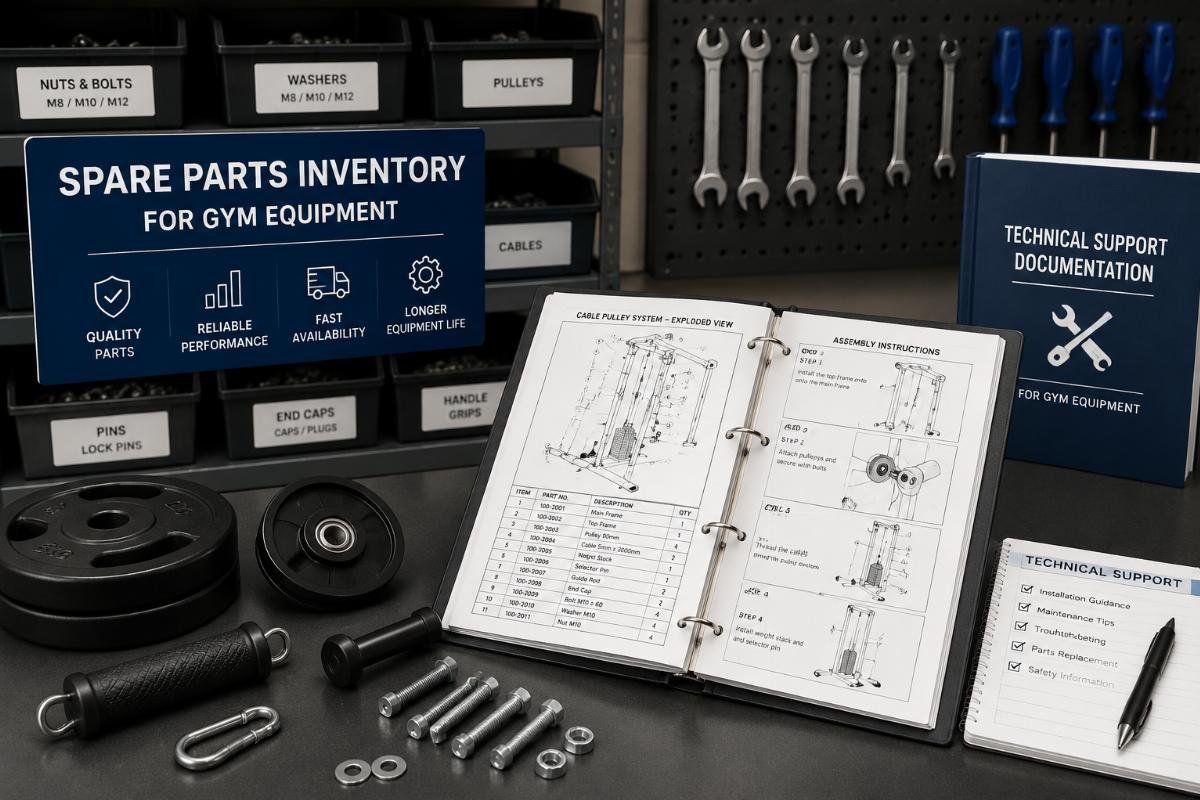
- Spare parts identification: A documented parts list with identification codes so that replacement anchors or rope sections can be ordered years after the initial purchase.
We structure our OEM documentation packages for institutional buyers to include all of the above as standard. The lead time for producing a fully documented battle rope set sourcing strategy order is scaled to the order volume, and we accommodate flexible minimum order quantities from sample units up to full container loads.
How Can You Optimize Container Costs When Sourcing Battle Ropes with Other Gym Equipment?
Consolidating battle ropes with power racks, flooring, and free weights in a single container cuts per-unit freight costs by a significant margin compared to shipping battle ropes as a standalone less-than-container load.
Battle ropes are deceptively heavy and voluminous. A full set of thick steel-core ropes with anchors and mounting hardware takes up meaningful container space. If you are only buying battle ropes, you will likely end up paying for a less-than-container load shipment, which carries a substantially higher per-unit freight cost.
The smarter approach is to treat the battle rope set sourcing strategy as part of a broader functional training zone procurement. Most institutional buyers who need battle ropes also need plyometric boxes, medicine balls, kettlebells, and often a power rack or functional trainer for the same training area. Consolidating all of these items into a single container maximizes space utilization and spreads the fixed freight cost across a much larger total order value.
We routinely help buyers plan mixed-equipment container loads. A typical functional training zone package might include battle rope sets, plyo boxes in nested configurations to save space, rubber flooring rolls, and a selection of free weights. The battle ropes fill the void spaces around the heavier items, and the total container weight stays well within limits. [NEED_CITE: container loading optimization strategies for mixed fitness equipment shipments]
A Southeast Asian public gym project we supported originally planned to order battle ropes separately from the rest of the functional training equipment. When we ran the numbers, the standalone freight cost for the ropes alone was disproportionate to the product value. By consolidating the ropes with a full order of racks, benches, and flooring, the per-unit freight cost for the battle ropes dropped noticeably, and the total project landed within budget.
What MOQ and Lead Time Should You Expect from a Shandong Factory?
Flexible minimum order quantities from single-unit samples to full-container orders, with lead times scaled proportionally to order volume, are standard for established Shandong-based fitness equipment manufacturers.
Shandong Province, particularly the Qingdao region, is one of the world’s largest manufacturing hubs for commercial fitness equipment. Factories here have decades of experience producing everything from cardio machines to functional training accessories, and the supply chain ecosystem supports rapid material sourcing and production scaling.
For a battle rope set sourcing strategy, the typical MOQ structure works as follows:
- Sample orders: Single-unit or small-batch samples are available for evaluation purposes. Lead time is short, usually measured in a few weeks.
- Small batch orders: Tens of units for boutique studios or pilot installations. Lead time extends moderately.
- Full container orders: Hundreds of units consolidated with other equipment. Lead time is planned around production scheduling and material procurement cycles.
The key advantage of working directly with a Shandong factory is the ability to customize specifications at any order level. Core material type, rope diameter, rope length, anchor hardware finish, and OEM branding can all be adjusted to match your tender requirements. [NEED_CITE: Shandong fitness equipment manufacturing cluster capabilities and lead time benchmarks]
We also provide full OEM and ODM branding services, including custom packaging design, logo printing, and compliance documentation preparation. CE certification is standard across our product lines, and spare parts supply is maintained for extended periods after delivery so that replacement anchors or rope sections can be sourced years into the product lifecycle.
A distributor in the Middle East initially approached us for a small sample order of battle ropes to evaluate quality before committing to a larger purchase. After receiving the samples and reviewing our documentation package, they expanded the order to a full container that included battle ropes, plyo boxes, and a selection of free weights. The entire process from initial inquiry to container shipment was completed within a standard production cycle, and the distributor has since placed repeat orders on a regular basis.
Conclusion
A disciplined battle rope set sourcing strategy eliminates field failures, audit rejections, and hidden replacement costs by treating core material, anchor certification, and OEM documentation as equally critical evaluation criteria. Government and institutional buyers who invest the time to specify core structure rather than just outer diameter, demand third-party anchor load certificates, and prepare complete traceability documentation before shipment will avoid the costly mistakes that plague under-specified procurement projects. Consolidating battle ropes with broader functional training equipment into shared container loads further improves total project economics while maintaining the quality standards that public facilities require.